Introduction
B2B buyers have changed how they decide — and most companies haven't caught up.
According to 6sense's 2024 survey of 2,509 B2B buyers, 69% of the purchase process is complete before a buyer ever contacts a vendor. More striking: 81% had already selected a preferred vendor before reaching out. For industrial and B2B companies, this means your shortlist position is decided before a single sales conversation happens.
Traditional outbound and lead generation assume buyers will engage early. They won't. High-value accounts are already researching your capabilities, comparing you against competitors, and forming conclusions — without any outreach.
Account-Based Marketing (ABM) is built for exactly this dynamic. Instead of generating volume and waiting for the right accounts to surface, ABM concentrates coordinated resources on the specific companies most likely to buy — reaching them during the independent research phase, before they signal intent.
This guide covers what ABM is, the three types, how to build a strategy, what content fuels it, and how to measure results.
Key Takeaways
- ABM targets defined high-value accounts instead of broad audiences
- 69% of the B2B purchase process happens before buyers contact vendors, making pre-sales visibility critical
- Three tiers exist: one-to-one (bespoke), one-to-few (segmented), one-to-many (programmatic)
- Sales and marketing must share account-level goals — not siloed MQL metrics
- ABM measurement tracks pipeline, win rates, and deal size — not just clicks and form fills
What Is Account-Based Marketing and Why It Matters
ABM is a B2B strategy that treats each high-value account as its own market. Instead of generating broad audience demand and filtering for quality afterward, ABM defines the target accounts first — then builds campaigns specifically for them.
It's a strategic operating model — not a software tool or a single tactic — that requires coordination across marketing, sales, and leadership.
Why ABM Fits Industrial and B2B Companies
Industrial and technical B2B companies have naturally small total addressable markets. A manufacturer selling specialized controls or industrial automation systems might have a few hundred viable prospects globally — sometimes fewer. Mass demand generation makes no sense when your universe of potential buyers is that concentrated.
ABM is built for this reality — precision targeting that matches how concentrated industrial buying actually works. The challenge, though, isn't just reaching the right accounts. It's reaching them before they've already decided.
The Pre-Sales Research Problem
The challenge isn't just that buyers research independently — it's that they decide independently. Forrester's 2026 research found the typical B2B purchase now involves 13 internal stakeholders and 9 external influencers. And 6sense's 2025 data found 95% of winning vendors were on the Day One shortlist — the first vendor contacted won 80% of the time.
This is what practitioners call the "dark funnel" — the invisible research phase where buyers form preferences without the supplier ever knowing.
Evidence Communications, a Chicago-based B2B strategic communications consultancy, describes this directly: "Sales isn't failing. It's being invited in after your buyers' opinions have already formed."
Their concept of the Proof Gap captures the problem precisely — capable companies excluded from consideration before sales is ever contacted, not because their performance is weak, but because their proof isn't visible where buyers are looking.
ABM vs. Traditional Lead Generation
| Dimension | Traditional Lead Gen | Account-Based Marketing |
|---|---|---|
| Starting point | Cast wide net | Define target accounts |
| Quality filter | After lead capture | Before campaign launch |
| Success metric | MQL volume | Account engagement, pipeline |
| Sales role | Receives qualified leads | Co-owns account strategy |
| Personalization | Generic or minimal | Account- or segment-specific |
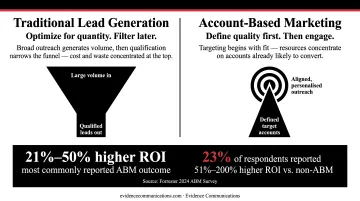
Lead gen optimizes for quantity, then filters. ABM defines quality first.
Forrester's 2024 ABM survey found the most commonly reported outcome was 21%–50% higher ROI than non-ABM marketing, with 23% of respondents reporting 51%–200% higher ROI.
The Three Types of ABM Strategies
ABM is not one-size-fits-all. Successful programs use different approaches for different account segments, based on account value and available resources. ITSMA, the organization that codified the ABM framework, identifies three core tiers.
One-to-One ABM (Strategic ABM)
The highest-touch, most resource-intensive approach: reserved for accounts that could generate transformational revenue.
What highly customized looks like in practice:
- Custom content mapped to a specific account's operational challenges
- Personalized outreach to named executives and buying committee members
- Account-specific events, direct mail, or demonstration experiences
- Coordinated multi-stakeholder engagement across marketing and sales
This tier demands significant investment per account, which is why it's typically limited to a small number of strategic targets. The ROI justification comes from deal size: when a single win could be worth $1M+ in revenue, spending heavily on 20 accounts makes financial sense.
One-to-Few ABM (ABM Lite)
This tier targets small clusters of accounts that share meaningful characteristics — same industry, company size, use case, or business challenge.
Campaigns are semi-personalized: developed for a segment rather than an individual account. An industrial automation company might group 10 automotive OEM accounts and build content addressing shared challenges like line downtime, changeover frequency, or quality inspection throughput.
This makes ABM Lite more scalable than one-to-one while staying far more relevant than generic demand generation. For most mid-market B2B companies, it's the tier that produces the highest return relative to the resources committed.
One-to-Many ABM (Programmatic ABM)
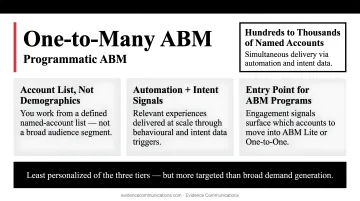
Uses automation and intent data to deliver relevant experiences to hundreds or thousands of named accounts simultaneously.
It's the least personalized of the three, but still more targeted than broad demand generation — you're working from a defined account list, not a demographic audience. Programmatic ABM works well as a starting point: the engagement signals it surfaces tell you which accounts to move up into ABM Lite or one-to-one programs.
How to Build an ABM Strategy: Step-by-Step
Step 1 — Build Your Target Account List
Start with your best existing customers and identify what they have in common:
- Industry and sub-vertical
- Revenue size and company structure
- Geography and operational footprint
- Technology stack or equipment in use
- Triggering events (leadership changes, expansions, acquisitions, funding rounds)
Start small. A focused list of 20–50 accounts you know well outperforms a sprawling list of 500 accounts you don't. Validate patterns from early campaigns before expanding.
Step 2 — Research Accounts and Map the Buying Committee
Firmographic data tells you who to target. Research tells you how to reach them.
For each target account, understand:
- Their current operational challenges and known pain points
- Solutions they're using today (and why they might switch)
- Who is involved in purchase decisions — and what each stakeholder cares about
Forrester's 2026 research pegs the average buying group at 13 internal stakeholders plus 9 external influencers. In industrial contexts — where operations, engineering, procurement, finance, and C-suite all have a stake — this isn't surprising. Different roles carry different objections and require different proof.
Step 3 — Select Channels and Develop Personalized Content
Channel selection should follow where target accounts actually spend their time. McKinsey's 2024 B2B Pulse found B2B buyers used 10 interaction channels on average, split roughly equally between in-person, remote, and digital self-service.
For industrial and B2B accounts, relevant channels typically include:
- LinkedIn (peer validation from engineers and operators)
- YouTube (how-it-works explanations and demonstrations)
- Industry trade publications
- Direct mail for named executive outreach
- Webinars and live demonstrations
Content must go beyond surface personalization. Inserting a company logo into a generic email is not ABM. True personalization speaks to the account's specific operational environment, known challenges, and the proof that would help a stakeholder defend a purchase decision internally.
Step 4 — Execute with Sales Alignment
ABM requires genuine coordination, not handoffs. Marketing and sales must execute from shared account intelligence, with consistent messaging across every touchpoint.
The "revenue team" model is the right operating structure. That means:
- Shared pipeline and revenue metrics (not marketing tracking MQLs while sales tracks opportunities)
- Consistent follow-through on marketing-engaged accounts
- Sales and marketing aligned on which accounts are active and why
Start with minimum viable campaigns — one or two target accounts — before scaling.
Step 5 — Measure, Learn, and Optimize
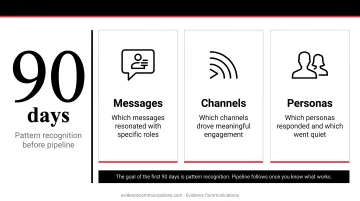
Early campaigns generate learning before they generate revenue. Build a debrief process into every campaign cycle — reviewing:
- Which messages resonated with specific roles
- Which channels drove meaningful engagement
- Which personas responded and which went quiet
The goal of the first 90 days is pattern recognition. Pipeline follows once you know what works.
The Content That Fuels ABM
Personalization only works when there's substantive content behind it.
For industrial and B2B buyers, the content that builds conviction includes:
- Case studies with specific, verifiable outcomes in relevant environments
- Technical demonstrations showing performance under real operating conditions
- Industry-specific ROI data that speaks to known cost or efficiency pressures
- Thought leadership that addresses real buying objections — not generic industry trends
- Third-party validation that buyers can find independently through AI tools, trade publications, and peer forums
Buyers use these assets during independent research — not just when a salesperson sends them over. That's why distribution matters as much as content quality.
Most industrial companies face a structural gap here. Strong operational capability exists, but translated, findable proof often doesn't. A buyer querying an AI tool or searching LinkedIn can't verify what the company already knows it delivers.
Evidence Communications addresses this directly — translating industrial and B2B companies' real-world proof into content that appears across the channels buyers actually use to decide, so sales gets the call before the shortlist closes.
How to Measure ABM Success
ABM measurement requires a shift from campaign-level activity metrics to account-level outcome metrics.
Key metrics to track:
- Account engagement scores — interactions across all channels by named accounts
- Buying stage progression — are target accounts moving from unaware to engaged to active?
- Pipeline influenced or created — revenue opportunities tied to target accounts
- Win rates for target accounts vs. non-target accounts
- Average deal size from ABM accounts vs. baseline
Attribution in Multi-Stakeholder Deals
Attribution is difficult in ABM. Deals involve 10+ stakeholders over extended timelines. No single tactic deserves full credit — and assigning it that way produces misleading insights.
Multi-touch attribution models that track account-level progression over time are more meaningful than first-touch or last-touch approaches. Demand Gen Report's 2024 measurement research found only 26% of respondents had a robust attribution strategy, despite 86% calling it a growing priority. Most teams know what good measurement looks like — they just haven't built the infrastructure to do it yet.
Reporting to Different Stakeholders
How you frame ABM results depends entirely on who's in the room. The same data tells different stories to different functions:
| Audience | What They Want to See |
|---|---|
| Executives | Pipeline created, revenue closed, target account win rates |
| Marketing leaders | Channel performance, engagement by account segment, content effectiveness |
| Sales leaders | Territory coverage, deal velocity, account progression by rep |
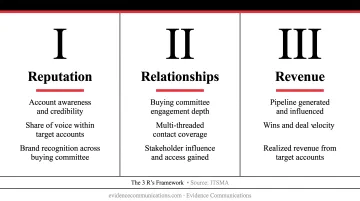
The 3 R's framework from ITSMA provides a useful structure: Reputation (account awareness and credibility), Relationships (buying committee engagement depth), and Revenue (pipeline, wins, and realized revenue).
Common ABM Challenges and How to Solve Them
Data Quality and Account Selection Errors
ABM programs fail most often because the target account list is wrong. Targeting the wrong accounts wastes disproportionate resources — because every tactic is expensive when it's account-specific.
Fix: Review your target account list quarterly against actual win patterns. Which accounts converted? What did they have in common? Let results refine selection criteria over time.
Sales and Marketing Misalignment
When sales ignores accounts marketing has engaged, or marketing pursues accounts outside sales territories, the program stalls. This is the most common execution failure, and it's an organizational problem, not a technology problem.
Fix: Shared goals, shared data, and regular joint account review meetings. If both teams aren't reviewing the same account list together, you're running parallel programs with a shared name — not ABM.
Personalization at Scale
Producing custom content for every account is unsustainable without a tiered approach. Segment by industry or use case instead.
An industrial equipment company targeting food and beverage manufacturers can build one set of content addressing sanitation compliance, contamination risk, and OEE benchmarks, then apply it across a cluster of 15 accounts without producing 15 unique assets.
Fix: Group accounts by shared context (industry, use case, compliance environment), create content at the segment level, and personalize only the final layer — company name, specific application, or relevant proof point.
Frequently Asked Questions
What is an ABM strategy?
An ABM strategy is a B2B marketing approach that focuses coordinated sales and marketing efforts on a defined list of high-value target accounts. Instead of pursuing broad audience demand, it uses personalized messaging and multi-channel engagement to reach the full buying committee at each specific account.
What does ABM stand for?
ABM stands for Account-Based Marketing, a strategic framework where specific companies are treated as individual markets. Campaigns are tailored to each account's challenges, stakeholders, and buying stage — not a broad demographic audience.
What is an example of an ABM strategy?
An industrial manufacturer identifies its top 20 target accounts, develops content addressing their known operational challenges, runs targeted LinkedIn ads to key decision-makers at those companies, and coordinates personalized follow-up from sales when engagement signals appear. Every tactic is built around those specific accounts.
What are the 3 R's of ABM?
The 3 R's of ABM (a framework attributed to ITSMA) are Reputation (building credibility with target accounts), Relationships (engaging and nurturing decision-makers within those accounts), and Revenue (converting account engagement into pipeline and closed deals). They guide both program structure and measurement.
How is ABM different from traditional lead generation?
Traditional lead generation casts a wide net to generate volume, then qualifies leads after the fact. ABM defines the ideal accounts first and builds targeted campaigns specifically for them — reversing the funnel and prioritizing fit over volume. The practical result is fewer, higher-quality opportunities with better win rates.
How do you measure ABM success?
ABM success is measured through account-level metrics: engagement scores, buying stage progression, pipeline from target accounts, win rates, and average deal size. These replace top-of-funnel metrics like lead volume or click-through rates, which don't show whether the right accounts are actually moving forward.