Introduction
Picture a procurement manager at an industrial firm typing into ChatGPT: "Who are the leading contract manufacturers for precision aerospace components in the Midwest?" Three names come back. Yours isn't one of them.
That buyer now has a working shortlist. They'll reach out to those three companies. Your sales team will never know the conversation happened.
This isn't a hypothetical. According to G2's April 2025 survey of 1,169 B2B decision-makers, 29% of B2B buyers now start vendor research through AI platforms like ChatGPT more often than Google. Nearly 8 in 10 said AI search had changed how they research. The shortlist forms before your sales team gets the call. If AI tools can't surface evidence of your capability, you won't be on it.
This guide covers what Generative AI Optimization (GEO) is, why it's a commercial urgency for industrial and B2B companies, and the specific strategies to make your business visible, citable, and credible in AI-generated responses.
Key Takeaways:
- GEO determines whether AI tools cite and recommend your company — not just whether you rank in search
- 29% of B2B buyers now start research through AI platforms; shortlists form before sales is ever contacted
- Content with specific data, quotes, and verifiable evidence earns higher AI citation rates than generic overviews
- Technical access, schema markup, and off-page authority all influence AI citation likelihood
- AI visibility requires separate measurement: brand mentions, citation frequency, and share of voice in AI responses
What Is Generative AI Optimization (GEO)?
GEO is the practice of optimizing your content, digital presence, and authority signals so that AI-powered platforms — ChatGPT, Perplexity, Google AI Overviews, Gemini, and Claude — surface and cite your company when generating responses to buyer queries.
GEO vs. SEO: A Critical Distinction
These aren't competing strategies. SEO helps you appear in a ranked list of links. GEO determines whether you appear inside the synthesized answer AI delivers.
- SEO outcome: Your page ranks #4 for "precision machining Chicago"
- GEO outcome: When a buyer asks ChatGPT who to consider for precision machining in Chicago, your company is named and cited
GEO builds on a strong SEO foundation — but a page that ranks well in Google may still be ignored by AI if it lacks the credibility signals those systems look for.
How AI Systems Choose What to Cite
AI platforms don't rank pages — they synthesize answers from sources they assess as authoritative and reliable. The KDD 2024 GEO study by Aggarwal et al. identified specific content tactics and their impact on AI visibility:
| Content Tactic | Position-Adjusted Visibility Lift |
|---|---|
| Quotation addition | +40.9% |
| Statistics addition | +30.6% |
| Fluency optimization | +28.0% |
| Cite sources | +27.5% |
| Keyword stuffing | -8.3% |
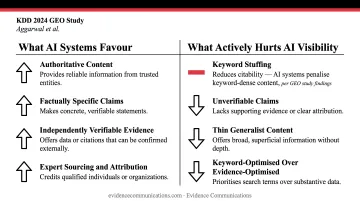
AI systems favor content that is authoritative and factually specific — independently verifiable over keyword-dense. Keyword stuffing actively hurts performance.
What GEO Is Not
GEO is not about gaming AI systems or creating special AI-only files. Google's own guidance states that AI Overviews and AI Mode require no special optimization beyond normal Search eligibility — a page must be indexed, crawlable, and helpful. Foundational content quality remains the primary driver of AI visibility.
How AI Search Changes the B2B Buyer Journey
The Silent Shortlist Problem
B2B buyers — particularly in industrial categories — now use AI tools to pre-qualify vendors before making any contact. They ask a question, receive a curated response with a handful of cited sources, and form a consideration set. Your sales team has no visibility into this process.
Evidence Communications, a Chicago-based strategic consultancy working with industrial and B2B companies, calls this the Proof Gap: the gap between what a company can actually do and what AI systems and buyers can find and verify online. The consequence they describe is precise: "Buyers form their shortlist before sales ever gets involved. Sales isn't failing — it's being invited in after your buyers' opinions have already formed."
From "Search and Click" to "Ask and Synthesize"
The behavioral shift is structural, not incremental. Instead of browsing ten links and forming an opinion over multiple sessions, buyers receive one synthesized answer and act on it.
This creates a winner-take-most dynamic for AI citations. If three vendors are named and you're not one of them, you don't lose a deal : you never enter the conversation at all.
The research shows this is already the default behavior:
- 61% of B2B buyers prefer a rep-free buying experience overall, according to Gartner's 2024-2025 survey of 632 B2B buyers
- 82% of buyers already had a top product in mind when forming a shortlist, and 70% bought that product (TrustRadius, 2025)
- Industry research from 6sense suggests buyers initiate first contact once they're approximately 70% through their journey
The Commercial Consequence for Industrial Companies
This is not a marketing problem alone. For industrial and B2B companies, AI invisibility is a commercial infrastructure problem. If your company doesn't appear in AI-generated responses for category-relevant queries, purchasing decisions are already formed before your sales team knows a prospect exists.
Evidence Communications frames the downstream impact in terms industrial operators and PE owners immediately recognize. Three consequences trace directly to a proof gap that forms upstream, before any sales engagement begins:
- Longer sales cycles as buyers arrive with pre-set preferences that require displacement
- Price pressure when your differentiation wasn't visible during independent research
- Compressed multiples for companies whose commercial infrastructure doesn't reflect the value they've built
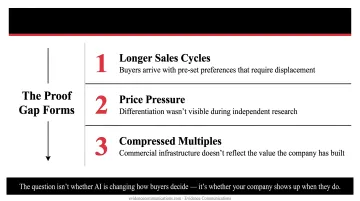
The strategic question isn't whether AI is changing how buyers decide — it's whether your company shows up when they do.
Content Strategies to Maximize AI Visibility
Structure Content for AI Extraction
AI systems are built to extract the clearest, most direct answer from a page. Help them do it.
Lead with the answer, then expand with depth. If a page addresses "What tolerances can your CNC shop hold on titanium components?", the first sentence should answer it directly — not build up to it through three paragraphs of context.
Use specific, named entities throughout your content:
- Exact company names, not "our partner"
- Product names and model numbers, not "the system"
- Named processes, certifications, and standards (AS9100, IATF 16949, ISO 9001)
- Measurable outcomes, not "improved performance"
Vague references confuse AI interpretation and reduce citation likelihood. A contract manufacturer that writes "we held ±0.0002″ tolerances across a 500-piece titanium aerospace run" gives AI something citable. One that writes "we deliver precision machining" does not.
Format content for modular extraction:
- Clear H2/H3 heading structure
- FAQ-style sections that map to how buyers phrase questions
- Numbered processes with defined steps
- Defined terms with clear explanations
AI systems favor content they can accurately pull and summarize without losing meaning.
Build Topic Authority With Evidence-Backed Content
Publish deeply researched content in your core areas of expertise — not broad overviews that could have been written by anyone. Sparse, generic content signals weak authority to systems designed to recommend credible sources.
For industrial and B2B companies, operational proof is your highest-leverage GEO asset:
- Case studies with specific, measurable client outcomes
- Technical capability documentation with real performance data
- Process explanations grounded in engineering, not marketing
- Verified client results with named applications and outcomes
That list maps directly to what buyers — and AI systems — actually need from content. Evidence Communications' internal framework breaks it into five requirements: content that lets buyers see it work, understand why it works, trust it applies to their situation, defend the decision internally, and see it confirmed elsewhere.
Content satisfying all five signals to AI systems that it's substantive, specific, and worth citing — not generic filler.
The KDD 2024 research confirms this directionally: content containing quotations and specific quantitative data earned 30-40% higher AI visibility than equivalent content without those elements.
Keep Content Fresh and Consistently Updated
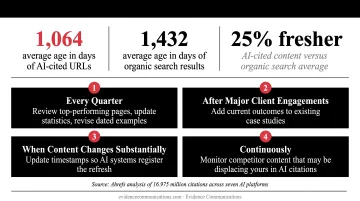
AI tools actively prefer recently updated content. Ahrefs' analysis of 16.975 million citations across seven AI platforms found that AI-cited URLs averaged 1,064 days old versus 1,432 days for organic search results — meaning cited content is roughly 25% fresher than the organic average.
Stale content loses citation preference, even if it was originally high quality.
A practical refresh cadence:
- Every quarter: Review top-performing pages, update statistics, revise dated examples
- After major client engagements: Add current outcomes to existing case studies
- When content changes substantially: Update timestamps so AI systems register the refresh
- Continuously: Monitor competitor content that may be displacing yours in AI citations
Technical GEO Foundations Every B2B Website Needs
Technical gaps can erase well-crafted content from AI consideration entirely — regardless of how strong the content is.
AI Crawler Access
Verify your robots.txt does not block the major AI crawling bots. Each platform uses distinct agents:
| Platform | Crawling Agent(s) |
|---|---|
| OpenAI | OAI-SearchBot, GPTBot, ChatGPT-User |
| Anthropic | Claude-SearchBot, ClaudeBot, Claude-User |
| Perplexity | PerplexityBot, Perplexity-User |
Googlebot (controls AI Overview eligibility); Google-Extended (Gemini grounding) |
Block the agents you want to restrict; allow those you want to crawl. Don't accidentally block all of them with a blanket disallow rule.
Beyond robots.txt, avoid making core content dependent on JavaScript execution. Non-Google AI crawlers don't reliably render JS — if your content only appears after JS execution, those crawlers may never see it.
Schema Markup
Schema helps AI systems understand the context and authority of your content. Prioritize:
- Article schema to establish author, publication date, and content type — the credibility signals AI systems weight
- Organization schema to disambiguate who you are and supply contact and authority signals
- FAQ schema for structured Q&A readability (Google deprecated FAQ rich results in August 2023, but the format still aids AI parsing)
Validate any schema implementation using Google's Rich Results Test. Schema doesn't guarantee AI citation, but it helps AI systems accurately interpret your content.
Core Site Quality
AI crawlers treat site performance as a proxy for content reliability. A slow or broken site signals lower quality before a single word gets evaluated. Ensure:
- Fast page load times
- Mobile responsiveness
- HTTPS security
- Clean navigation and internal linking structure
Building Off-Page Authority for AI Citations
Earn Third-Party Mentions in High-Authority Sources
AI systems weight content from sources they already trust. A mention of your company in a respected trade publication carries citation value that no amount of internal publishing can replicate.
The practical starting point: identify authoritative trade publications, analyst roundups, or industry comparison articles that mention your competitors but not you. These gaps are worth targeting first.
Ahrefs' correlational study of 75,000 brands found that branded web mentions were among the strongest correlates of visibility in ChatGPT, AI Mode, and AI Overviews. And a Semrush analysis of 230,000 prompts found that Reddit and LinkedIn appeared among the most-cited domains — with Google AI Mode citing LinkedIn in nearly 15% of responses.
Build Substantive Presence in User-Generated Channels
For B2B industrial companies, LinkedIn and industry forums are primary citation channels — not supplementary ones. Treating LinkedIn as a proof distribution channel means engineers, operators, and customers generate the kind of observable, experience-based evidence AI systems index and cite.
What earns organic mentions AI systems favor:
- In-field demonstration footage showing products in real operating conditions
- Engineer and operator commentary explaining process decisions
- Customer use case documentation with specific applications and outcomes
- Substantive responses in industry forums — not promotional posts
Pursue Unlinked Brand Mentions as a GEO Asset
AI language models don't rely solely on link graphs. They learn from and reference the broader text corpus across the open web. A reference to your company in a trade publication, forum thread, or industry analysis contributes to AI visibility whether or not it includes a hyperlink.
Authentic participation in your industry's online conversation has measurable GEO value. Traditional link-building metrics won't show it — but AI systems will register it. Tactics that build unlinked mention density include:
- Contributing expert commentary to trade publication roundups
- Answering technical questions in industry forums with genuine detail
- Publishing analysis or original data that others reference in their own content
- Participating in LinkedIn threads where your buyers are already active
How to Measure and Track Your GEO Performance
Traditional SEO metrics don't capture AI visibility. Ranking position and click-through rate tell you nothing about whether AI systems are citing your company when buyers ask relevant questions.
The Metrics That Matter for GEO
Track these separately from your standard SEO dashboard:
- AI brand mentions — how often your company name appears in AI-generated responses
- Citation frequency — across ChatGPT, Perplexity, Google AI Overviews, and Gemini
- Share of voice — your citations versus competitors for key industry queries
- Cited page distribution — which specific pages are being pulled into AI responses
- AI referral visits — traffic arriving from AI-linked citations
Tools for Cross-Platform Tracking
Google has introduced dedicated generative AI performance reports in Search Console, showing impressions by page, country, and device for Google's AI features. For cross-platform tracking across ChatGPT, Claude, and Perplexity, third-party tools provide the coverage Search Console doesn't:
| Tool | What It Tracks |
|---|---|
| Profound | Visibility, share of voice, sentiment, citations, competitor gaps |
| Semrush AI Visibility Toolkit | Tracked prompts, mentions, citations, sentiment, competitor comparison |
| Ahrefs Brand Radar | Brand mentions and cited URLs across major AI search surfaces |
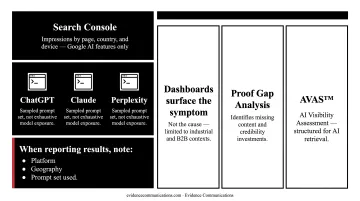
Each tool samples from a tracked prompt set rather than measuring exhaustive model exposure. When reporting results, note the platform, geography, and prompt set used — context matters for interpreting what the numbers actually reflect.
For industrial and B2B companies, tool dashboards surface the symptom — not the cause. Identifying why AI systems overlook your company requires a deeper assessment of your full commercial narrative: what proof exists, where it lives, and whether it's structured for AI retrieval.
Evidence Communications addresses this through its Proof Gap Analysis and AI Visibility Assessment (AVAS™), which identify not just where visibility is missing, but what content and credibility investments will close the gap fastest.
Frequently Asked Questions
Is GEO the same as SEO, or do I need to do both?
GEO builds on SEO rather than replacing it. Strong SEO foundations — quality content, technical structure, authoritative backlinks — directly support GEO performance. The difference is that SEO helps you rank in a list of links, while GEO determines whether AI systems cite you in their synthesized answers.
How does AI search specifically affect B2B and industrial buyers?
B2B buyers use AI tools to shortlist vendors before making contact, meaning GEO determines whether your company enters the consideration set before your sales team is ever engaged — often before any human conversation occurs.
What type of content gets cited most often by AI tools?
Specific, evidence-backed content with clear structure, data points, quotations, and demonstrable expertise. Original case studies with measurable outcomes, technical explainers grounded in real engineering, and comprehensive capability documentation consistently outperform generic overviews.
How long does it take to see results from GEO efforts?
Early improvements can appear within weeks for newly optimized, technically accessible pages. Sustained citation authority typically builds over 2-6 months of consistent content quality and off-page presence work. The gains accumulate progressively rather than arriving all at once.
What is the biggest GEO mistake B2B companies make?
Publishing generic content that could have been written by anyone — capability claims without proof or operational grounding. AI systems are trained to prefer specific, independently verifiable content. Commodity overviews don't meet that standard.
Do I need a large team or budget to start implementing GEO?
Practical GEO progress starts with auditing your existing content for AI access and proof gaps, fixing technical crawler issues, and updating your highest-value pages with specific evidence and clear structure. None of that requires a large team — it requires a clear priority list and consistent execution.