Introduction
B2B buyers are no longer waiting for a sales call to form an opinion about your company. Instead of scrolling through pages of blue links, they're asking questions and getting synthesized answers — answers that skip traditional gatekeepers and form opinions before a single sales call is made.
Forrester found that 89% of B2B buyers had adopted generative AI by late 2024, ranking it among their top sources of self-guided research throughout the buying process.
Gartner forecasts traditional search volume will fall 25% by 2026 as users shift toward AI-powered tools — and that shift is already underway.
For procurement managers, plant engineers, and industrial decision-makers, this creates a new reality: vendor shortlists are being built by AI tools before anyone picks up the phone.
This article breaks down the top AI search engines, covering what each does well, which situations each suits best, and how to choose the tool that fits your workflow.
Key Takeaways
- AI search engines synthesize answers from multiple sources using LLMs — they understand intent, not just keywords
- Each tool fits a different use case — the right choice depends on whether you need citations, document analysis, privacy, or deep generation
- Most tools have free tiers; the right choice depends on your specific workflow
- For B2B companies, appearing in AI-generated answers now shapes buyer decisions before a single sales conversation happens
What Is an AI Search Engine — and Why It Matters for B2B Leaders
Traditional search engines match keywords and return ranked links. You click, you read, you judge.
AI search engines work differently. They use large language models (LLMs), natural language processing (NLP), and retrieval-augmented generation (RAG) to read across multiple sources simultaneously, interpret the intent behind a query, and return a direct answer — typically with citations, and without requiring you to click anywhere.
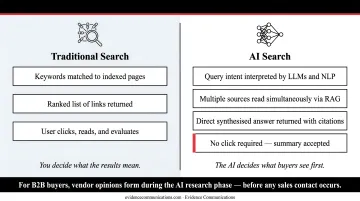
That last part matters. Users increasingly accept AI-generated summaries without going deeper. For B2B buyers, this means vendor opinions form during the AI research phase — before any sales contact occurs.
What This Means for Industrial and B2B Companies
When a procurement manager types "who are the best providers of [your category]" into Perplexity or ChatGPT, that tool will synthesize whatever publicly available information exists about your company and your competitors. Companies with clear, structured, verifiable content online are far more likely to appear in those answers.
This is the visibility gap Evidence Communications helps industrial and B2B companies close. The firm's AI Visibility Assessment (AVAS™) evaluates how a company appears across seven major platforms:
- ChatGPT
- Gemini
- Claude
- Perplexity
- Copilot
- Grok
- Google Search
The goal is identifying where a company is absent from AI-generated answers before that absence costs them a spot on a buyer's shortlist.
The companies that appear in those answers share a common trait: their capabilities are documented, distributed, and independently verifiable across multiple channels. The ones that don't show up often have strong operational performance — it's simply not visible in formats that AI tools can read and cite.
Best AI Search Engines: Top Tools Compared by Use Case
Tools below were evaluated on answer accuracy, citation quality, real-time web access, ease of use, and relevance for business research. No single tool won across every dimension — use case alignment matters more than any single ranking.
Perplexity — Best for Research and Citation Accuracy
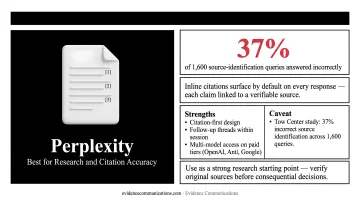
Perplexity is purpose-built for search, not general conversation. Every response surfaces inline citations by default, linking each claim to a verifiable source. That citation-first design makes it the strongest option for fact-checking, competitive research, and any task where you need to verify what you're reading quickly.
It also supports follow-up questions within the same thread and, on paid tiers, offers access to multiple model families including options from OpenAI, Anthropic, and Google.
One important caveat: a Tow Center study testing 1,600 source-identification queries found Perplexity answered 37% incorrectly. That number should inform how you use it — as a strong starting point for research, not a replacement for verifying original sources on consequential decisions.
| Category | Details |
|---|---|
| Best For | Research, fact-checking, competitive intelligence, B2B due diligence |
| Free Tier | Unlimited standard searches; limited advanced searches per day |
| Starting Price | Pro plan at $20/month |
Google AI Mode — Best for Broad Coverage and Ecosystem Integration
Google AI Mode is the AI layer built directly into the world's most widely used search engine, powered by Gemini LLMs. As of May 20, 2025, it rolled out to all US users with no sign-up required, appearing as a dedicated tab in Google Search alongside existing AI Overviews.
No other AI search engine matches Google's index breadth. Google's Search index spans hundreds of billions of webpages and over 100 million GB of data, making it unmatched for local queries, niche topics, and anything that benefits from sheer coverage. AI Mode adds conversational follow-up capability on top of that foundation.
For general search users already inside the Google ecosystem, this requires no behavior change to adopt.
| Category | Details |
|---|---|
| Best For | General search, broad topic coverage, users already in the Google ecosystem |
| Free Tier | Yes — available via Google Search, no account required for core use |
| Starting Price | Free; AI Pro plan at $19.99/month; AI Ultra at $249.99/month |
ChatGPT Search — Best for Search Plus Content Generation
ChatGPT added real-time web search on top of its core generation capabilities, and the combination is genuinely useful for multi-step workflows. You can research a vendor, ask for a comparison summary, and get a draft memo, all in one session, without switching tools.
GPT-5 adds meaningful depth here: OpenAI reports GPT-5 responses are approximately 45% less likely to contain factual errors than GPT-4o on representative prompts (vendor evaluation, not independent). ChatGPT Search became available without signup in February 2025.
The same Tow Center study that tested Perplexity found ChatGPT Search answered 67% of source-identification queries incorrectly — a meaningful gap worth noting for citation-dependent research tasks.
| Category | Details |
|---|---|
| Best For | Conversational research, writing assistance, multi-step workflows combining search and output |
| Free Tier | Yes — web search included on free plan with usage limits |
| Starting Price | Plus plan at $20/month; Pro at $200/month |
Microsoft Copilot — Best for Microsoft 365 Business Users
Microsoft Copilot sits across Bing, Edge, and the full Microsoft 365 suite, pulling together web results alongside the documents, spreadsheets, and email threads users already work in.
The practical advantage for enterprise teams is real: Copilot surfaces separate "From your company's data" and "From the web" sections within a single response. Procurement teams can query internal specifications alongside external supplier information without switching tools.
40% of the Fortune 100 participated in Microsoft's Copilot Early Access Program, with named customers including BP, Honda, Pfizer, and Visa.
For organizations in regulated industries already running on Microsoft 365, the enterprise data protection controls make this a practical choice.
| Category | Details |
|---|---|
| Best For | Enterprise teams using Microsoft 365, productivity-integrated search, internal + external research |
| Free Tier | Yes — basic Copilot access via Bing and Edge |
| Starting Price | Copilot Pro at $20/user/month; Microsoft 365 Copilot at $30/user/month |
Claude — Best for Long-Form Reasoning and Document Analysis
Claude, built by Anthropic, is optimized for accuracy on complex material rather than fast answers. Claude Sonnet 4.5 offers a 200,000-token context window: enough to process entire documents, lengthy RFPs, or multi-part technical specifications in a single session.
Where other tools return quick summaries, Claude produces structured, nuanced responses grounded in the material you provide. It handles tasks that require real reading:
- Analyzing supplier contracts for risk language
- Reviewing technical documentation against specifications
- Comparing competing arguments across long reports
- Summarizing multi-part RFP packages into clear recommendations
Context limits do vary by model and platform, so check specific plan documentation before assuming a uniform capability across all Claude tiers.
| Category | Details |
|---|---|
| Best For | Document-heavy research, long-form analysis, high-accuracy responses on nuanced topics |
| Free Tier | Yes — basic access at claude.ai |
| Starting Price | Pro plan at $20/month; Team and Enterprise tiers available |
Brave Search — Best for Privacy-First Users
Brave Search operates on a fully independent web index — it doesn't rent results from Google or Bing. Its AI answer layer (Leo) provides synthesized responses without building user profiles or storing behavioral data, per Brave's privacy documentation.
For organizations where data privacy is non-negotiable — healthcare, legal, defense-adjacent sectors — Brave offers capable AI-assisted search at no cost and without the data trade-offs that come with most mainstream tools. No account is required for full access.
| Category | Details |
|---|---|
| Best For | Privacy-conscious users, anonymous research, sectors with strict data policies |
| Free Tier | Yes — full AI-assisted search, no account required |
| Starting Price | Search Premium at $3/month (ad-free); Leo Premium at $14.99/month |
How to Choose the Right AI Search Engine
No single tool fits every use case. The most common mistake is choosing based on brand familiarity rather than workflow fit — defaulting to Google when Perplexity would serve better for structured research, or assuming ChatGPT handles citations as well as it handles generation.
A few practical decision rules:
- Need verified, cited research? Perplexity is purpose-built for this — despite its citation error rate, it remains the strongest option for source-linked research tasks
- Already inside Google or Microsoft ecosystems? Use the tool that's already embedded in your workflow — AI Mode or Copilot — rather than adding friction with a new platform
- Combining research with content output? ChatGPT's search-plus-generation workflow is purpose-built for multi-step tasks
- Processing long documents or RFPs? Claude's large context window handles material that other tools will truncate or misrepresent
- Working in a regulated industry with strict data policies? Brave Search is the only major option with a fully independent index and no user profiling
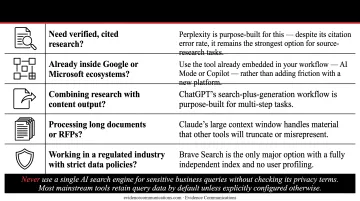
One consideration cuts across all of these: privacy. Never use a single AI search engine for sensitive business queries without checking its privacy terms. Most mainstream tools retain query data by default unless explicitly configured otherwise.
Conclusion
AI search engines are no longer experimental. They're the primary research infrastructure buyers, analysts, and procurement teams use to gather information and form opinions — often before a vendor ever knows they were evaluated.
Selecting the right tool means matching capability to workflow, not chasing the most recognized name. Perplexity handles deep research, Google AI Mode maximizes coverage, ChatGPT excels at generation, Copilot fits enterprise workflows, Claude works best with documents, and Brave prioritizes privacy.
The more pressing question for B2B and industrial companies is whether your company shows up credibly when these tools synthesize information about your category. Organizations whose capabilities are well-documented, structured, and publicly verifiable have a built-in advantage in AI-driven discovery. Those that don't may never know they were passed over.
Evidence Communications helps industrial and B2B companies translate real operational capability into the kind of clear, consistent, verifiable proof that AI search tools surface and buyers actually trust. If your company's story isn't showing up where buyers are looking, that's a commercial problem worth solving before the decision is made. Reach out directly at jvargas@evidencecommunications.com.
Frequently Asked Questions
What is the best AI search engine right now?
Perplexity is widely regarded as the strongest option for research and citation accuracy, while Google AI Mode leads on general coverage. The right choice depends on whether you need verified, source-linked research, broad search capability, or productivity integration with existing tools like Microsoft 365.
What do Gen Z use instead of Google?
Gen Z increasingly turns to AI-native tools like ChatGPT and Perplexity alongside social platforms for discovery and research. A 2024 survey found that 46% of Gen Z preferred social media over traditional search engines for finding information — a meaningful shift away from traditional Google-first search behavior.
How is an AI search engine different from a traditional search engine?
Traditional search engines return a ranked list of links based on keyword matching. AI search engines synthesize information from multiple sources and return a direct, conversational answer. They understand intent and context rather than matching words, and users often don't click through to source pages at all.
Are AI search engines reliable enough for business research?
Yes, with appropriate verification. Perplexity and Claude are strong for structured, citation-backed research. However, all AI tools can hallucinate — the Tow Center found over 60% error rates on source-identification tasks across eight platforms, so cross-check AI-generated summaries against original sources for consequential decisions.
How are B2B buyers using AI search engines to evaluate vendors?
B2B buyers use AI search to shortlist vendors, compare capabilities, and validate claims before making contact. If a company's operational proof, case studies, and differentiators aren't visible in publicly available content, they may not appear in AI-generated answers at all — excluded before sales is ever involved.