
Introduction
Picture a procurement manager at a mid-sized manufacturer. They've identified a capability gap and need a new supplier — fast. Before calling anyone, they run a few searches, ask ChatGPT for options, check LinkedIn for who's active in the space, and scan two industry forums. They build a shortlist in about 45 minutes. Then they make calls.
Is your company on that list?
And if it is — when they find you, does what they see create confidence or uncertainty?
Those two questions point to the core distinction this article addresses. Brand visibility and brand awareness are not the same investment, and for B2B and industrial companies, confusing them produces predictable problems: either chasing impressions that never convert, or building brand equity that no one ever encounters.
Gartner's 2025 survey found 61% of B2B buyers prefer a rep-free buying experience. That makes the research phase — where visibility and awareness both do their work — the most consequential stage in the buying process.
TL;DR
- Visibility = how often and where your brand appears across the channels buyers use
- Awareness = whether buyers recognize and recall your brand when they encounter it
- Visibility is measured through impressions, search presence, and share of voice
- Awareness is measured through branded search volume, recall surveys, and recognition
- High visibility without awareness means you're seen but not remembered; high awareness without visibility means buyers know your name but can't find you
- For B2B companies, visibility comes first — buyers must find you before they can form any opinion
- The goal isn't to choose between them; it's to identify which gap exists and address it deliberately
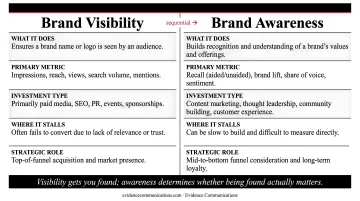
Brand Visibility vs. Brand Awareness: Quick Comparison
| Dimension | Brand Visibility | Brand Awareness |
|---|---|---|
| Definition | How often and where your brand appears across buyer research channels | Whether buyers recognize, recall, and associate your brand with a specific capability |
| What it measures | Frequency and breadth of brand exposure | Depth and accuracy of buyer recognition |
| Primary question | Can buyers find us? | When buyers find us, does our name mean something? |
| Key metrics | Share of voice, search rankings, AI citations, impressions, social mentions | Unaided recall, aided recognition, branded search volume, consideration set inclusion |
| When it matters most | Early research phase — supplier identification and shortlisting | Evaluation phase — preference formation and consideration |
| Common mistake | Investing in one channel only (e.g., trade shows) while being absent online | Running brand campaigns without verifiable proof to back them up |
The relationship is sequential, not interchangeable. Visibility gets you found; awareness determines whether being found actually matters. Each requires its own investments, metrics, and strategy — and confusing the two is where most B2B companies stall.
What Is Brand Visibility?
Brand visibility is the frequency and breadth with which your brand appears across the channels your buyers actually use — search engines, industry publications, LinkedIn, trade forums, AI-generated results, and peer networks — relative to competitors.
The critical word is relative. Visibility is always comparative. A company can have strong presence at trade shows and near-zero presence in the channels where modern B2B buyers do their independent research. According to a 2025 GlobalSpec/TREW survey of engineers, 82% routinely consult supplier websites when researching a work purchase, and 45% first contact sales specifically to validate information already gathered online. By the time a salesperson gets the call, the shortlist is already forming.
For industrial and B2B companies, this creates a specific operational problem: if a buyer queries an AI tool or search engine to identify capable suppliers and your company doesn't appear, you have a visibility gap — not a quality problem. The capability exists. The market just can't find it.
Where B2B Visibility Must Exist
The channels matter. Visibility in the wrong places doesn't create opportunity. For industrial and B2B buyers, the relevant channels include:
- Organic search results — still a primary starting point for supplier research
- AI tools (ChatGPT, Perplexity, Gemini, Claude, Copilot) — increasingly used to surface and compare supplier options without human search effort
- LinkedIn — where engineers, operators, and buyers observe proof of capability from peers
- YouTube — where technical buyers evaluate "how it works" before engaging anyone
- **Industry directories and trade publications** — used for validation and cross-referencing
- Third-party review platforms and peer forums — trusted because buyers didn't pay for them
Multi-channel presence is what separates companies that get considered from those that get overlooked. That distinction — being findable vs. being known — is exactly where visibility and awareness diverge.
What Is Brand Awareness?
Brand awareness is the degree to which buyers recognize, recall, and correctly associate your brand with a specific capability, product, or reputation. It has two measurable forms:
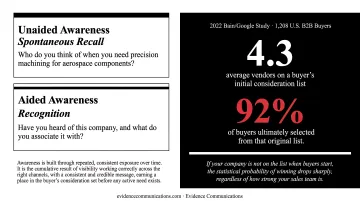
- Unaided awareness — spontaneous recall: "Who do you think of when you need precision machining for aerospace components?"
- Aided awareness — recognition: "Have you heard of this company, and what do you associate it with?"
Awareness is built through repeated, consistent exposure over time. It's the cumulative result of visibility working correctly — a brand that appears frequently across the right channels, with a consistent and credible message, earns a place in the buyer's consideration set before any active need exists.
This directly affects B2B sales efficiency. A 2022 Bain/Google study of 1,208 U.S. B2B buyers found that buyers started with an average initial list of 4.3 vendors, and 92% ultimately selected from that original list. If your company isn't on the list when buyers start, the statistical probability of winning drops sharply — regardless of how strong your sales team is.
Awareness in B2B vs. B2C
The mechanics differ significantly from consumer marketing:
- B2C awareness is built through mass exposure and emotional association — broad reach across a large population
- B2B awareness is built through proof-based credibility and capability recognition among a specific, high-value audience
For an industrial manufacturer, awareness among 50 key decision-makers at 20 target accounts may matter more than broad market recognition. Those decision-makers need to associate your company with a specific capability — not just recognize your logo. In high-stakes industrial purchasing, the goal isn't more information in front of buyers — it's less doubt. Being seen is a start; being trusted is what earns a spot on the consideration list.
Key Differences: Brand Visibility vs. Brand Awareness
Sequencing: Visibility Must Come First
Visibility is the prerequisite. If a buyer cannot find your company during their independent research phase — before they've contacted anyone — they will never develop awareness of you. The research comes before the call, and the shortlist is built before sales is invited in.
However, visibility without a credible message produces impressions that disappear. A company can generate significant search or social presence and still fail to build awareness if what buyers encounter is inconsistent, undifferentiated, or lacks verifiable proof of capability.
The Measurement Gap
Most B2B companies can measure visibility reasonably well. Impressions, search rankings, share of voice, AI citations — these are trackable and relatively immediate. Awareness is harder. Brand recall, consideration set inclusion, and branded search volume trends move slowly and require deliberate measurement infrastructure to track.
That measurement gap has real consequences. Marketing Week's 2025 Language of Effectiveness survey found that among B2B marketers, 67% prioritized leads generated and 54.4% tracked click-through rates — but only 27.2% measured business outcomes. Awareness measurement barely registers in standard dashboards, which means companies systematically underinvest in understanding whether their visibility is actually building buyer familiarity and trust.
The Trust Dimension
This is where the two constructs diverge most consequentially for industrial buyers. Visibility answers "can buyers find us?" Awareness answers "when they find us, does our name mean something?"
For buyers making high-stakes, long-cycle purchasing decisions — where a wrong choice creates downtime, safety exposure, missed output, or warranty claims — a company that is visible but unknown still carries friction. They'll look for proof before proceeding.
Third-party validation, case studies, client references, and industry mentions are what convert visibility into awareness. Without them, buyers see a name they don't recognize and move to someone they can verify.
A Common B2B Failure Mode
Two patterns appear repeatedly among established industrial companies:
Heavy trade show and outbound investment, weak digital presence — works for buyers who were already in the room; invisible to everyone researching independently. When a younger procurement manager runs an AI search or Google query, the company simply doesn't appear.
Digital brand campaigns without specific, credible proof — generates impressions but not confidence. Buyers encounter the brand repeatedly and form no meaningful association with a real capability.
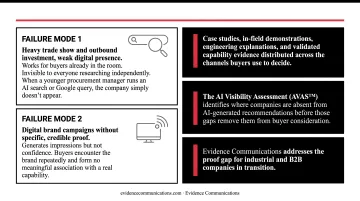
Evidence Communications addresses this gap by helping industrial and B2B companies build and distribute real-world proof — case studies, in-field demonstrations, engineering explanations, and validated capability evidence — across the channels buyers use to decide. The firm's AI Visibility Assessment (AVAS™) identifies where companies are absent from AI-generated recommendations before those gaps remove them from buyer consideration.
Where to Focus First
The right investment depends on where you actually stand:
- Genuinely unknown in the market — visibility investments come first; buyers can't consider you if they can't find you
- Findable but not converting — low conversion rates or unusually long sales cycles point to an awareness and credibility problem
- Most established industrial companies fall into a third position: partial visibility, weak awareness — present in the market but not occupying a clear position in buyers' minds
Conclusion
Brand visibility and brand awareness are not competing priorities. They are sequential ones.
Visibility creates the opportunity to be found. Awareness determines what happens next. For B2B and industrial companies, the practical starting point is an honest audit of where gaps actually exist:
- Are buyers finding you during independent research — in search, in AI tools, on LinkedIn, in trade publications?
- When they do find you, does what they encounter create confidence or uncertainty?
Companies that close both gaps — appearing consistently where buyers search, backed by verifiable proof of capability — enter sales conversations earlier in the buying cycle, with buyers who already have a formed impression. The goal is for sales to receive the call before the decision is made, not after preferences have solidified elsewhere.
Companies that carry real capability but lack the proof to show it risk being eliminated from a buyer's shortlist before the first conversation. Evidence Communications provides the commercial diagnostic and strategy to close visibility gaps and proof deficits — before they cost you the opportunity.
Frequently Asked Questions
What is brand visibility?
Brand visibility refers to how often and where your brand appears across the channels buyers use to research and make decisions — including search engines, social platforms, AI tools, and industry publications — relative to competitors. It is always a comparative measure, not an absolute one.
What is the difference between brand awareness and brand visibility?
Visibility is about how often your brand appears (exposure); awareness is about whether buyers recognize, recall, and associate your brand with a specific capability or reputation. Visibility is the input; awareness is the outcome it builds over time when the message is consistent and credible.
How do you measure brand visibility?
Key metrics include share of voice in search, branded search volume, AI citation frequency across tools like ChatGPT and Perplexity, social media mentions, and impression share. Because visibility is comparative, these metrics are most useful when measured against competitors in your category.
Can a company have high visibility but low brand awareness?
Yes. A company can generate high impression volume through advertising or strong search rankings but fail to build awareness if the message is inconsistent, undifferentiated, or lacks credible proof. Buyers see the brand repeatedly but form no meaningful association with a specific capability.
Which should B2B companies prioritize first — brand visibility or brand awareness?
Visibility is the prerequisite: buyers must find you before awareness can form. For companies with low market presence, visibility investments come first. For companies already known in the market but struggling to convert interest, the priority shifts to improving the credibility and clarity of what buyers actually encounter.
Why does brand visibility matter more in an AI-driven buying environment?
AI tools now conduct supplier research on behalf of buyers, generating shortlists without any human search effort. Brands absent from AI-cited sources and trusted third-party references are effectively invisible to a growing share of the B2B research process — excluded before sales ever gets the chance to compete.