Introduction
Most manufacturing companies have deep operational expertise. The problem isn't capability — it's visibility during the phase that matters most.
Today's industrial buyers — engineers, procurement managers, plant managers, and CFOs — conduct independent research through AI tools, peer networks, and digital channels before they ever contact a supplier's sales team. If your content doesn't surface during that research phase, you're removed from consideration before a conversation starts. Sales never gets the call. No rejection notice arrives. The company simply isn't on the shortlist.
The gap between content effort and actual content impact is significant. According to CMI's manufacturing-specific research, 80% of manufacturing marketers rate their content strategy as only moderately effective or worse. That's not a resource problem — it's an execution problem.
This guide covers what's changed in manufacturing content marketing, who you're writing for, which formats and channels actually produce results, how to build a strategy, and how to measure what matters.
Key Takeaways
- 80% of manufacturing marketers rate their content strategy as moderately effective or worse — the gap is execution, not effort
- Industrial buyers research suppliers independently before contacting sales — no proof means no shortlist
- Video (74%), case studies (45%), and white papers (43%) are the top-performing content formats for manufacturing marketers
- LinkedIn delivers the best social ROI for 85% of manufacturing marketers — proof content outperforms promotion
- Engineers, procurement, operations, and finance each require different content — one format rarely serves all
Why Manufacturing Content Marketing Has Changed
The Self-Guided Buyer Is Already Deciding
Industrial buyers no longer wait for a sales rep to educate them. Forrester's 2023 Global Buyers' Journey Survey found that nearly 90% of B2B purchase processes stall — often because buyers encounter friction during independent research. Separately, Gartner reports 67% of B2B buyers now prefer a rep-free experience during initial evaluation.
The implications for manufacturing are direct. Buyers are already researching — without you:
- Engineers search YouTube for "how it works" demonstrations before contacting anyone
- Procurement teams use ChatGPT and Perplexity to generate initial supplier shortlists
- Plant managers check LinkedIn for peer validation before a first call
If a manufacturer's proof isn't findable across those channels, the company doesn't make the cut.
This isn't a sales failure. It's a pre-sales visibility failure.
The Proof Deficit Problem
Manufacturers who rely on relationship-based selling alone — without maintaining credible digital proof infrastructure — create what Evidence Communications calls a Proof Gap: the distance between what a company can genuinely do and what buyers can independently verify online.
The disqualification is invisible. Buyers don't explain why they moved on. Sales never knows what it lost.
Common proof deficits that trigger silent disqualification:
- No verifiable case studies — buyers can't see whether you've solved their specific problem before
- Claims without evidence — marketing language without demonstrations, specs, or customer outcomes
- Absence from AI tools — ChatGPT and Perplexity can't recommend companies whose proof isn't structured and distributed across the open web
- Proof confined to the company website — buyers discount evidence that only appears in self-published formats
Multiple Stakeholders, Multiple Proof Requirements
Manufacturing purchases aren't single-decision-maker events. Forrester's 2026 State of Business Buying research identifies an average of 13 internal stakeholders and 9 external influencers in a typical B2B decision. For manufacturers, that typically means:
- Engineers need technical depth, real-world application footage, and peer validation
- Procurement managers need defensible case studies and third-party credibility signals
- Plant/operations managers need reliability evidence and installation documentation
- CFOs need ROI data, total cost of ownership analysis, and financial risk reduction
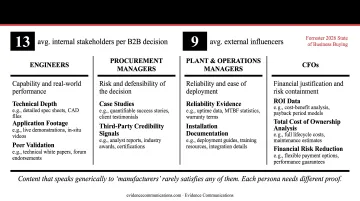
Content that speaks generically to "manufacturers" rarely satisfies any of them. Each persona needs different proof.
AI-Driven Research Has Changed Who Gets Found
76% of manufacturing marketers are already using generative AI tools to produce content. The more consequential shift, however, is on the buyer side. Buyers now use AI platforms to generate supplier options during early research — before any human contact occurs. Manufacturers with more structured and better distributed digital content — case studies, technical documentation, FAQ pages, demonstrated proof — are more likely to surface in those AI-generated recommendations. Those without it are excluded from consideration they never knew they were part of.
Who You're Actually Writing For
Building Useful Buyer Personas
Effective manufacturing content personas go beyond job titles. They map three things: the specific pain the persona carries, the questions they're asking at each research stage, and the proof required to convert their skepticism into confidence.
| Persona | Primary Concern | Proof They Need |
|---|---|---|
| Design Engineer | Will it perform under our operating conditions? | Application footage, specs, engineering explanations |
| Procurement Manager | Can I defend this selection internally? | Detailed case studies, third-party validation, references |
| Plant/Operations Manager | Will it keep running without disrupting output? | Installation documentation, reliability data, operator testimonials |
| CFO | Is this investment financially defensible? | ROI data, TCO analysis, supplier stability signals |
The Longer, Consensus-Driven Buying Journey
Manufacturing purchases move through distinct stages — and content must serve each:
- Awareness — Buyer recognizes a problem or evaluates alternatives
- Consideration — Buyer researches solution types and approaches
- Supplier evaluation — Buyer assesses specific companies against each other
- Internal approval — Buyer builds the case for multiple stakeholders
- Decision — Purchase is finalized (often after months of research)
Most manufacturing content lives at Stage 1 — blog posts about industry trends. Very little serves Stages 3 and 4, where the actual shortlisting happens. That's where the content gap is most costly.
The Specificity Principle
Closing that gap requires specificity. Generic content that speaks to everyone resonates with no one — the most effective manufacturing content operates at the intersection of three variables: specific problem + specific application + specific industry vertical.
"How precision machined components reduce warranty claims in automotive stamping" outperforms "the importance of precision machining" across every channel — search rankings, AI discoverability, and buyer confidence — because it answers the question the buyer is actually typing.
The Most Effective Content Formats for Manufacturing Companies
CMI's manufacturing research gives clear direction on format effectiveness. Video leads at 74%, followed by case studies and customer stories at 45%, and e-books/white papers at 43%. These aren't equivalent — video has a 29-point lead over the next format.
Video and Product Demonstrations
Video outperforms because it does what no other format can: it shows proof operating in real conditions. For industrial buyers researching independently, seeing a product run under actual field conditions is fundamentally different from reading that it "performs well."
High-value video types for manufacturing:
- Factory floor tours and capability walkthroughs
- Product demonstrations under operating conditions
- Customer installation footage with before/after context
- Engineer and operator explanations ("how it works" content)
- Customer testimonial videos with named contacts
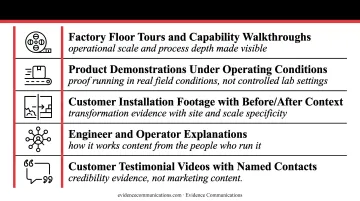
These function as credibility evidence, not marketing content.
Case Studies and Customer Success Stories
Case studies answer the buyer's most critical pre-sales question: Have you solved this exact problem for someone like me?
A high-converting manufacturing case study includes:
- The customer's specific challenge (not a generic description)
- The application context and operating environment
- Measurable outcomes (uptime improvements, cost reductions, cycle times)
- A quote from a named contact — not anonymous attribution
The last point matters. Anonymous case studies signal that the manufacturer couldn't get permission to publish — which raises questions about the customer relationship.
Technical Content: White Papers, Data Sheets, and Guides
Technical documentation serves the evaluation stage, when engineers and procurement teams are in deep comparison mode. Two distinct types serve different purposes:
- Educational content (white papers, application guides) — explains the "why" behind your approach
- Validation content (spec sheets, test data, certifications) — confirms that claims are verifiable
Both must be web-accessible, not PDF-gated only. Content behind a form fill can't be indexed by search engines or surfaced by AI tools. Early-stage buyers who haven't committed to engaging will simply move on.
Blog Posts and Thought Leadership
Unlike technical documentation, which serves buyers already in evaluation mode, blog content pulls in buyers earlier — when they're still defining the problem. The rule is specificity: target problem-application-industry combinations rather than general industry commentary.
"How [product type] reduces downtime in food and beverage packaging operations" attracts buyers already researching that specific problem. "Manufacturing trends in 2025" generates volume, but none of it is commercially relevant.
How to Build a Content Marketing Strategy for Manufacturing Companies
Step 1: Connect Goals to Commercial Outcomes
Content strategy must connect to revenue — not exist in a parallel universe of traffic metrics. Define goals in commercial terms:
- Reducing time from first digital touchpoint to qualified sales conversation
- Building credibility in a new industry vertical
- Supporting three specific product lines during a sales cycle
Without this anchor, content plans drift toward activity that feels productive but doesn't influence pipeline.
Step 2: Audit What Buyers Find Before You Create Anything New
Before producing new content, map what a buyer discovers when they search for your company's capabilities right now. Specifically, identify:
- Where does credibility break down?
- Which applications have no case studies?
- Where do product pages carry claims without supporting evidence?
- Is your proof findable on LinkedIn, YouTube, and through AI tools — or only on your website?
This gap analysis becomes the content roadmap. The goal is to identify what proof exists, what's missing, and which gaps are most likely to remove your company from buyer shortlists before sales is ever contacted.
Step 3: Map Content to Buyer Stages
Build an editorial plan that assigns content types to specific stages:
- Awareness — Problem-focused blog content, industry application guides, search-optimized landing pages by vertical
- Consideration — White papers, comparison guides, "how we approach [challenge]" content
- Decision — Case studies, customer video testimonials, live demonstrations, technical validation data
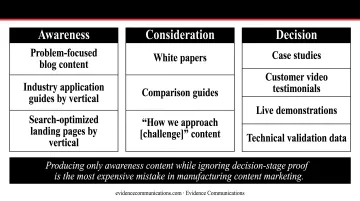
Producing only awareness content while ignoring decision-stage proof is the most expensive mistake in manufacturing content marketing.
Step 4: Build a Lean but Sustainable Content Operation
Resource constraints are real. A workable model:
- Pull in subject matter experts for input — engineers, operators, and application specialists carry the credibility that marketing teams alone can't manufacture
- Start with a simple editorial calendar; even a monthly cadence beats ad hoc production
- Repurpose aggressively — one white paper can generate a blog series, a LinkedIn post sequence, and a video script
- Assign clear ownership for review and publication, or content will stall in draft indefinitely
Step 5: Align Content with Sales
Manufacturing content should reduce friction in the sales process. Work with sales to identify:
- Which objections come up repeatedly in discovery calls
- Which questions prospects ask before they're ready to move forward
- Which proof points converted the last three customers
Content that answers those questions proactively gets sales the conversation earlier — and with a buyer who's already partially convinced.
Where to Distribute: Channels That Work for Manufacturers
CMI's research identifies three leading distribution channels for manufacturing marketers: in-person events (51%), corporate website blogs (49%), and webinars (49%). On social media, LinkedIn delivers the best value for 85% of manufacturing marketers. These aren't competing channels — they're complementary.
Digital Channels
The website is the hub. Case studies, videos, technical documentation, and thought leadership articles must live on the site as indexed, searchable proof. A website that functions only as a brochure — no technical depth, no case studies, no proof infrastructure — fails both the AI discoverability test and the buyer confidence test.
LinkedIn is the primary social distribution channel for B2B manufacturing. It reaches procurement professionals, design engineers, plant managers, and C-suite decision-makers in a single feed.
Content that performs: customer outcomes, process demonstrations, technical insights, and behind-the-scenes capability posts. Company announcements and award posts do not.
YouTube is underused by most manufacturers, and that's an opening. Buyers search YouTube the same way they search Google: "how it works" explanations, application demonstrations, operator-level education. A library of real application videos builds discoverability over time.
In-Person and Hybrid Channels
Trade shows remain high-value because they allow direct proof experiences: live demonstrations, facility tours, and technical conversations that no digital format fully replicates. IMTS 2024 drew 89,020 registrants — buyer demand for in-person engagement is real.
The mistake is treating event content as disposable. One trade show appearance can fuel months of distribution when you capture it deliberately:
- Record live demos for YouTube and website landing pages
- Publish post-event recaps so non-attendees get access to what happened
- Follow up with webinars for qualified leads who couldn't attend
- Repurpose technical conversations into LinkedIn posts and short-form articles
Measuring Content Marketing Performance in Manufacturing
64% of manufacturing marketers report difficulty attributing ROI to content efforts, and only 45% agree their organization measures performance effectively. The fix isn't adding more metrics — it's tracking at the right levels of the commercial system.
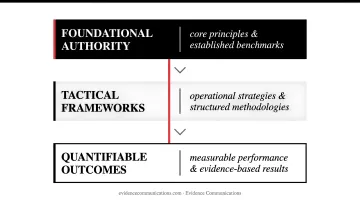
Three-Level Measurement Framework
| Level | What It Measures | Example Metrics |
|---|---|---|
| Activity | Content production and reach | Posts published, traffic, social reach |
| Engagement | Buyer interaction quality | Time on page, video completion rates, download rates |
| Business impact | Commercial influence | Content-influenced leads, sales cycle length, pipeline contribution |
KPIs Worth Tracking
- Organic search rankings for target capability and application keywords
- Content-influenced leads tracked in CRM (content consumed before first sales contact)
- Case study page views and download rates by industry vertical
- Video completion rates for technical demos and capability walkthroughs
- Return visit rates from target company domains
- Sales cycle length for content-touched vs. non-touched prospects
The Vanity Metric Warning
High traffic to generic blog posts that doesn't convert to qualified pipeline gives you no useful signal. A single case study that generates three qualified conversations in a quarter is worth more commercially than tens of thousands of pageviews on a trend article.
Tie every content KPI back to the commercial goal it supports. If you can't explain how a metric connects to pipeline or revenue, it's a vanity metric — useful for reporting, not for decision-making.
Frequently Asked Questions
How is content marketing different for manufacturing companies compared to other industries?
Manufacturing content marketing is predominantly B2B, involves longer sales cycles with multiple decision-makers, and requires technically detailed, proof-based content — case studies, specifications, demonstrations — rather than the emotionally-driven content common in B2C industries. Each stakeholder in the buying group has different proof requirements, and effective content has to serve all of them at once.
What types of content work best for industrial and B2B manufacturers?
CMI research identifies video (74% effectiveness rating), case studies and customer stories (45%), and white papers/e-books (43%) as top-performing formats. The strongest results come from content that combines technical credibility with real-world, verifiable proof — not marketing language.
How long does it take to see results from content marketing in a manufacturing company?
SEO-driven content typically takes 3–6 months to gain organic traction, and reaching the first page can take longer. Case studies and direct distribution content on LinkedIn and in sales enablement can influence active deals much faster. How quickly results appear depends more on distribution strategy than on content volume.
How do you measure ROI from content marketing in manufacturing?
Track content's influence on pipeline: qualified leads that consumed content before engaging sales, reduced sales cycle length for content-touched prospects, and new business that cited specific content during their evaluation process. Page views and downloads don't move deals — pipeline influence does.
How should manufacturing companies use LinkedIn for content marketing?
LinkedIn delivers the best social media value for 85% of manufacturing marketers per CMI data. It performs best when used to share proof content — customer outcomes, process demonstrations, technical insights, and capability footage — targeting procurement professionals, engineers, and executive decision-makers. Promotional posts consistently underperform; evidence builds the credibility that earns the call.
What is the biggest mistake manufacturers make with content marketing?
Investing in general awareness content — industry trends, generic tips, company announcements — without building proof content. Case studies, demonstrations, and validated evidence are what buyers need to justify shortlisting a manufacturer, and without that foundation, content generates traffic but not pipeline.