This isn't a traffic problem. It's a commercial visibility problem.
This article covers 12 data-backed strategies to earn citations in Google's AI Overviews — framed specifically for B2B and industrial companies competing in an AI-driven marketplace where buyers decide before sales ever gets involved.
Key Takeaways
- AI Overviews appear on 57.9% of question-based queries — "how," "why," and "what" questions are your highest-opportunity targets
- Pages ranking in the top 10 organic results are significantly more likely to be cited — traditional SEO remains the prerequisite
- Content structure matters more than length — direct answers, scannable formatting, and clear intent alignment outperform word count
- Branded web mentions (correlation coefficient: 0.664) are the strongest single factor driving AI Overview brand visibility
- Topic depth beats single pages — covering a subject area comprehensively raises your citation chances across related queries
What Google's AI Overviews Are (and Why B2B Buyers Use Them)
Google's AI Overviews are AI-generated summaries that appear at the top of the search results page, synthesizing information from multiple sources to answer a query directly — without requiring the user to click through to individual websites. They're powered by a custom Gemini model and designed to help users understand complex topics quickly.
Two mechanics matter for anyone trying to appear in them:
- Query fan-out: When an AI Overview is triggered, Google may break the original query into multiple related sub-searches across subtopics and data sources. Your content might get cited for a subtopic — not necessarily the exact keyword you targeted.
- Multi-source synthesis: Unlike a featured snippet, which quotes a single source, AI Overviews pull from several — as Search Engine Land's 2026 comparison confirms. Being cited means Google has ranked your content among the most credible sources on that topic, which carries real weight with B2B buyers who are already vetting vendors before they reach out.
Why AI Overview Visibility Is a B2B Competitive Advantage
B2B buyers conduct most of their research independently before ever engaging a vendor. Gartner's 2025 survey found that 61% of B2B buyers prefer a rep-free buying experience, with 73% actively avoiding irrelevant outreach. AI Overviews accelerate this dynamic, delivering synthesized answers that shape buyer perceptions before sales is ever involved.
The risk for companies that don't appear: it's not just lost traffic. It's lost consideration. Buyers who never see your brand cited may never know to reach out. This is what Evidence Communications calls a proof deficit : capable companies being removed from buyer shortlists before sales knows an opportunity existed.
The compounding effects are real:
- Slower organic growth as buyer confidence forms elsewhere
- Longer sales cycles when buyers can't verify credentials independently
- Price pressure when differentiation isn't visible during research
- Compressed valuation multiples for PE-backed companies approaching exit
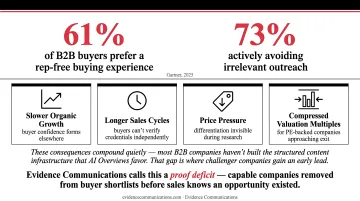
These consequences compound quietly. Most industrial and B2B companies haven't yet built the structured content infrastructure that AI Overviews favor, and that gap is where challenger companies gain an early lead. The window is narrowing as competitors accumulate credibility signals over time.
Evidence Communications works with B2B and industrial companies to close that gap through their proprietary AI Visibility Assessment (AVAS™) and Proof Gap Analysis, identifying exactly where capable companies are being overlooked and what it takes to get back into buyer consideration.
12 Proven Tips to Rank in Google's AI Overviews
Group 1: Target the Queries That Trigger AI Overviews
Tip 1 — Prioritize informational, question-based queries
Ahrefs analyzed 146 million SERPs and found AI Overviews appeared on 57.9% of question-format queries. Queries beginning with "how," "why," "what," and "when" consistently trigger AI Overviews at the highest rates.
For B2B companies, this means publishing content that answers the questions buyers ask when independently researching a supplier category. Not product pages. Not brochure content. Actual answers to real questions.
Tip 2 — Target long-tail keywords with 7+ words
The same Ahrefs research found that 46% of queries with 7 or more words triggered AI Overviews. Their 2024 study also found the median keyword length for AI Overview appearances was 4 words, versus 2 words for non-AIO keywords.
71% of AI Overview keywords had Keyword Difficulty below 30, with a median KD of 12. These low-competition, informational long-tail queries are the highest-opportunity targets — especially for niche industrial and B2B companies where the query pool is already specific.
Tip 3 — Secure a top-10 organic ranking first
AI Overviews don't exist in isolation from traditional search. Google's AI must be able to retrieve and index your content through its standard search infrastructure. An Ahrefs study from July 2025 found 76% of AI Overview citations also appeared in the top-10 organic results — though a March 2026 update revised this to 37.9% as the feature evolved. Either way, organic visibility remains the prerequisite for AI citation eligibility.
If Google doesn't surface your content in standard search, it won't surface it in AI Overviews either. Traditional SEO excellence isn't optional — it's the foundation.
Group 2: Structure Content So AI Can Extract and Use It
Tip 4 — Lead with a direct answer
Google's AI rewards content that provides the answer immediately. Put the core response within the first 1-2 sentences under each heading, then support it with detail. Dan Petrovic's analysis of 7,000+ queries (relayed by Ahrefs) found that grounding gains plateau around 540 words — meaning content density beats content length.
Structure every piece of content like a well-answered question. Answer first. Explain second.
Tip 5 — Format for scannability and AI ingestion
AI systems extract content more effectively when it's easy to parse. Apply these formatting principles:
- Short paragraphs — 2-3 sentences maximum
- H2/H3 headings framed as questions — signals intent clearly
- Bulleted and numbered lists for steps, comparisons, and features
- Bold text for key terms and defined concepts
- Definition sections ("What is X?") — AI Overviews frequently pull from these
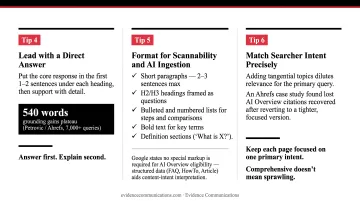
On schema: Google explicitly states that no special markup is required for AI Overview eligibility. That said, structured data (FAQ, HowTo, Article) helps Google's systems interpret content intent accurately — and better traditional SERP performance increases AI citation eligibility through the standard retrieval process.
Tip 6 — Match searcher intent precisely
Adding too many tangential topics to a page can dilute its relevance for the primary query. An Ahrefs case study described adding content to a post coinciding with lost AI Overview citations — which recovered after reverting to a tighter, more focused version.
Keep each page tightly focused on one primary intent. Comprehensive doesn't mean sprawling. Address related subtopics through separate cluster pages rather than cramming them into one.
Group 3: Demonstrate Expertise, Authority, and Freshness
Tip 7 — Apply E-E-A-T signals consistently
Google's guidance for AI features directs publishers to create helpful, reliable, people-first content. For B2B companies, E-E-A-T (Experience, Expertise, Authoritativeness, Trust) translates to practical actions:
- Add author bios with verifiable credentials and industry experience
- Link to original research, internal case studies, and client outcomes
- Write from actual operational experience — not just credentials listed on an About page
- Demonstrate hands-on understanding of the problems your buyers face
Tip 8 — Include specific facts, statistics, and cited data
Vague claims don't earn citations. Back every significant statement with a specific number, a named source, or a documented outcome. Reference third-party industry data. Include percentages and measurable results rather than general statements.
This matters doubly for industrial and B2B companies: your buyers are engineers, procurement managers, and operations leaders. They're trained to spot unsupported claims.
Tip 9 — Keep content fresh with regular updates
SE Ranking's analysis of 100,000 long-tail news queries found that 55.61% of AI Overview citations came from content published in 2024-2025. That data covers news-specific queries, so it shouldn't be generalized across all content — but the direction is clear: recency signals relevance.
Build a content review schedule. Update statistics, add new case data, and refresh timestamps on high-performing pages at least annually. Freshness maintains citation eligibility; stale content loses it.
Group 4: Build Topical Depth and Internal Authority
Tip 10 — Create topic clusters, not isolated pages
Google's AI doesn't just evaluate individual pages — it evaluates how comprehensively a brand covers a subject area. A single authoritative page on a topic is less competitive than a cluster of interconnected content that addresses the full range of related questions.
The pillar-cluster model:
- One comprehensive cornerstone page on your core topic
- Cluster content covering related subtopics and buyer questions
- Strategic internal linking connecting them
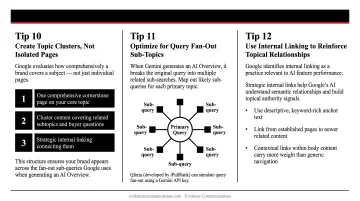
This structure ensures your brand appears across the fan-out sub-queries Google uses when generating an AI Overview — not just for the primary keyword.
Tip 11 — Optimize for query fan-out sub-topics
When Gemini generates an AI Overview, it often breaks the original query into multiple related sub-searches. Your content needs to address those sub-queries, whether within a single comprehensive page or distributed across a cluster.
Map out the likely sub-queries for each primary topic your company targets. A free tool called Qforia (developed by iPullRank) can simulate query fan-out using a Gemini API key — useful for identifying the sub-topics your content needs to cover.
Tip 12 — Use internal linking to reinforce topical relationships
Google explicitly identifies internal linking as a practice relevant to AI feature performance. Strategic internal links between cluster pages help Google's AI understand semantic relationships between your content and build topical authority signals.
Use descriptive, keyword-rich anchor text. Link from established, high-authority pages to newer content on related topics. Don't rely on generic navigation — contextual links within body content carry more weight.
Build Off-Site Authority to Signal Trust to Google's AI
What happens off your website matters as much as what's on it — sometimes more.
Brand Mentions Are the Strongest Correlating Factor
Ahrefs' study of 75,000 brands found that web mentions had the strongest reported correlation with AI Overview brand visibility — a correlation coefficient of 0.664. That outperformed backlinks as a predictor. Note: this is correlation, not causation. Brands with broad digital recognition across the open web get cited more frequently.
Appear on High-Authority Domains
Ahrefs' June 2026 analysis of 14.5 million US prompts found the most-cited domains in AI Overviews were:
- Reddit — 27.5% mention share
- YouTube — 13.7%
- Wikipedia — 12.7%
For B2B and industrial companies, the practical targets are industry trade publications, analyst reports, association websites, and LinkedIn. Getting your company mentioned on pages from these and similarly authoritative domains significantly increases the likelihood of AI citing your brand.
Pursue "Best Of" and Comparison Placements
Dan Petrovic's analysis (relayed by Ahrefs) found that nearly 50% of AI Overview citations in his sample fell into a "best" post category. Pursue inclusion in industry-specific "top vendors," "best solutions," and comparison articles on credible third-party sites. Offer demos, case study data, or exclusive insights to earn authentic placement — not just a listed name.
Digital PR and Consistent Brand Activity
Practical off-site strategies that build AI-visible authority:
- Press releases that generate news mentions on authoritative sites
- Guest contributions to trade publications in your sector
- Speaking at industry events and webinars
- LinkedIn thought leadership from engineers, operators, and executives
- Responding to journalist queries through media request platforms
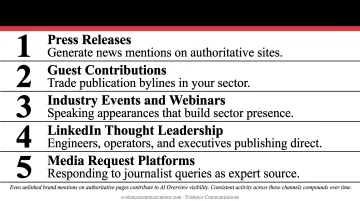
Even unlinked brand mentions on authoritative pages contribute to AI Overview visibility. Google builds its understanding of your brand from the full picture of what exists about you across the open web, which means consistent activity across these channels compounds over time.
Technical and Tracking Foundations
Technical Prerequisites
Google states that AI Overview supporting pages must be indexed and eligible for a standard search snippet — no special requirements beyond standard indexability. The practices that keep pages eligible:
- Ensure Googlebot can crawl and index your content (no accidental noindex tags)
- HTTPS security across the entire site
- Mobile optimization
- Core Web Vitals within Google's good thresholds: LCP ≤ 2.5 seconds, INP ≤ 200ms, CLS ≤ 0.1 (measured at the 75th percentile)
These are standard page-experience benchmarks, not special AI Overview requirements — but poor performance in any of them can remove otherwise strong content from traditional search eligibility, which is exactly what feeds AI citation eligibility.
Once the technical foundation is solid, the next step is knowing whether it's working.
Track AI Overview Performance
Monitor your AI Overview appearances using:
- Google Search Console — filter for AI-related SERP features to identify traffic from AI-cited pages
- SE Ranking's AI Visibility Tracker — filters Google AI Overviews and reports brand mentions, links, and citations
- Ahrefs Brand Radar — includes a Google AI Overviews database tracking mentions and cited sources
- Manual SERP checks — search your target keywords directly to see whether AI Overviews appear and who they cite
Track which keywords trigger AI Overviews where your brand appears, and monitor click-through rates from those pages. As you make changes, the pattern shifts will tell you what's actually moving the needle.
Frequently Asked Questions
What types of queries most commonly trigger Google AI Overviews?
Question-based, informational queries with 7+ words trigger AI Overviews most frequently — especially "how," "why," and "what" queries. Low keyword difficulty (median KD of 12 in Ahrefs' data) is a strong associated factor. High-commercial-intent queries trigger AI Overviews less often.
How is optimizing for AI Overviews different from traditional SEO?
Traditional organic rankings remain the foundation: AI Overviews primarily cite content already ranking in standard search. The additional layer involves content structure (direct answers, scannable formatting), topical cluster depth, off-site brand mentions, and demonstrable E-E-A-T signals beyond keyword placement.
Can a small or niche B2B company appear in Google's AI Overviews?
Yes. Niche, long-tail queries with lower competition are actually more likely to trigger AI Overviews — Ahrefs found 71% of AI Overview keywords had difficulty below 30. Fewer dominant sources compete in specific industrial niches, making them a genuine opportunity for smaller companies with well-structured, authoritative content.
How do I know if my content is being cited in an AI Overview?
Monitor Google Search Console for traffic signals from AI-featured pages and run manual SERP checks for target keywords. Purpose-built tools like SE Ranking's AI Overviews Tracker or Ahrefs Brand Radar both surface the specific keywords triggering AI Overviews that cite your domain.
Is a 75 SEO score enough to rank in AI Overviews?
There's no single score threshold. Google requires only that pages be indexed and eligible for a standard snippet. What matters is whether individual pages rank in the top 10 for target queries, demonstrate strong E-E-A-T signals, and are well-structured — page-level relevance and topical authority outweigh aggregate domain scores.