Introduction
B2B and industrial buyers are making decisions before sales teams ever know they're being evaluated. Research from the 2025 State of Marketing to Engineers found that 60% of the buying process for a significant work purchase occurs online before engineers speak with anyone at the company. Meanwhile, 61% of B2B buyers now prefer a rep-free buying experience altogether.
By the time a vendor gets the call, preferences are often already formed.
This is where the content marketing vs. thought leadership debate becomes a commercial question. Companies use both terms interchangeably, but they serve different roles in the modern buyer journey. Confusing them leads to misdirected investment and, for industrial and B2B companies especially, quiet exclusion from shortlists that form without any sales interaction.
The core argument: content marketing builds reach and supports the funnel. Thought leadership builds credibility and shapes buyer perception before the funnel begins. This article breaks down how each works, where they overlap, and how industrial and B2B companies can deploy both strategically to stay on shortlists they never knew they were on.
Key Takeaways
- Content marketing drives awareness, traffic, and funnel progression through consistent volume
- Thought leadership earns credibility and shapes buyer perception before the RFP exists
- 73% of decision-makers trust thought leadership more than conventional marketing materials
- Sequencing matters more than choosing — both approaches work together, in the right order
- Industrial buyers verify credibility independently — long before they contact your sales team
Content Marketing vs. Thought Leadership: A Quick Comparison
| Dimension | Content Marketing | Thought Leadership |
|---|---|---|
| Primary Purpose | Attract, educate, and convert buyers | Build credibility and shape market perception |
| Core Goal | Drive traffic, leads, and funnel progression | Establish trust and authority with decision-makers |
| Typical Formats | Blogs, SEO articles, email campaigns, videos, case studies | Research reports, bylined articles, speaking engagements, expert commentary |
| Volume Expectation | High — consistency and cadence matter | Low — quality and originality matter more |
| Time to Results | Weeks to months (search traffic, lead gen) | Months to years (reputation, authority, inbound quality) |
| Primary KPIs | Traffic, conversions, email signups, lead volume | Media mentions, inbound inquiry quality, RFP inclusion, share of industry conversation |
| Who Drives It | Brand voice and content team | Named individuals — executives, subject matter experts |
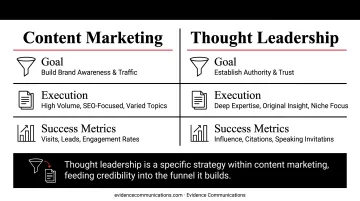
One important clarification: thought leadership is not a separate or competing discipline. It is a specific strategy that can live within a broader content marketing program. The goals, execution, and success metrics differ enough to manage separately — but in practice, thought leadership content feeds credibility into the funnel that content marketing builds.
What Is Content Marketing?
Content marketing is the practice of creating and distributing valuable, relevant content — blogs, videos, case studies, email campaigns, SEO articles, whitepapers — with the goal of attracting a defined audience, educating them, and guiding them through the buying process.
The Content Marketing Institute puts it plainly: creating and distributing consistent content to attract a clearly defined audience and drive profitable action.
How It Maps to the Buyer Journey
Content marketing is intentional and funnel-aware. Each stage serves a different job:
- Top of funnel: Answers the questions buyers are actively searching, building awareness through organic discovery
- Mid funnel: Educates and nurtures over time, building familiarity before buyers reach out
- Bottom of funnel: Delivers proof points, comparisons, and ROI data that close the confidence gap
According to CMI's 2025 B2B benchmark report, content marketing helped B2B marketers create brand awareness (87%), generate demand and leads (74%), and nurture audiences (62%). These are marketer-reported outcomes, so treat them as directional — but they reflect how broadly content marketing spans the commercial funnel.
Why Volume Matters Here
Content marketing runs on consistency. For industrial and B2B companies, this typically means maintaining a steady output of:
- Technical guides and product explainers
- Blog posts answering specific buyer search queries
- Case studies and application examples
- Email sequences for different buyer segments
The goal is coverage: showing up across every question your buyers ask during independent research, at every stage of their process.
What Is Thought Leadership?
Thought leadership is the recognition by a market that a person or organization holds genuine expertise, a distinct point of view, and the credibility to shape how others think about a problem or industry. It is earned through demonstrated insight — not declared through positioning statements.
The Four Elements That Distinguish It
Genuine thought leadership requires four things simultaneously:
- Innovation — a fresh or contrarian perspective that advances the conversation
- Education — informing without selling; the moment you push your services, you've written a marketing piece
- Credibility — backing claims with original data, research, or verified operational experience
- Visibility — ensuring those insights reach the right audiences through the right channels
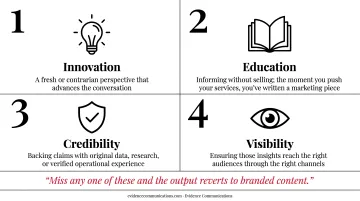
Miss any one of these and the output reverts to branded content — which is fine for content marketing purposes, but it won't build the authority that earns you a seat before the RFP exists.
The Formats That Carry It Best
For B2B and industrial audiences, the most credible thought leadership formats are:
- Data-backed research reports with original or synthesized insights
- Bylined articles in trade publications — not company blogs
- Speaking and panel participation at industry events where peers are paying attention
- Expert commentary in earned media
- LinkedIn content from identifiable subject matter experts, not brand accounts
The channel matters as much as the content. An insight published on a company blog carries far less weight than the same insight appearing in a trade publication or at an industry forum.
What Decision-Makers Actually Want
The 2024 Edelman-LinkedIn B2B Thought Leadership Impact Report found that 73% of decision-makers considered thought leadership a more trustworthy basis for assessing capabilities than marketing materials and product sheets. More than 75% said a piece of thought leadership prompted them to research a product or service they hadn't previously considered.
That's demand creation — happening before a buyer ever enters a recognized funnel. The channel credibility described above is precisely what makes that possible.
What Thought Leadership Is Not
This distinction matters in industrial and B2B markets, where buyers are technically sophisticated and skeptical of marketing language:
- Not a product announcement reframed as insight
- Not content that mentions your services every third paragraph
- Not generic industry news with your logo on it
Poor quality "thought leadership" doesn't just fail to build credibility — it actively damages it. Buyers in complex purchasing environments identify the difference immediately.
Key Differences That Matter for B2B and Industrial Companies
Depth Over Volume
Content marketing thrives on publishing cadence and breadth of topic coverage. Thought leadership prioritizes depth, originality, and the ability to challenge assumptions.
A single, well-researched piece that reframes an industry problem can generate more trust and pipeline influence than dozens of SEO articles. They're complementary — but they operate on entirely different productivity logic. Measuring thought leadership by content volume is the fastest way to produce high volumes of mediocre content.
Reactive vs. Proactive Demand
Content marketing responds to what buyers are searching for today — it is pulled by existing demand. Thought leadership creates demand by addressing problems buyers haven't fully articulated yet.
This distinction matters most in long-cycle B2B sales, where trust must be established long before an RFP exists.
In industrial purchasing — where procurement involves multiple stakeholders, long evaluation windows, and significant personal accountability — being a recognized and trusted voice before the first call determines whether you're on the shortlist at all.
Evidence Communications describes this precisely: "Buyers form their shortlist before sales ever gets involved." The implication for industrial companies is uncomfortable but important: if your organization lacks visible proof of capability, you may be excluded from consideration without ever knowing it happened.
Positioning Is Not the Same as Trust
Content marketing is permitted — expected, even — to position your product or service as the solution. Thought leadership never does this directly.
The 2025 Edelman-LinkedIn report found that 53% of both hidden buyers and target buyers said brand recognition matters less when thought leadership is high quality. Credibility, when established through genuine expertise, does more commercial work than brand familiarity. The mechanism is trust, not positioning.
KPIs Look Different
The metrics for each approach require distinct measurement frameworks:
Content marketing KPIs:
- Organic traffic and keyword rankings
- Lead magnet downloads and email signups
- Conversion rates by content type
- Pipeline attributed to content-assisted journeys
Thought leadership KPIs:
- Return visitors and repeat engagement from target accounts
- Media mentions and third-party references
- Inbound inquiry quality (were you called before the RFP?)
- RFP inclusion rates and shortlist frequency
- Whether key decision-makers reference your perspective in conversations
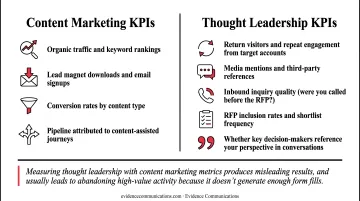
Measuring thought leadership with content marketing metrics produces misleading results — and usually leads to abandoning high-value activity because it doesn't generate enough form fills.
The AI Research Dimension
Buyers increasingly use AI tools — ChatGPT, Gemini, Claude, Perplexity — to research vendors before any human contact. According to Forrester's 2024 Buyers' Journey Survey, 89% of buyers used GenAI in at least one area of their purchasing process.
Content marketing ensures discoverability in those searches. Thought leadership ensures that what gets surfaced is credible and differentiated.
For industrial companies, this gap has a name: the "Proof Gap" — the distance between a company's real capabilities and what AI systems and buyers can actually find and verify online. Evidence Communications' AI Visibility Assessment (AVAS™) specifically identifies where companies are being excluded from AI-generated recommendations before the problem reaches the sales team.
Which Approach Works Best — and When?
Choose Content Marketing When:
- Building awareness at scale is the primary goal
- You're entering a new market or addressing search-driven demand
- You need to maintain brand visibility across a broad buyer base
- You're supporting a product launch with educational resources
- Buyers are actively searching for information you can provide
Choose Thought Leadership When:
- The goal is getting into the consideration set before the RFP exists
- You're competing in complex enterprise deals where credibility outweighs price
- Multiple stakeholders evaluate who to trust — not just what to buy
- Your buyers are sophisticated enough to immediately identify low-quality content
- You need to compete in markets where being unknown is a disqualifier
The Most Effective Approach: Integration
The choice isn't either/or. Mature B2B programs run both simultaneously: content marketing to maintain visibility and funnel flow, thought leadership to build the credibility that puts your company in the room when decisions are made.
CMI's 2024 B2B Content Marketing report found that 96% of B2B organizations use thought leadership — but only 37% have more than 5% of internal experts actively participating. That gap explains why most corporate thought leadership falls flat: the activity exists, but the genuine expertise isn't consistently making it into the content.
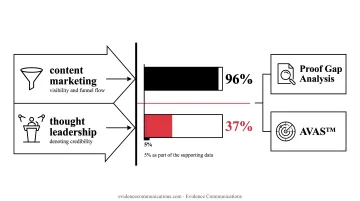
For industrial and B2B companies navigating this challenge, we work at the intersection of both: identifying where proof deficits exist, translating operational capability into visible market evidence, and building the commercial infrastructure that ensures buyers encounter credibility before they ever make contact.
Our Proof Gap Analysis and AVAS™ diagnostic tools surface exactly where companies are being excluded from buyer consideration — and what needs to be fixed first.
Conclusion
Neither content marketing nor thought leadership is universally better. Content marketing builds the commercial infrastructure for reach and conversion. Thought leadership builds the credibility that ensures your company is trusted and preferred when the decision moment arrives.
For industrial and B2B companies, both are necessary — but the sequencing and investment should reflect where the buyer journey actually starts.
Modern B2B buyers form opinions through AI tools, independent research, and peer networks long before any sales conversation begins. So the question isn't "should we do content marketing or thought leadership?" It's more immediate than that: when your buyers are researching you right now, what are they finding — and does it give them the confidence to call?
Frequently Asked Questions
Is thought leadership the same as content marketing?
No. Content marketing encompasses all content a company produces to attract and convert buyers — but thought leadership is a specific subset focused on influencing how decision-makers think. Content marketing drives traffic and funnel progression; thought leadership shapes perception before the funnel begins.
Can B2B and industrial companies pursue both simultaneously?
Yes — most mature B2B programs include both. Content marketing maintains visibility and funnel flow while thought leadership runs in parallel to strengthen credibility with high-value decision-makers. The key is coordinating both around a consistent point of view rather than running them as disconnected programs.
How much original research does thought leadership actually require?
Original research strengthens thought leadership by providing data only your organization holds, but it isn't strictly required. What is required is a genuine point of view that adds something new, whether from operational experience, proprietary data, or novel synthesis of what's already known.
What content formats work best as thought leadership for industrial companies?
For industrial audiences, the most credible formats are data-backed research reports, expert bylined articles in trade publications, case studies framed around business outcomes, and speaking at industry events. These put real expertise in front of the peers and buyers already paying attention.
How do I know if my company is ready to invest in thought leadership?
Readiness is less about company size and more about having genuine expertise worth sharing. If your team regularly solves problems that buyers haven't figured out yet, you already have the raw material. The question is whether that expertise is currently visible to the market or still invisible inside your organization.