Introduction
Decades of operational excellence used to be enough. Build a reliable product, develop strong supplier relationships, and let your sales team do the rest. That model worked — until buyers stopped waiting for sales teams to educate them.
Today, 92% of B2B buyers already have a preferred vendor shortlist before the buying process formally begins, according to Google and Bain research. Procurement teams and engineers are using AI tools — ChatGPT, Claude, Perplexity, Google AI Overviews — to research, compare, and shortlist suppliers on their own.
If a manufacturer's capability isn't visible and credible in those channels, they never get the call.
This guide covers what makes B2B manufacturing marketing structurally different, how industrial buyers have changed the rules, how to build a strategy that works, and how to measure commercial impact — not just activity.
Key Takeaways:
- Industrial buying committees average 13 people — marketing must reach all of them, not just procurement
- Most buyers shortlist suppliers before engaging sales, making pre-sales visibility non-negotiable
- The 95/5 rule: only ~5% of your market is actively buying — the other 95% are forming opinions now
- Technical depth and verifiable proof outperform volume-based content strategies
- Pipeline influence and sales velocity replace activity metrics as the measurements that matter
What Makes B2B Manufacturing Marketing Different
Buying Committees, Not Individual Buyers
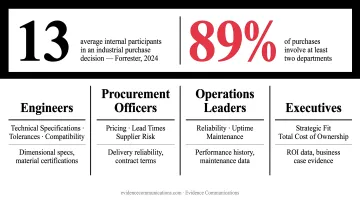
A consumer purchase involves one person making a decision, often quickly. An industrial purchase involves a committee — and Forrester's 2024 research puts the average at 13 internal participants, with 89% of purchases involving at least two departments.
That committee typically includes:
- Engineers evaluating technical specifications, tolerances, and compatibility
- Procurement officers focused on pricing, lead times, and supplier risk
- Operations leaders concerned with reliability, uptime, and maintenance
- Executives weighing strategic fit and total cost of ownership
Each stakeholder needs different proof. An engineer wants dimensional specs and material certifications. A CFO wants ROI data. A procurement lead wants delivery reliability and contract terms. Marketing that speaks only to one of these audiences leaves the others without a reason to advocate for you internally.
Long Cycles Demand Early Credibility
High-value manufacturing purchases don't happen fast. Forrester reports that 86% of B2B purchases stall and 81% of buyers are dissatisfied with the vendor they ultimately choose — both figures pointing to friction in a process where trust must be established long before a formal RFQ appears.
This reality shifts marketing's function. In long-cycle environments, credibility can't be built during the sales conversation. It must exist in the channels buyers research before they identify themselves. By the time a prospect contacts your sales team, they've already formed a strong impression of whether you're a credible option.
Technical Precision Over Emotional Persuasion
Consumer marketing runs on emotion, aspiration, and entertainment. Industrial buyers aren't persuaded that way — they verify. B2B manufacturing marketing earns trust through specificity, demonstrated proof, and technical substance.
Industrial buyers are domain experts. They can instantly detect:
- Vague capability claims without supporting data
- Generic case studies that could apply to any company
- Marketing language where engineering detail should be
This raises the standard for every piece of content a manufacturer publishes. Vague positioning doesn't just fail to persuade — it signals that the company doesn't understand its own buyers.
How the Modern Industrial Buyer Has Changed the Rules
Buyers Are Shortlisting Before Talking to Sales
The familiar premise that buyers complete most of their journey before contacting a vendor is now well-documented behavior, even if the exact percentage is debated. What's clear from current research: 61% of B2B buyers prefer an overall rep-free buying experience, and 73% actively avoid suppliers who send irrelevant outreach, per Gartner's 2025 survey of 632 B2B buyers.
A finding from Google and Bain sharpens this further: 92% of B2B buyers have a shortlist before the buying process officially starts. The journey isn't linear — preference forms early, through independent research, long before any contact form gets submitted. By the time a prospect reaches out, the decision is already leaning somewhere.
Forrester's 2025 analysis reports that 95% of B2B buyers plan to use generative AI in at least one area of a future purchase, and more than half believe AI led them to consider more or different vendors than they would have found otherwise.
A manufacturer can be ruled in or ruled out before a single human conversation occurs. If ChatGPT or Google AI Overviews can surface verifiable proof of your capabilities, you're on the list. If that proof doesn't exist in AI-readable formats across the open web, you're not — no matter what your actual performance looks like.
The 95/5 Rule and Always-On Visibility
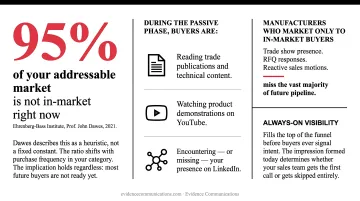
Professor John Dawes of the Ehrenberg-Bass Institute formulated the 95/5 rule in 2021: up to 95% of your addressable market is not in-market at any given time. Dawes describes it as a heuristic rather than a fixed constant — the actual ratio depends on how frequently companies in your category replace suppliers or make purchases.
The implication holds regardless of the precise number: most buyers who will eventually call you aren't ready yet. But they're forming impressions. During this passive phase, they're typically:
- Reading trade publications and technical content relevant to their category
- Watching product demonstrations and application videos on YouTube
- Encountering — or missing — your presence on LinkedIn
The impression they form today determines whether your sales team gets the first call in six months or gets skipped entirely.
Manufacturers who only market to in-market buyers — through trade show presence, RFQ responses, and reactive sales motions — miss the vast majority of future pipeline. Always-on visibility is the mechanism that fills the top of the funnel before buyers ever signal intent.
Building a B2B Manufacturing Marketing Strategy
Define Your Ideal Customer Profile and Buyer Personas
Before any marketing activity begins, two definitions must exist:
Ideal Customer Profile (ICP): The type of company that benefits most from what you offer, defined by industry, company size, buying trigger, geography, and strategic fit. This is a company-level definition.
Buyer Personas: The individual decision-makers within those companies — their goals, pain points, technical background, and how they prefer to gather information. An ICP tells you which companies to target. Personas tell you what to say and where.
Most manufacturers skip this step or treat it as a one-time exercise. The result is marketing that's vaguely aimed at "industrial companies" rather than precisely aimed at the engineers and procurement leads who actually sign off on decisions.
Competitive research sharpens both. Analyze what competitors claim in their marketing versus where their proof falls short. Three gaps appear repeatedly — and each is a differentiation opportunity:
- Generic claims with no specifics or supporting data
- Testimonials without measurable outcomes
- Capability pages with no real application examples
Where competitors are vague, you can be specific.
Define Your Value Proposition and Brand Position
A value proposition for manufacturers must move beyond product features. Features describe what you make. A value proposition articulates how you specifically reduce operational risk, improve quality outcomes, or solve a business problem that competitors cannot credibly claim to solve.
The Value Proposition Canvas offers a useful structure: map your offer's benefits against the specific gains your buyers want and the pains they're trying to avoid.
For industrial buyers, the pain side is often personal — downtime, safety exposure, warranty risk, missed output, and the accountability of having signed off on a wrong decision.
Consistency across your website, LinkedIn, proposals, and trade content matters more than most manufacturers recognize. Gartner found that 69% of buyers encountered inconsistencies between a supplier's website and its sellers. Every disconnected message erodes the trust you're trying to build. Each touchpoint either builds the case or undermines it — there's no neutral ground.
That consistency doesn't happen without sales and marketing alignment. When both teams share definitions of the ideal customer, a common content approach, and mutual KPIs, marketing stops being a support function and starts generating qualified pipeline — especially in complex, consultative sales environments.
The Marketing Channels That Drive Results for B2B Manufacturers
Content Marketing and Search Visibility (SEO and AEO)
CMI's 2025 B2B content marketing research surveyed 980 B2B marketers and found:
- 87% reported content built brand awareness
- 74% said it generated demand or leads
- 49% said it generated sales or revenue
For manufacturers, content that earns results shares a common characteristic: technical depth. Case studies that document specific installations, process explainers grounded in engineering reality, capability demonstrations with real operating conditions — these earn credibility with buyers who are domain experts. Volume without substance earns nothing.
The search landscape is shifting in ways that demand a strategic adjustment. Traditional SEO optimizes for rankings and clicks. Answer Engine Optimization (AEO) optimizes for appearing in AI-generated summaries — the responses ChatGPT, Claude, and Google AI Overviews generate when buyers ask supplier-evaluation questions. This requires:
- Structured, authoritative content AI platforms can parse and cite
- FAQ and knowledge content in formats AI models commonly reference
- Topically comprehensive coverage of your core capability areas
- Industry-specific pages that increase relevance for vertical-specific queries
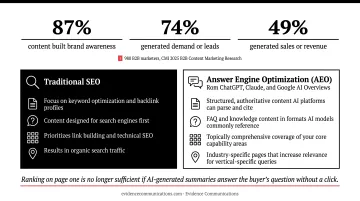
Ranking on page one is no longer sufficient if AI-generated summaries answer the buyer's question without a click.
LinkedIn and Social Proof
85% of B2B marketers in CMI's 2025 study rated LinkedIn as the social platform delivering the best value — more than triple YouTube's 22% and Facebook's 28%. For manufacturers, this tracks: the engineers, procurement leads, operations directors, and executives who make or influence purchasing decisions are active there.
The content approaches that build credibility on LinkedIn for industrial companies:
- Process and capability demonstrations — showing equipment operating in real environments, not render images or studio footage
- Technical insights from engineers and operators — proof from the people who actually work with the product daily carries more weight than corporate posts
- Customer installations and application footage — verifiable evidence of how the product performs for real customers in real conditions
- Employee advocacy — content from individual team members reaches audiences more authentically than brand accounts and triggers peer-level credibility with buyers doing independent validation
What this means in practice: buyers on LinkedIn are already evaluating suppliers. Content that shows real evidence moves them forward; content that sells pushes them away.
Website and Digital Experience
A manufacturer's website has one job in the modern buyer's journey: remove doubt. Buyers researching suppliers at 10pm don't have a sales rep to call. If the website can't answer their evaluation questions — what you do, how it works, who you've done it for, under what conditions — they move on.
The specific elements that convert research-mode visitors:
- Capability and service pages that answer buyer questions, not just describe product categories
- Case studies structured to be verifiable and specific enough that buyers can share them internally
- Technical content — specs, certifications, standards compliance, application parameters
- Industry-specific pages that speak to the buyer's vertical rather than generic positioning
- AI-first information architecture — structured for how AI platforms parse and recommend content, not just how humans navigate it
Email and Account-Based Marketing (ABM)
These two channels complete the stack for long-cycle nurturing — the kind of buying process where months pass between a supplier's first impression and the RFQ.
Email maintains visibility during the 95% non-active phase, keeping a manufacturer present in a buyer's shortlist when budget cycles and project timelines shift. ABM targets high-value accounts with personalized content designed to accelerate specific opportunities — particularly effective when sales and marketing are aligned on which accounts matter most and what proof those accounts need to move forward.
Translating Operational Capability Into Buyer Confidence
Most industrial manufacturers face the same structural problem: their operational capability exists inside the company — in the expertise of their engineers, in the results delivered for long-term customers, in certifications earned and standards met — but none of it is visible where buyers research.
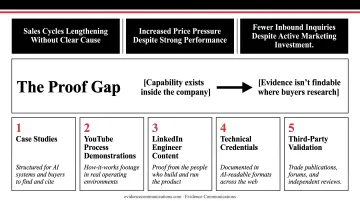
This is the Proof Gap: capable manufacturers being excluded from buyer consideration before sales ever gets involved, not because of product weakness, but because the evidence of that strength isn't findable online.
The gap typically reveals itself through three symptoms:
- Sales cycles lengthening without clear cause
- Increased price pressure despite strong performance
- Fewer inbound inquiries despite active marketing investment
What evidence-based marketing looks like in practice is building a deliberate system that makes real capability verifiable across the channels buyers actually use. This means:
- Customer outcomes structured as case studies AI systems and buyers can find and cite
- Process demonstrations on YouTube — "how it works" footage in real operating environments
- Engineer and operator content on LinkedIn — proof from the people who build and run the product
- Technical credentials documented in AI-readable formats across the web
- Third-party validation through trade publications, industry forums, and independent reviews
Evidence Communications helps industrial and B2B manufacturers build this kind of commercial infrastructure — diagnosing where proof deficits exist through tools like the proprietary AI Visibility Assessment (AVAS™), then distributing real-world proof across LinkedIn, YouTube, and web channels in formats AI tools can surface and buyers can independently verify.
This is especially critical for manufacturers in commercial transition: entering new markets, recovering from a period of sales-led growth with no marketing foundation, or establishing a direct enterprise presence after years of operating through channel intermediaries.
In these situations, the absence of visible proof removes companies from buyer consideration before sales has any opportunity to engage.
Measuring What Matters in B2B Manufacturing Marketing
Activity metrics — blog posts published, social impressions, emails sent — measure effort, not results. Forrester's Marketing Survey 2024 found that 64% of B2B marketing leaders don't trust their measurement for decisions, and 59% of CMO dashboards still track sourcing metrics that assign implausible sole credit in a multi-touch buying process.
The shift is toward commercial impact metrics that track buying-group opportunity progress:
| Metric | What It Measures |
|---|---|
| Pipeline influence | Qualified sales conversations touched by marketing |
| Lead quality by ICP fit | Whether marketing attracts the right companies |
| Stage conversion rate | How opportunities progress through the funnel |
| Sales cycle velocity | Whether marketing is accelerating or slowing deals |
| Content engagement from target accounts | Whether the right people are paying attention |
Forrester's B2B Revenue Waterfall offers a practical framework — moving from individual lead tracking to buying-group opportunity stages: Detected, Engaged, Prioritized, Qualified, Pipeline, and Closed. For manufacturers, this matters because industrial purchasing runs through committees, not individuals — and most traditional lead models miss that entirely.
Two leading indicators deserve explicit tracking alongside conversion metrics:
- AI platform visibility — how often and how accurately the company appears in AI-generated supplier research
- Share of voice in key topic areas — whether the manufacturer is building presence in the questions buyers are actually asking
Both are early warning signals. They show whether marketing is earning credibility in the channels buyers use to build shortlists — often weeks or months before that credibility shows up in pipeline numbers.
Frequently Asked Questions
What are the 4 types of B2B marketing?
The four commonly referenced types are product marketing, service marketing, content/inbound marketing, and account-based marketing. B2B manufacturing companies typically draw on all four depending on their growth stage and commercial objectives.
What are the 7 P's of B2B marketing?
The 7 P's — Product, Price, Place, Promotion, People, Process, and Physical Evidence — are defined by the Chartered Institute of Marketing. For B2B manufacturers, the final three matter most: People (team expertise), Process (consistency of delivery), and Physical Evidence (certifications, case studies, demonstrations). These are where industrial purchasing trust is built or lost.
What is the 95/5 rule in B2B marketing?
Developed by Professor John Dawes of the Ehrenberg-Bass Institute, the rule holds that up to 95% of your addressable market is not actively buying at any given time. The practical implication for manufacturers: buyers who will call in 12 months are forming impressions today — making always-on visibility essential for future pipeline, not just current demand.
What is the 3-3-3 rule in B2B sales?
No single authoritative or standardized definition of the 3-3-3 rule exists across established sales or marketing bodies — the term appears across coaching and vendor blogs with varying prescriptions. The general concept involves structured outreach across multiple touches and channels when a prospect shows intent. Its effectiveness depends heavily on timing and the channel mix used to reach the prospect.
What makes B2B manufacturing marketing different from B2C marketing?
The key structural differences: multiple decision-makers versus a single consumer, long sales cycles versus short-cycle purchases, technical proof and specification depth versus emotional appeal, and high-value contracts requiring credibility-building before any conversation begins. B2B manufacturing marketing must address a committee with competing priorities while building trust across months, not minutes.
How does AI affect how industrial buyers research and select suppliers?
AI tools like ChatGPT, Claude, and Google AI Overviews are actively used by procurement teams and engineers to research and shortlist suppliers. A manufacturer's digital presence — case studies, capability pages, third-party validation — determines whether AI systems surface and recommend them. Companies can be included or excluded from a buyer's shortlist entirely through AI-mediated research, before any sales rep is contacted.