Introduction
B2B buyers — including procurement managers at precision machining shops, steel mills, and contract manufacturers — are increasingly opening ChatGPT or Perplexity before they open a browser tab. They're asking questions like "best suppliers of aerospace-grade CNC components" and receiving synthesized answers that name specific companies. If your company isn't in those answers, you don't make the shortlist. The RFQ goes out without you.
According to a TrustRadius survey of 350 B2B buyers, AI tools are now a primary research channel:
- 32% used generative AI chatbots to discover vendors
- 24% used AI more than traditional search when evaluating suppliers
- 40% used both AI and traditional search equally
That's most of your buyers running their own research before a sales rep ever enters the picture.
This guide is specifically about SEO for AI — optimizing your content so AI-powered search engines can find, trust, and cite you. This is distinct from "AI for SEO" (using ChatGPT to write blog posts or do keyword research). By the end, you'll know exactly what to fix, what to build, and what to stop doing.
Key Takeaways
- AI search engines cite sources rather than list links — your goal is to become one of those cited sources
- Traditional SEO remains the foundation; if AI can't find your content in an index, it can't cite you
- Visibility is measured by share of voice across many prompts, not a fixed ranking position
- Unknowingly blocking AI crawlers via robots.txt or Cloudflare is the most common — and most fixable — mistake
- For industrial and B2B companies, buyers are building shortlists through AI before the RFQ ever goes out
What Is SEO for AI?
SEO for AI — also called Generative Engine Optimization (GEO), Answer Engine Optimization (AEO), or Large Language Model Optimization (LLMO) — refers to optimizing your website and content so it gets discovered, cited, and recommended by AI-powered search engines. That includes ChatGPT, Google AI Overviews, Perplexity, Gemini, and Copilot when users ask questions related to your industry or solutions.
The terminology can get confusing. GEO, AEO, and LLMO all describe facets of the same challenge. AI SEO is the umbrella term.
What AI SEO Is NOT
This guide is not about using AI tools to produce content faster. "AI for SEO" — having ChatGPT write your blog posts or generate keyword lists — is a separate practice entirely.
The distinction matters:
- AI for SEO: Using AI tools to create content, generate keywords, or speed up production
- SEO for AI: Making your existing content visible inside AI-generated answers
SEO for AI means making your content visible inside AI-generated answers. The direction matters: you're not using AI to do SEO, you're making your content usable by AI.
For industrial and B2B companies, this distinction has real commercial consequences. AI tools don't create credibility. They surface and reflect what already exists across the open web.
If your proof isn't there in a findable, structured form, no amount of AI-assisted content production will get you into the answers your buyers are reading.
Why AI Search Visibility Is Critical for B2B and Industrial Companies
The Scale of the Shift
The numbers are large and moving fast. Google reported AI Overviews now reach more than 1.5 billion users across 200+ countries, and in the US and India, AI Overviews drove more than 10% growth in Google usage for the query types where they appear. Perplexity handled 780 million queries in May 2025, growing more than 20% month over month.
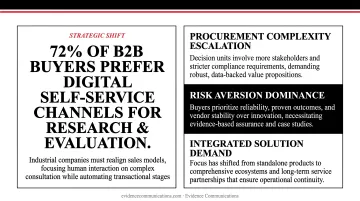
For complex, high-consideration B2B purchases — the kind where a procurement manager at a steel mill is evaluating suppliers before an RFQ — this shift is accelerating fastest. Buyers spending significant time in independent research are exactly the ones turning to AI tools.
How the B2B Buying Journey Changed
Industrial buyers now enter AI chat tools with highly specific questions:
- "Best contract manufacturers for aerospace aluminum components"
- "Top suppliers of [industrial component] with ISO 9001 certification"
- "Which CNC machining shops have experience with medical device tolerances"
The AI generates a synthesized answer naming specific companies. If your company isn't cited, you don't exist in that buyer's shortlist — before the sales conversation ever starts.
Evidence Communications identifies three questions buyers answer on their own before ever contacting a supplier:
- What does this company actually do?
- How does it work in real operating environments?
- Can I defend this choice internally?
If your content can't answer those three questions, buyers move on — and AI systems move on with them.
The Zero-Click Reality
Pew Research Center analyzed 68,879 Google searches and found that when an AI summary appeared, users clicked a conventional result in only 8% of visits (versus 15% without a summary). Users ended their browsing session after 26% of pages with a summary, compared to 16% without one.
The practical implication: being cited in an AI answer is now the visibility event. You may not get the click, but you get the brand impression — and, more importantly, you get included in the mental shortlist the buyer is forming.
The Compounding Risk for Industrial Companies
Many industrial manufacturers in the $2M–$100M revenue range have the profile that makes AI invisibility most likely:
- Thin digital presences with minimal indexed content
- Websites designed for traditional marketing, not AI information architecture
- Product specs and capabilities buried in PDFs, dynamic tabs, or JavaScript-rendered pages
- No case studies, demonstrations, or third-party validation distributed across the open web
The Proof Gap — a term from Evidence Communications' proprietary AI Visibility Assessment (AVAS™) — describes exactly this disconnect: the gap between a company's real operational capability and what AI systems can actually find and cite. A precision machining shop with decades of aerospace experience may be invisible to AI simply because they never documented that experience online.
The consequences are concrete: longer sales cycles, price pressure, and — for PE-backed industrial companies — compressed acquisition multiples. Buyer confidence forms with competitors whose proof is visible, regardless of who actually has the stronger capability.
How AI Search Engines Actually Work
Synthesis, Not Rankings
AI search engines don't show a list of links. They read dozens of web pages, synthesize the information, and generate a single answer — sometimes citing sources, sometimes not. The goal shifts from "ranking on page one" to "being a trusted source AI chooses to cite."
Fan-Out Querying
When a user asks a complex question, the AI doesn't search for the full prompt as written. It breaks the query into shorter sub-queries and searches for each separately. Google officially confirms this fan-out retrieval approach for AI Overviews.
The implication for industrial companies: your capability page titled "CNC Machining" won't rank for the sub-query "CNC machining tolerances for aerospace components" unless you've written specifically to that fragment. Generic capability pages fail in AI search even when they pass traditional SEO audits.
Where Each AI Platform Pulls Its Data
| Platform | How It Sources Content |
|---|---|
| Google AI Overviews / AI Mode | Google's own index; uses fan-out to issue multiple sub-queries |
| Gemini | Optional grounding with Google Search; returns citations and generated search queries |
| ChatGPT Search | Third-party search providers + direct partner content; OAI-SearchBot for search inclusion |
| Perplexity | Direct web crawl via PerplexityBot; cites sources transparently |
| Microsoft Copilot | Grounded on Bing results; officially confirmed |
| Meta AI | Bing integration confirmed in 2023; later reporting shows Google results incorporated too |
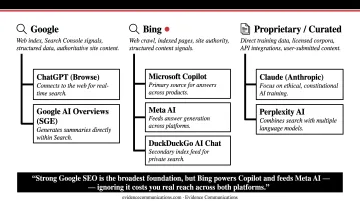
Don't ignore Bing. Strong Google SEO is the broadest foundation, but Bing powers Copilot and feeds Meta AI — ignoring it costs you real reach across both platforms.
Why AI Results Change Every Time
AI search is non-deterministic. The same question asked five times can generate five different answers. An Ahrefs study of 43,000 keywords found AI Overviews had a 70% pointwise change rate, refreshed on average every 2.15 days. When changes occurred, 45.5% of cited URLs were replaced entirely.
This is why share of voice is the correct metric for AI SEO — measuring how often your brand appears across a broad set of relevant prompts over time, not whether you "rank" for a specific query on a specific day.
How to Optimize for AI Search in 2026
Ensure AI Bots Can Actually Read Your Content
This is the single most impactful and most frequently missed step.
Many websites inadvertently block AI crawlers through their robots.txt file, CDN settings, or server configurations. Effective July 1, 2025, Cloudflare changed its defaults to block AI crawlers for every newly onboarded domain unless the owner explicitly grants permission — and more than 1 million existing customers had already enabled the one-click AI bot block before that change.
The AI user agents you need to explicitly allow:
GPTBot— OpenAI model trainingOAI-SearchBot— ChatGPT Search inclusion (separate from GPTBot)ChatGPT-User— user-triggered retrievalPerplexityBot— Perplexity indexingPerplexity-User— Perplexity user requestsClaudeBot/Claude-SearchBot— Anthropic crawling and searchGoogle-Extended— product token for some Gemini grounding uses
Check your robots.txt file and your CDN settings today. Blocking training crawlers like GPTBot does not automatically block search crawlers like OAI-SearchBot — these are distinct user agents with different functions.
The JavaScript problem: AI crawlers read raw HTML and cannot execute JavaScript. Content loaded dynamically — hidden behind tabs, accordions, or interactive sliders — is completely invisible to AI bots. For industrial companies, this often means product specifications, technical capability comparisons, and pricing tiers are hidden from the AI systems your buyers are using. The fix: ensure all critical content exists in plain HTML, not only inside dynamic elements.
Structure Content So AI Can Extract It
AI systems pull specific passages, not entire articles. The principle is extractable content: writing so that individual sections can be lifted and cited without context from surrounding text.
Practical structural rules:
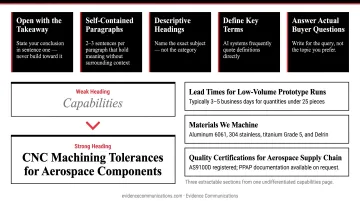
- Open each section with its key takeaway — don't build to a conclusion
- Write short, self-contained paragraphs — 2-3 sentences that make sense in isolation
- Use specific, descriptive headings — "CNC Machining Tolerances for Aerospace Components" performs better than "Capabilities"
- Define key terms explicitly — AI systems frequently quote definitions directly
- Write answers to questions your buyers actually ask — not just topics you want to cover
The sub-query targeting strategy: identify the broad questions buyers ask, then break them into the shorter fragments an AI would search for separately. Create content with headings that directly address each fragment. For an industrial contract manufacturer, that means separate sections for "lead times for low-volume prototype runs," "materials we machine," and "quality certifications for aerospace supply chain." A single undifferentiated "capabilities" page answers none of them.
Demonstrate Credibility and Build Brand Authority
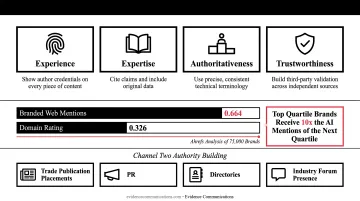
AI systems prioritize content from sources they can verify as credible. The same E-E-A-T principles (Experience, Expertise, Authoritativeness, Trustworthiness) that govern Google rankings apply directly to AI citation decisions.
For industrial companies, this means:
- Show author credentials on every piece of content — AI needs to verify who wrote it
- Cite claims and include original data — AI systems favor verifiable sources
- Use precise, consistent technical terminology that matches how buyers in your industry search
- Build third-party validation across independent sources: trade publications, industry forums, customer references
An Ahrefs analysis of 75,000 brands found branded web mentions had a 0.664 Spearman correlation with AI Overview visibility — stronger than domain rating (0.326). Brands in the top quartile for web mentions received roughly 10x the AI mentions of the next quartile.
Unlinked brand mentions — in trade publications, Reddit threads, industry forums, or third-party articles that AI already cites — build AI share of voice. This differs from traditional link-building. The objective isn't link equity; it's independent verification.
When AI systems see the same company mentioned consistently across independent sources, they're more likely to recommend it. At Evidence Communications, we call this Channel Two Authority Building: trade publication placements, PR, directories, and industry forum presence designed specifically to strengthen AI trust signals.
Keep Content Fresh and Implement Technical Quick Wins
Content freshness matters. An Ahrefs analysis of 16.9 million cited URLs found AI-cited content averaged 1,064 days old versus 1,432 days for organic results — a meaningful freshness difference. More recent content is relatively favored.
Treat your content as a living document:
- Update statistics, examples, and "last updated" dates on a regular cadence
- Add new case studies and customer applications as they develop
- Revise technical pages when specifications or capabilities change
Two technical quick wins:
Schema markup — Article, Organization, FAQPage, and Person schema give AI systems explicit context about content type. Note that HowTo rich results were deprecated in 2023, and FAQ rich results have been restricted. Schema is unlikely to be a major citation booster on its own (a controlled study of 1,885 pages found minimal citation uplift after adding JSON-LD), but it adds useful signal at low cost.
llms.txt file — An emerging community standard: a simple markdown file at your domain root that helps AI systems understand your site's content and structure. OpenAI and Perplexity publish their own llms.txt-style documentation indexes. No major AI provider has officially announced support for publisher-provided llms.txt files in their search crawlers, but adoption is growing and implementation cost is minimal.
AI SEO vs. Traditional SEO: What Changes and What Stays the Same
What Stays the Same
Traditional SEO remains the foundation:
- High-quality, comprehensive content still wins citations
- Backlinks, domain authority, and E-E-A-T signals still matter
- Technical health — site speed, mobile responsiveness, crawlability — is non-negotiable
- Strong Google SEO is the foundation for visibility across most AI platforms, since most AI tools pull from indexed search results
AI SEO builds on this foundation — it doesn't replace it.
What Changes
| Dimension | Traditional SEO | AI SEO |
|---|---|---|
| Success metric | Ranking position | Share of voice across prompts |
| Keyword focus | Keyword density | Semantic depth, concept coverage |
| Visibility type | Click-through traffic | Brand impressions from citations |
| Scope | Primarily Google | Google + Bing + direct crawlers |
| Result stability | Fixed (for a period) | Non-deterministic; changes constantly |
A Practical Frame for B2B Teams
The table above has a practical implication most B2B teams haven't acted on yet: AI systems reward documented specificity, not advertising spend. Companies with authoritative, specific content about their capabilities are better positioned than those with thin or generic websites — regardless of how much they've spent on backlinks.
For industrial manufacturers, this is where Evidence Communications frames the strategic opportunity: companies that have invested in documenting real-world proof — case studies, engineering explanations, customer applications — have a compounding advantage. Those that haven't are losing shortlist consideration before a sales conversation ever starts — with no traffic drop or ranking change to signal it.
Common AI SEO Mistakes B2B and Industrial Companies Make
1. Blocking AI crawlers unknowingly
This is the most common and immediately fixable mistake. Check your robots.txt today for blocks against:
- GPTBot and OAI-SearchBot (OpenAI)
- PerplexityBot
- ClaudeBot and Claude-SearchBot
- ChatGPT-User
Also review Cloudflare settings — the new default blocks AI crawlers for all newly onboarded domains. Cloudflare found that by May 2025, 14% of top domains had deployed robots.txt rules to manage AI crawlers, while GPTBot traffic had grown 305% year over year.
2. Hiding critical content behind JavaScript
Industrial companies frequently put their most valuable content — technical specifications, product configurators, capability comparisons, tolerance tables — inside dynamic elements that AI bots simply cannot read. Ensure all key content exists in the raw HTML, not only inside JavaScript-rendered components.
3. Treating the website as a static brochure
Thin, rarely-updated websites with generic capability claims are precisely the digital profile that makes industrial companies invisible in AI search. AI tools surface and reflect what exists across the open web — if your proof isn't there, current, and distributed across multiple channels, you won't appear in the answers your buyers are reading.
A static brochure website carries the entire burden of your digital presence with content that makes claims rather than providing verifiable proof. A living knowledge resource creates and distributes proof continuously — case studies, engineering explanations, customer applications, trade publication coverage — so AI systems have consistent, independently verified evidence to cite.
Companies that act like publishers gain compounding AI visibility. Those that don't are slowly removed from buyer consideration without knowing it's happening.
Frequently Asked Questions
How do you do SEO for AI?
SEO for AI involves four core actions: ensuring AI crawlers can access your site (check robots.txt and CDN settings), structuring content so specific passages are easy to extract and cite, building topical authority through credible and current content, and earning brand mentions across sources that AI systems already trust. All four must work in concert — weakness in any one limits the others.
Can ChatGPT do SEO?
ChatGPT can assist with traditional SEO tasks like keyword research, content drafting, and meta descriptions (that's "AI for SEO"). Optimizing your content to appear inside ChatGPT's answers ("SEO for AI") requires a separate set of strategies focused on content quality, crawlability, and third-party authority building.
What is the difference between traditional SEO and AI SEO?
Traditional SEO targets keyword rankings in a results list and measures rank position and click-through rate. AI SEO targets citations in AI-generated answers and measures share of voice across a set of relevant prompts. Both rely on the same technical and content quality foundations : AI SEO builds on top of traditional SEO rather than replacing it.
Does traditional SEO still matter for AI search?
Traditional SEO is the foundation of AI SEO. Most AI platforms (including Google AI Overviews and ChatGPT Search ) pull from indexed search results. If your content doesn't rank and isn't indexed, AI tools can't find it either. Getting the technical and content fundamentals right for Google remains the single most broadly effective investment.
What is "share of voice" in AI search?
Share of voice in AI search measures how frequently your brand appears in AI-generated responses across a broad range of relevant prompts. Because AI results are non-deterministic, there is no fixed "position" to track — visibility is gauged by sampling responses to many relevant queries over time.
How do I know if AI bots can crawl my website?
Start with your robots.txt file: look for Disallow rules targeting AI user agents such as GPTBot, OAI-SearchBot, PerplexityBot, ClaudeBot, and ChatGPT-User. Also review your CDN settings, since Cloudflare now blocks AI bots by default for newly onboarded domains. Confirm actual crawler access by checking your server logs for AI bot activity.