Introduction
Picture this: a precision components manufacturer with 20 years of documented performance, a tight client retention record, and certifications that competitors can't match. Their sales team is capable. Their product is legitimate. Yet they're losing deals — not in the room, but before the room ever happens.
Buyers researched five vendors, shortlisted two, and made outreach. This company wasn't one of them.
According to 6sense's 2024 B2B Buyer Experience Report, buyers complete 69% of the purchasing journey before first contacting a vendor — and 81% have already selected a preferred supplier by that point. The competitive battle is largely settled before sales picks up the phone.
That means demand generation isn't about reaching buyers with campaigns anymore. It's about being visible and credible while buyers are already deciding — before they've called anyone.
This guide covers what a demand generation agency actually does, how to evaluate the right partner for industrial and B2B companies, and which mistakes cost companies qualified pipeline before a conversation ever starts.
Key Takeaways
- B2B buyers complete 69% of their journey before contacting a vendor, meaning most shortlisting happens before sales is ever involved
- Demand generation builds buying intent upstream; lead generation captures contacts after intent already exists
- Industrial buyers are using AI tools to research and filter vendors before any sales interaction
- The right agency is accountable to pipeline value and qualified opportunities — not MQL volume
- Proof infrastructure must exist before campaigns can create buyer confidence
What Is a Demand Generation Agency?
A demand generation agency builds the full system to create buyer awareness, establish credibility, and connect marketing activity to qualified pipeline. That's a different mandate entirely from capturing contact information and calling it a lead.
A real demand generation partner takes responsibility for the full buyer journey — from the moment a prospect first encounters your category through to a sales-ready conversation. The right agency measures success in pipeline value and qualified opportunities, not clicks or form fills.
Demand Generation vs. Lead Generation
The distinction matters more than most companies realize.
Lead generation is transactional. It captures contacts through form fills, cold outreach, or gated content downloads — and stops at the point of information exchange. You get a name. You don't necessarily get intent, fit, or readiness.
Demand generation works upstream. It builds awareness, trust, and buying intent before a prospect is ready to engage. For industrial and B2B companies with long sales cycles and multi-stakeholder buying committees, this difference determines whether marketing contributes to revenue — or just generates activity that sales can't convert.
The accountability metrics should reflect this. A demand generation agency should be held to:
- Sales-qualified leads (SQLs) generated and tracked to close
- Pipeline value influenced by marketing activity
- Cost per qualified opportunity against industry benchmarks
- Revenue contribution over a defined period
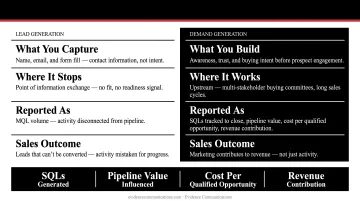
Any agency that reports only on MQL volume — without connecting that activity to pipeline or revenue — isn't running demand generation. It's running lead generation under a different label.
Why Industrial and B2B Companies Need Demand Generation Now
Industrial companies have historically relied on relationship-based selling, referrals, and trade show presence to fill the pipeline. That infrastructure still has value — but it no longer controls the buying process.
Gartner's 2025 research, based on 632 B2B buyers surveyed in 2024, found 61% preferred a rep-free buying experience overall. More pointedly, buyers enter an average of 10 interaction channels during a purchase decision — and they're actively setting requirements and forming preferences long before inviting sales into the conversation.
Demand generation is no longer optional. It's the infrastructure that ensures you exist during the phase of the buying process you can no longer control — including the AI-driven research phase that now precedes most vendor shortlists.
How AI Research Tools Are Reshaping Vendor Selection
AI-powered research tools are now part of how industrial procurement teams, engineers, and executives evaluate vendors. Platforms like ChatGPT, Copilot, Claude, Gemini, and Perplexity are being used to surface, compare, and filter suppliers — with no direct sales interaction required.
This changes the moment of competitive differentiation. Companies without visible, verifiable proof of their capabilities — technical content, case studies, validated claims, third-party recognition — are filtered out entirely before the sales team ever gets a call.
Consider what this means operationally: a procurement committee researches five potential vendors using AI tools and industry databases, narrows to two, then initiates outreach. Companies absent from that research phase — regardless of their actual capabilities — never get evaluated. The risk is never entering the evaluation at all.
Evidence Communications, a Chicago-based B2B strategic communications consultancy, calls this the Proof Gap — capable companies excluded from buyer shortlists before sales is ever contacted, not because their performance is weak, but because their proof is invisible to the channels buyers now use to decide.
The Visibility and Proof Gap
Many industrial companies have genuine operational excellence that lives primarily as internal knowledge — on the production floor, in long-term client relationships, in certifications and technical specs. It's real and defensible — buyers just can't find it.
When buyers research independently through AI tools, YouTube, and LinkedIn, they're asking three core questions:
- What does this company actually do?
- How does it work in real operating conditions?
- Can I defend this choice internally?
If those answers aren't findable without a sales call, the company doesn't make the shortlist. Demand generation for industrial B2B is fundamentally about closing that gap — making real capability visible and verifiable through the channels buyers actually use before they decide.
Core Services a Demand Generation Agency Should Provide
Not all agencies offering "demand generation" deliver the same thing. For industrial and B2B companies, these are the capabilities that matter most — and where weak agencies tend to fall short.
Full-Funnel Strategy and Content
Buyers move through distinct stages before they ever contact a vendor. Content must meet them at each one:
- Awareness stage — thought leadership, technical content, and industry positioning that builds category credibility
- Consideration stage — case studies, technical demonstrations, and client results that build specific proof
- Conversion stage — content that creates confidence for buyers ready to engage
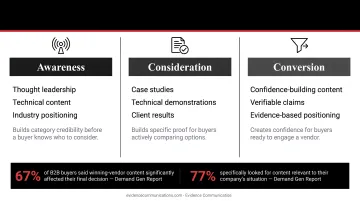
For industrial companies, this content must be evidence-based. Claims need verifiable proof behind them, not marketing generalities. Demand Gen Report research found that 67% of B2B buyers said winning-vendor content significantly affected their final decision — and 77% specifically looked for content relevant to their company's situation.
Multi-Channel Distribution and Targeting
A strong agency distributes through the channels industrial buyers actually use during independent research:
- LinkedIn (peer validation, engineer and operator proof)
- YouTube (demonstrations, how-it-works explanations)
- Industry publications and trade media
- Search and AI-indexed content repositories
- Email for nurture and re-engagement
For industrial companies with defined target account lists, account-based marketing (ABM) capabilities matter. Buying committees aren't single contacts — Forrester reports an average of 13 internal participants in B2B purchases, with 89% spanning at least two departments.
That scale means targeting must work at the account level, not just the individual contact level.
Measurement and Attribution
Pipeline-connected KPIs tell you whether demand generation is working — not vanity metrics. Look for tracking across:
- Qualified opportunities created
- Cost per qualified opportunity
- Sales cycle length trends
- Revenue influenced
CRM integration that connects campaign activity to pipeline outcomes is required. Vague dashboards showing only impressions and clicks are a warning sign — in long-cycle industrial sales, early signal interpretation is where the value gets proven.
How to Evaluate and Choose a Demand Generation Agency
Assess ICP and Industry Fit First
Demand generation for a SaaS startup is structurally different from demand generation for an industrial components manufacturer with technical buyers and complex procurement processes.
Ask for case studies specific to complex B2B or industrial environments — not generic digital marketing wins. An agency that only references software clients will default to SaaS-style playbooks:
Ask for case studies specific to complex B2B or industrial environments — not generic digital marketing wins. An agency that only references software clients will default to SaaS-style playbooks:
- Gated content funnels optimized for rapid lead capture
- Aggressive MQL scoring tied to ad spend volume
- Short-cycle optimization models built for software buying behavior
None of those approaches are calibrated for industrial buying cycles.
Assess How They Address the Independent Buyer Journey
Ask specifically: How do you plan to make our company visible and credible during the phase when buyers are researching independently?
An agency focused exclusively on ad spend and MQL targets isn't built to create the kind of evidence-based market presence that industrial buyers actually respond to. The right partner thinks upstream — in the pre-contact research phase — not just downstream in campaign conversion.
Questions to Ask Before You Sign
On pipeline accountability: "What metrics do you track, and how do you connect your work to qualified opportunities and revenue?" Agencies that can only report clicks, impressions, and MQL volume are optimizing for activity. Agree on success metrics — SQLs, pipeline value, cost per qualified opportunity — before the engagement starts.
On sales feedback integration: "How do you use insights from sales calls, lost deal analysis, and buyer objections to improve campaigns?" A strong agency treats the sales-to-marketing feedback loop as a core process. For industrial companies, buyer objections and qualification signals reveal exactly which proof and messaging gaps exist.
On transparency: "What does a standard reporting cadence look like, and how do you connect campaign activity to business outcomes?" Confirm the agency provides regular visibility into what's running and what's being tested. Monthly reports that only show activity metrics signal the agency is measuring its own effort — not your pipeline. Ask for the reporting template before you sign.
Common Mistakes Industrial Companies Make When Hiring a Demand Generation Agency
Hiring Before Positioning Is Clear
If your ideal customer profile is vague or your differentiation isn't defined, no agency can overcome that with campaigns. Demand generation amplifies what's already working — it doesn't fix unclear positioning.
Audit your capability-to-market narrative before engaging any external partner. Can you answer — in concrete, verifiable terms — what you do, how it works in real environments, and why a buyer should choose you over alternatives? If the answer is uncertain, positioning work comes first.
Expecting Campaigns to Substitute for Proof
Industrial buyers are skeptical of claims not backed by evidence. Launching campaigns without first building the underlying proof infrastructure leaves buyers with nothing to verify. That proof infrastructure includes:
- Client case studies grounded in specific outcomes
- Technical demonstrations that show the work, not just describe it
- Certifiable results buyers can reference internally
- Reference-ready clients willing to speak on the company's behalf
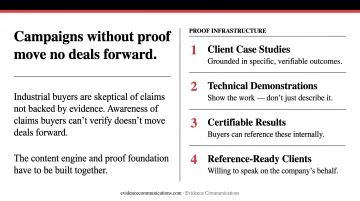
The content engine and proof foundation have to be built together. Campaigns create awareness — but awareness of claims buyers can't verify doesn't move deals forward.
Optimizing for MQL Volume Instead of Pipeline Quality
Many industrial companies default to measuring agencies by lead count — metrics that feel familiar but don't reflect commercial outcomes. Forrester states that fewer than 1% of leads progress from funnel entry to closed-won — and argues that an individual MQL signals possible interest, not a buying opportunity representing a full committee.
The right measure is pipeline quality: are the conversations being generated advancing toward qualified opportunities? Align agency incentives around SQL and pipeline metrics from the start. MQL-optimized agencies generate activity that sales teams can't convert — and sales teams rarely catch it until months of budget have been spent.
Choosing an Agency Without Complex B2B Experience
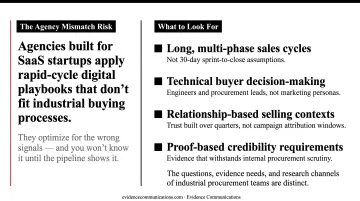
Agencies built primarily for SaaS startups apply rapid-cycle digital playbooks that don't fit industrial buying processes. Look for demonstrated experience with:
- Long, multi-phase sales cycles
- Technical buyer decision-making
- Relationship-based selling contexts
- Proof-based credibility requirements in procurement environments
The questions industrial procurement teams ask, the evidence they need to defend a decision internally, and the channels they use to research are distinct. An agency without this background will optimize for the wrong signals — and you won't know it until the pipeline shows it.
Building Demand Generation on Evidence, Not Just Campaigns
The most effective demand generation for industrial and B2B companies makes real operational capability visible and verifiable to buyers who are already researching — before any campaign runs.
Buyers who can discover, understand, and verify your capabilities independently arrive at the sales conversation already informed and already confident. That shortens cycles, improves close rates, and gets sales the call before the decision is finalized elsewhere.
Evidence Communications approaches demand generation by starting before the campaigns. The process begins diagnostically, identifying where target buyers research, what proof they look for, and where visibility and credibility gaps exist.
From there, real-world proof is structured and distributed across LinkedIn, YouTube, and AI-indexed channels that buyers actually use during independent research:
- Technical explanations that demonstrate domain depth
- Client results that validate outcomes
- Operational demonstrations that prove execution capability
- Third-party validation that confirms credibility
The goal is buyer confidence that forms before sales ever gets involved — not more marketing activity.
If your current demand generation approach is generating marketing activity but not genuine buyer confidence, examine that gap before your next agency engagement. Evidence Communications works with industrial and B2B companies to translate operational capability into market confidence — ensuring the right buyers find compelling evidence before they've already decided. Reach out at jvargas@evidencecommunications.com to start a conversation.
Frequently Asked Questions
What is a demand generation agency?
A demand generation agency builds awareness, trust, and buying intent through full-funnel strategy and execution — going beyond lead collection to connect marketing activity to qualified pipeline and revenue. The defining difference is accountability: demand generation partners are measured on commercial outcomes, not activity metrics.
How much should you pay for demand generation services?
Costs vary based on scope, channels, and execution depth. Strong demand generation agencies typically operate on monthly retainers, and the right benchmark is pipeline quality and revenue outcomes relative to investment — not the lowest rate available. Expect to scope pricing after an initial diagnostic, not from a published rate card.
What is the difference between demand generation and lead generation?
Lead generation focuses on capturing contact information. Demand generation builds awareness and buying intent before a prospect is ready to engage — making it especially critical for companies with complex, long-cycle B2B sales processes where buyers form preferences independently before contacting vendors.
When should an industrial or B2B company hire a demand generation agency?
The right time is when positioning is clear, the ICP is defined, a working sales process exists, and leadership is prepared to invest consistently over 6–12 months. Demand generation is not a quick fix for unclear differentiation or broken product-market fit.
What metrics should a demand generation agency report on?
Pipeline-connected metrics: sales-qualified leads, opportunities created, cost per qualified opportunity, pipeline value, and revenue influenced. Clicks, impressions, and MQL volume are activity proxies. Reporting them as primary success indicators can mask commercial underperformance.
How long does it take to see results from a demand generation agency?
Initial signals may emerge within the first few months, but sustainable pipeline growth typically requires 3–4 quarters. For industrial and B2B companies, sales cycles are longer and buyer trust builds through repeated proof exposure across multiple channels before decisions get made.