Introduction
Industrial buyers no longer wait for a sales rep to introduce them to a supplier. They research independently — through AI tools like ChatGPT, YouTube technical demos, and LinkedIn — before a single sales conversation takes place.
According to 6sense's 2025 B2B Buyer Experience Report, 94% of buying groups rank a vendor shortlist before contacting a seller, and the eventual winner appears on that Day One shortlist 95% of the time.
The problem for many manufacturers: their operational capabilities are real, but their proof isn't visible during this research phase. Great work that buyers can't verify independently doesn't win business — it loses it silently.
This guide gives manufacturers a practical path to becoming visible, credible, and chosen — before buyers ever pick up the phone.
Key Takeaways
- 94% of B2B buying groups shortlist vendors before contacting sales — discoverability during self-directed research is now a commercial prerequisite
- Technical credibility beats promotional messaging for industrial buyers evaluating capability
- A proof architecture — evidence mapped to buyer research stages — outperforms general content strategies
- Marketing-sales misalignment often stems from invisible shortlist formation, not poor execution
- Pipeline contribution, not traffic, is the right measure of manufacturing marketing success
What Is Manufacturing Marketing?
Manufacturing marketing is the strategic process of communicating a manufacturer's capabilities, credibility, and differentiated value to B2B buyers. It spans the full journey from demand creation and lead generation through to sales enablement and customer retention, across both digital and traditional channels.
It differs meaningfully from general B2B or consumer marketing in three ways:
- The audience is technically layered. Engineers evaluate specs. Procurement compares vendors. Executives assess risk. Each stakeholder conducts independent research using different criteria.
- Products are complex and high-consideration. A wrong supplier decision can mean downtime, safety exposure, or missed output — so buyers scrutinize evidence carefully.
- Sales cycles are long. Months or years, not days. Marketing must maintain credibility and visibility across the entire evaluation window.
The primary objectives manufacturers pursue through marketing:
- Building category visibility before buyers start shortlisting
- Generating qualified leads from buyers who already understand the capability
- Educating technically sophisticated stakeholders across the buying committee
- Establishing trust before the first sales conversation
- Expanding into new markets or breaking into new accounts
Each of these objectives requires more than messaging — they require structured proof that holds up under independent buyer scrutiny. Evidence Communications, a Chicago-based B2B strategic communications consultancy, works specifically at this intersection, helping industrial manufacturers translate operational capability into buyer confidence through a proof-first, commercial infrastructure approach.
Why Manufacturing Marketing Has Become More Urgent
The Self-Directed Buyer Has Changed the Rules
The research-first buying model isn't new, but its depth has accelerated. Buyers now consume technical documentation, peer reviews, case studies, and competitive comparisons entirely on their own — meaning the first sales interaction is often late in the evaluation, not the start of it. Gartner's 2025 survey of 1,632 B2B buyers found that 61% prefer an overall rep-free buying experience. And Forrester reports that the average purchase now involves 13 internal participants, with 89% spanning at least two departments.
That's not a sales problem. That's a visibility and credibility problem.
AI Amplifies the Disadvantage for Invisible Manufacturers
Buyers are using AI tools — ChatGPT, Copilot, Gemini, Claude, Perplexity — to research and shortlist suppliers without ever speaking to anyone. These platforms don't generate credibility from scratch. They surface and reflect what already exists across the open web.
If a manufacturer's proof — case studies, demonstrations, engineering explanations, real-world application footage — isn't visible and ongoing across those channels, AI tools simply cannot recommend them. The manufacturer is excluded from the shortlist entirely before sales is ever contacted. Forrester's 2024 research found that 89% of B2B buyers have adopted generative AI, ranking it among their top self-guided information sources across every buying phase.
Evidence Communications identifies this directly: "If AI can't find your company's proof, it can't recommend you." Their AI Visibility Assessment (AVAS™) measures exactly this — how often a manufacturer appears across major AI platforms in realistic buyer search scenarios.
The Proof Deficit Problem
Most manufacturers have strong performance records, certifications, and client outcomes. The problem isn't capability — it's accessibility. Proof typically fails buyers in three consistent ways:
- Exists only in internal files, not buyer-facing formats
- Isn't distributed across the channels buyers actually use to research
- Isn't structured for AI systems to locate and cite
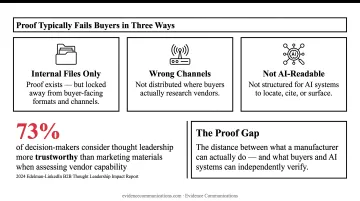
The 2024 Edelman-LinkedIn B2B Thought Leadership Impact Report found that 73% of decision-makers consider thought leadership more trustworthy than marketing materials when assessing vendor capability.
When proof is absent, buyers default to competitors whose evidence is visible — not because they're better, but because their credibility is findable.
This is what Evidence Communications calls the Proof Gap: the distance between what a manufacturer can actually do and what buyers and AI systems can independently verify.
Core Manufacturing Marketing Strategies That Drive Growth
Content Marketing and Thought Leadership
Technical content functions as the primary evidence layer for industrial buyers evaluating a vendor. The goal isn't traffic — it's giving buyers verifiable proof before the conversation starts.
Content that performs across different buyer roles:
- Engineers: Application guides, technical specifications, process documentation, tolerance and material detail
- Procurement and finance: ROI analysis, cost-benefit breakdowns, risk mitigation content, vendor comparison frameworks
- Executives: Industry positioning, market leadership content, strategic case studies
CMI's manufacturing research (2024, n=104 manufacturing marketers) found video rated effective by 74% of respondents and case studies/customer stories by 45%. These are the formats industrial buyers actually use to build confidence.
Search Engine Optimization and Digital Visibility
Industrial buyers search highly specific, technical queries — materials, tolerances, certifications, application types — and manufacturers that don't appear in those results simply don't enter consideration. Organic search is where vendor evaluation begins.
A vendor-produced 2022 survey of industrial part buyers found that 64% discovered new vendors through Google or internet search — the top channel ahead of referrals and trade publications. Organic visibility isn't optional; it's the baseline.
SEO priorities for manufacturers:
- Capability and product pages structured around specification-driven queries
- Technical content that answers the questions engineers actually search
- Authority-building through industry-relevant backlinks and thought leadership placements
- AI-readable content architecture so platforms like ChatGPT can surface and cite the company
Account-Based Marketing for High-Value Targets
ABM shifts focus from broad lead generation to precision engagement with defined, high-value accounts. Manufacturers identify target companies, develop account-specific messaging, and coordinate outreach across marketing and sales simultaneously.
This works well when pursuing enterprise clients or breaking into new verticals — especially when the product or service is highly configurable and requires relationship depth before a deal closes.
LinkedIn and Paid Media
LinkedIn's targeting allows manufacturers to reach specific job titles — procurement directors, engineering managers, plant managers, VP-level executives — at the exact company types they're targeting. For manufacturing marketers, it's the highest-priority social platform.
The three-part LinkedIn approach that builds buying committee presence:
- Sponsored content to maintain visibility with decision-makers across the committee
- Targeted InMail for direct outreach to high-priority contacts
- Organic thought leadership from company pages and executive profiles, showing proof from engineers and operators
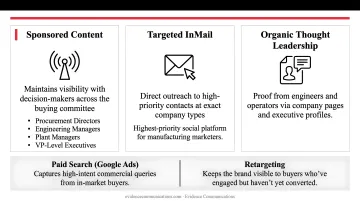
Paid search (Google Ads) complements this for capturing high-intent commercial queries. Retargeting keeps the manufacturer's brand visible to buyers who've already engaged with content but haven't yet converted.
Evidence-Based Communication as a Marketing Foundation
For industrial manufacturers, the most powerful marketing asset is structured, accessible, verifiable proof of capability. Creative messaging moves no one if the underlying evidence isn't there. That proof takes several forms:
- Client case studies with measurable outcomes
- Certifications displayed prominently and consistently
- Process demonstrations buyers can watch independently
- Performance data and reference-able client relationships
- Third-party validation that appears across independent sources
Manufacturers that distribute this proof across the channels buyers use to verify vendors build a credibility advantage that accumulates over time — so when a buyer is ready to make contact, the decision is already leaning their way.
Building a Manufacturing Marketing Plan That Gets Sales the Call
Define Your Positioning and Proof Architecture
The first step is clear, differentiated positioning: what you do differently, the outcomes you've delivered, and why those outcomes matter to the buyers you're trying to reach. Vague claims — "quality," "reliability," "experience" — carry no weight. Specific, evidenced proof does.
That positioning only holds if it's supported. Build a proof architecture — a structured map of the evidence assets you have (or need to create) that match the questions buyers ask at each research stage.
A complete proof architecture includes:
- Capability statements specific to target verticals
- Case studies from real customer environments
- Certifications and process documentation, publicly accessible
- In-field demonstrations and application footage
- Third-party validation through trade media and independent reviews
- AI-readable website content structured for how platforms like Gemini and Perplexity surface information
The Evidence Communications Proof Gap Analysis identifies where this architecture has gaps — what proof exists internally but isn't buyer-accessible, and which gaps are most urgently removing the company from buyer consideration.
Map Content and Proof to the Buyer's Journey
Different content types serve different stages:
| Stage | Content Type | Purpose |
|---|---|---|
| Awareness | Thought leadership, technical guides, SEO content | Establish category relevance, generate search visibility |
| Evaluation | Case studies, comparison guides, technical specs | Reduce buyer uncertainty, answer verification questions |
| Decision | ROI tools, implementation roadmaps, client testimonials | Remove final barriers, give buyers language to defend the choice internally |
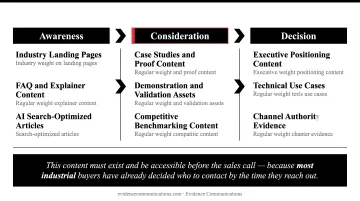
This content must exist and be accessible before the sales call — because most industrial buyers have already decided who to contact by the time they reach out.
Align Marketing and Sales Around Shared Goals
Marketing-sales misalignment is one of the most common failure points in manufacturing marketing. The symptom looks like a sales execution problem — fewer inbound inquiries, longer cycles, increased price pressure.
But the root cause is usually upstream: marketing hasn't built the credibility infrastructure that keeps the company on buyer shortlists before sales is ever contacted.
Evidence Communications frames this directly: "Sales isn't failing. It's being invited in after your buyers' opinions have already formed."
High-performing manufacturers address this by:
- Defining a shared ideal customer profile that both teams recognize
- Agreeing on what constitutes a qualified lead
- Integrating marketing content directly into the sales process as enablement tools — so when sales does get the call, the buyer is already largely convinced
Set Measurable Goals Using a Structured Framework
Connect marketing goals directly to commercial outcomes, not just awareness metrics. Track these four metrics to keep your marketing accountable to revenue:
- Measure what share of your revenue pipeline marketing activity directly influenced
- Track qualified lead volume by channel — not total leads, but the ones that match your ICP
- Monitor whether marketing-sourced leads close faster than outbound-sourced ones
- Count new account wins in target verticals, reviewed quarterly
Key Digital Channels for Manufacturing Marketers
Three channels deliver the highest return for most industrial manufacturers:
Organic Search and SEO
Organic search is a long-term compounding asset. Content optimized for the technical and commercial searches industrial buyers conduct creates steady visibility without per-click spend. It also feeds AI platforms — structured, well-organized web content is what AI tools pull from when answering buyer queries.
LinkedIn gives manufacturers direct access to multi-stakeholder buying committees. Engineers, procurement specialists, operations managers, and C-suite executives can all be reached through organic thought leadership and paid campaigns.
Evidence Communications uses LinkedIn as the primary proof distribution channel for industrial clients. Buyer confidence forms through real-world evidence from engineers and operators — not marketing copy.
Email Nurture Programs
SEO and LinkedIn generate awareness; email keeps manufacturers in the conversation. Segmented, automated sequences maintain engagement across the months-long evaluation periods typical in industrial B2B — ensuring the company stays on the shortlist through a long, committee-driven process.
Measuring Manufacturing Marketing Success
The Attribution Challenge
Long sales cycles, multiple touchpoints, and committee-based decisions make last-touch attribution unreliable. Forrester states directly that no multitouch attribution model can assign precise value to an individual tactic in a complex B2B sales system. And CMI's manufacturing research found 64% of manufacturing marketers struggle with content ROI attribution and customer-journey tracking.
The answer isn't more granular attribution — it's outcome-focused measurement that connects marketing to pipeline rather than to individual clicks.
Metrics That Matter
Focus measurement on:
- Pipeline contribution — what percentage of active revenue opportunities were influenced by marketing activity
- Cost per qualified lead — not total leads, but leads that match the ideal customer profile and enter meaningful sales conversations
- Deal velocity — whether marketing-sourced inbound leads move through the pipeline faster than outbound-sourced opportunities
- Account engagement scores — for ABM programs, tracking depth of engagement across the buying committee before sales outreach
- Account engagement scores — for ABM programs, tracking depth of engagement across the buying committee before sales outreach
- AI platform visibility — how often the manufacturer appears in realistic buyer search scenarios across ChatGPT, Gemini, Claude, and Perplexity, indicating pre-sales credibility before prospects ever contact sales
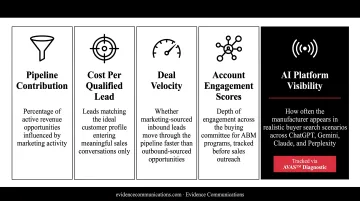
Evidence Communications tracks this last metric through its AVAS™ diagnostic — a leading indicator of whether the proof infrastructure is reaching buyers during independent research, before sales conversations begin.
The Technology Stack
Effective measurement requires CRM integration with marketing automation platforms. When marketing activity connects to pipeline data, teams can see which channels and content types actually drive revenue — not just engagement — and shift budget toward what demonstrably generates pipeline.
Frequently Asked Questions
What is manufacturing marketing?
Manufacturing marketing is the strategic process of promoting a manufacturer's capabilities, products, and services to B2B buyers through digital and traditional channels. The goal is to build awareness, generate leads, and drive revenue growth across long, complex buying cycles.
What is the 40-40-20 rule in marketing?
The 40-40-20 rule is a direct marketing principle stating that campaign success depends 40% on targeting the right audience, 40% on having the right offer, and 20% on creative execution — meaning that reaching the right buyer with relevant proof matters more than messaging polish alone.
What is the 3-3-3 rule in marketing?
The 3-3-3 rule is an attention framework: you have 3 seconds to grab attention, 3 minutes to communicate your core value, and 3 days to follow up before interest fades — a useful structure for designing content and outreach sequences for technical buyers with limited time.
What makes manufacturing marketing different from general B2B marketing?
Manufacturing marketing addresses technically sophisticated, multi-stakeholder audiences with longer sales cycles and higher-consideration purchases. Content depth, technical credibility, and verifiable capability proof matter more here than in most other B2B contexts.
What digital channels work best for manufacturing companies?
Organic search/SEO, LinkedIn, and email nurture programs are the highest-priority digital channels — SEO drives discoverability during self-directed research, LinkedIn reaches decision-maker committees, and email sustains engagement across long sales cycles.
How do you measure manufacturing marketing ROI?
Manufacturing marketing ROI is best measured through pipeline contribution, opportunity influence rate, and deal velocity — not traffic or impressions. These metrics connect marketing activity directly to commercial outcomes that executive teams can evaluate and act on.