Introduction
Most B2B buyers have already formed a shortlist before your sales team knows they exist. According to Demand Gen Report's 2024 B2B buyer research, buyers are nearly 70% through their purchasing process before engaging a vendor — and 80% of the time, the buyer initiates that first contact.
For industrial and B2B companies selling complex solutions to buying committees, this creates a specific problem: if your content isn't doing the pre-selling, your sales team is competing for deals they were never really in contention for.
This guide covers what B2B content marketing actually is, why it's structurally necessary when buyers control the research process, and how to build a strategy that works — from content types and distribution to measurement. It's written specifically for companies selling technical, high-stakes solutions where trust has to be built long before a sales conversation begins.
Key Takeaways
- B2B buyers are 70% through their decision before contacting a vendor — content is your first impression
- The 95-5 rule means most of your market isn't buying now, but is forming opinions that determine future shortlists
- Proof-based content outweighs brand-level messaging in B2B buying decisions
- LinkedIn delivers the best organic social value for 85% of B2B marketers, per CMI research
- Measurement requires connecting content touchpoints to pipeline, not just traffic
What Is B2B Content Marketing?
B2B content marketing is the practice of creating and distributing substantive content to attract, educate, and build trust with business buyers — without directly promoting a product or service in every piece.
How B2B Differs from B2C
B2C content marketing often works by reaching large audiences, triggering emotional resonance, and driving a relatively fast purchase decision. B2B content marketing operates on a different set of conditions:
- Multi-stakeholder decisions — a CFO, operations leader, and procurement manager each have different concerns and different information needs
- Longer sales cycles — six to eighteen months is common in industrial and technical purchasing environments
- Higher perceived risk — a wrong decision surfaces as downtime, missed output, or reputational exposure for the person who signed off
- Heavier research load — buyers conduct extensive independent research before engaging any vendor
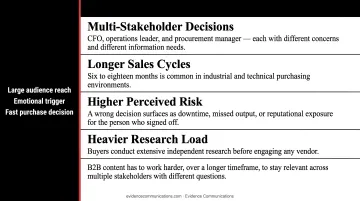
This means B2B content has to work harder, over a longer timeframe, to stay relevant across multiple stakeholders with different questions.
Content Marketing as Infrastructure
B2B content marketing isn't a single tactic. It's a strategic infrastructure — blog posts, white papers, case studies, video, technical guides — all working together to move a buyer from unaware to ready to reach out.
That last part matters: confident enough to reach out. The goal isn't to inform buyers. It's to reduce enough doubt that they put you on the shortlist.
Why B2B Content Marketing Is Non-Negotiable in Today's Buyer-Led Market
Why B2B Content Marketing Is Non-Negotiable in a Buyer-Led Market
The buyer behavior shift isn't a trend. It's a structural change in how purchasing decisions are made — and it has specific implications for companies selling complex industrial or technical solutions.
The 95-5 Rule and Why It Changes Everything
At any given moment, roughly 95% of your potential buyers are not actively in market. This approximation, introduced by Professor John Dawes of the Ehrenberg-Bass Institute in a 2021 report developed with LinkedIn's B2B Institute, reflects how infrequent category purchases are in most B2B markets.
The implication: if you're only marketing to buyers who are currently buying, you're ignoring the 95% who will eventually buy and are forming impressions right now. Content is how you earn a place on the shortlist they build before they ever signal purchase intent.
The AI Amplification Problem
Forrester's November 2024 research found that 89% of B2B buyers had adopted generative AI as one of their primary self-guided research tools. These tools — ChatGPT, Gemini, Claude, Perplexity, and others — don't create credibility. They surface and reflect what already exists across the open web.
Companies without visible, evidence-backed content are effectively invisible in these queries. A capable manufacturer with no structured proof content will simply not appear when a buyer asks an AI tool to recommend suppliers in their category.
Closing that gap — between what a company is genuinely capable of and what buyers and AI systems can actually find and verify — is the defining content challenge for industrial firms right now.
The Business Case
That visibility problem has a direct revenue consequence. CMI's 2026 B2B research found that content marketing helped 74% of B2B marketers generate demand and leads, and 49% generate sales and revenue. These are reported outcomes from companies actively running content programs — not theoretical projections.
For industrial companies, the stakes are higher. When buyers are evaluating operational compatibility, reliability, and risk before they ever contact a supplier, content has to do the pre-qualifying work that sales teams once handled face-to-face. Without it, the shortlist gets built without you.
How to Build a B2B Content Marketing Strategy That Works
Align Goals Before Creating Content
Every piece of content should trace back to a defined commercial objective. The four most common in B2B are:
- Brand awareness — reaching new buyer segments before they're in market
- Lead generation — capturing demand from buyers actively researching
- Pipeline acceleration — helping stuck deals move forward with proof
- Retention — reinforcing value with existing customers
Each goal maps to different content formats and different KPIs. Producing content without this alignment is how companies end up with a lot of activity and little commercial impact.
The documentation piece matters more than most teams expect. CMI's 2024 research found that 53% of top-performing B2B marketers identified a documented content strategy as a factor in their success — compared to far fewer among average performers. Getting that on paper is also what makes persona research actionable rather than abstract.
Build Buyer Personas Based on Real Research
In B2B, you're not writing for one person. A typical buying committee includes:
- Operations leaders — focused on performance, reliability, and integration with existing systems
- Finance — focused on cost, ROI, and risk exposure
- Procurement — focused on compliance, vendor qualification, and defensible selection
- Engineering or technical leads — focused on specifications, compatibility, and real-world performance
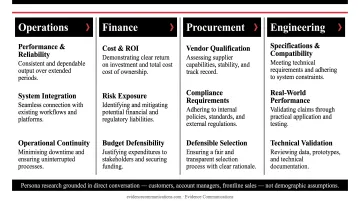
Each stakeholder needs content that speaks to their specific concerns. A white paper on operational efficiency won't move a CFO the same way a clear ROI model does.
Persona research should be grounded in direct conversation — with customers, account managers, and frontline sales — not demographic assumptions. Buyer priorities shift. Content built on outdated assumptions loses relevance before anyone notices it's underperforming.
Map Content to the Buyer Journey
Different content formats serve different stages:
| Funnel Stage | Goal | Content Types |
|---|---|---|
| Top-of-funnel | Awareness | Blog posts, industry insights, social content |
| Middle-of-funnel | Consideration | White papers, webinars, comparison guides |
| Bottom-of-funnel | Decision | Case studies, demos, ROI calculators, testimonials |
For companies with long sales cycles, the middle and bottom funnel are usually the most underdeveloped — and the most commercially valuable. Proof-based content that reduces perceived risk and helps a buyer defend their decision internally is what closes deals, not awareness content alone.
Conduct a Competitive and Visibility Audit
Before creating new content, understand what you have, what's missing, and where competitors have claimed territory you haven't.
A content audit should examine:
- Existing content performance — what's ranking, what's converting, what's ignored
- Proof deficits — capabilities buyers care about that you haven't documented visibly
- Competitor content gaps — topics they own that you should
- AI search presence — whether your company appears in AI-generated responses to relevant buyer queries
- Channel presence — LinkedIn, YouTube, trade publications, and industry forums
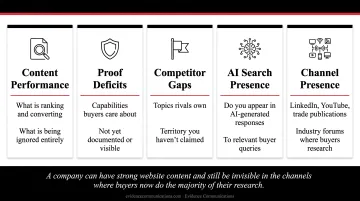
This last point is where many industrial companies find the most urgent gaps. A company can have strong website content and still be invisible in the channels where buyers now do the majority of their research.
The Content Types That Build Buyer Confidence in B2B
Not all content carries equal weight at equal stages. For industrial and B2B companies, proof-based formats consistently have the most influence on purchase decisions — because they reduce perceived risk for risk-averse buyers.
Long-Form Articles and Guides
In-depth articles and pillar guides serve two purposes simultaneously: they demonstrate knowledge depth, and they rank for the queries buyers research early in their journey. A 2,000-word technical guide on a relevant operational challenge does more for credibility than ten short blog posts on adjacent topics.
Case Studies and Customer Evidence
Case studies are among the most persuasive B2B content formats because they show rather than tell. They give a buyer a recognizable scenario — similar company, similar problem, specific measurable outcome — that they can use to validate a decision internally.
The 2024 Edelman-LinkedIn B2B Thought Leadership Impact Report found that 75% of B2B decision-makers researched a product or service they hadn't previously considered after engaging with thought leadership — and 73% said thought leadership was a more trustworthy basis for assessing capabilities than conventional marketing materials.
Specificity is everything. "Improved efficiency" is not evidence. "Reduced unplanned downtime by 34% in a steel processing environment" is evidence a buyer can use.
That's the distinction Evidence Communications draws between promotional content and genuine proof: verifiable, measurable outcomes that buyers can evaluate and share internally without it sounding like a sales pitch.
White Papers, Industry Reports, and Original Research
White papers signal something campaigns can't: investment in knowledge. For middle-funnel B2B buyers evaluating multiple vendors, a substantive white paper that addresses their actual operational questions carries more credibility than a data sheet. Original research — data your company has gathered — raises the credibility further still, because it can't be replicated by competitors.
Video, Demos, and Interactive Proof
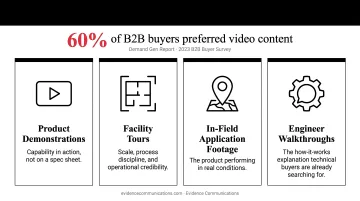
Demand Gen Report's 2023 B2B buyer survey found **60% of buyers preferred video content**. In industrial markets specifically, video translates operational capability into something a buyer can actually see and evaluate — before a single sales conversation happens.
Each format serves a distinct role in that process:
- Product demonstrations — show capability in action, not on a spec sheet
- Facility tours — establish scale, process discipline, and operational credibility
- In-field application footage — shows the product performing in real conditions
- Engineer walkthroughs — give technical buyers the "how it works" explanation they're already searching for
Distributing and Activating Your B2B Content
Creating content is only half the equation. Distribution determines whether the right buyers actually encounter it.
Core Distribution Channels
| Channel Type | Examples | Buyer Awareness Stage |
|---|---|---|
| Owned | Website, email newsletter, LinkedIn page | All stages |
| Earned | PR coverage, backlinks, guest publishing | Early awareness |
| Paid | LinkedIn sponsored content, content syndication | Targeted reach |
Each channel serves a different purpose. Owned channels give you control. Earned channels provide third-party validation that buyers encounter independently. Paid channels let you put specific content in front of specific audiences during active buying periods.
LinkedIn as the Primary B2B Platform
CMI's research found that 85% of B2B marketers say LinkedIn delivers the best organic social value of any platform. For industrial companies, this is where buyers go to validate peer experience — to see proof from engineers, operators, and customers who have direct experience with a vendor.
Consistency on LinkedIn matters more than volume. A company that publishes credible, specific proof content three times a week for twelve months builds more authority than one that publishes daily for six weeks and stops.
Internal Activation
External channels build awareness — but getting content into the hands of sales is where distribution converts into revenue. A long-standing estimate — originally from SiriusDecisions in 2013, later cited by Forrester in 2022 — holds that 60-70% of B2B marketing content goes unused by sales teams. The number has been debated, but the problem it describes is not: content that never reaches buyers at the moment of decision has no commercial value.
An effective distribution plan equips sales with the right content for each stage of a conversation:
- A relevant case study sent before a technical review can answer objections before they're raised
- A short proof video shared after a demo reinforces what the buyer just saw
- A capability comparison doc given during late-stage evaluation removes the need to rely on memory
Getting this right matters more than publishing volume. One well-placed piece of content at the right moment can do more to advance a deal than weeks of outreach.
Measuring B2B Content Marketing Performance
Measuring content ROI in B2B is more complex than tracking a single conversion. The path from content consumption to closed revenue can span months and multiple touchpoints.
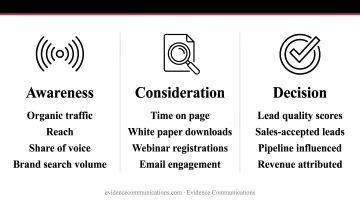
Metrics by Funnel Stage
- Awareness: Organic traffic, reach, share of voice, brand search volume
- Consideration: Time on page, white paper downloads, webinar registrations, email engagement
- Decision: Lead quality scores, sales-accepted leads, pipeline influenced, revenue attributed
Tracking Dark Funnel Indicators
Those funnel metrics only capture what analytics can see. Buyers who encounter your content through AI tools, LinkedIn, or peer conversations won't always appear as a trackable referral source. Watch for:
- Direct inquiries where the prospect references something specific they read or watched
- Sales conversations where a buyer was already familiar with your approach before the first call
- Inbound contact from companies you never actively reached out to
Each of these signals confirms your content is reaching buyers and building familiarity — even when no attribution trail exists to prove it.
Tools and Connection to Revenue
The core toolkit for B2B content analytics typically includes:
- Google Analytics — traffic volume, behavior data, and content engagement
- Marketing automation platforms — lead tracking, email engagement, and nurture sequencing
- CRM pipeline data — connecting specific content touchpoints to actual revenue outcomes
Tying content to revenue requires multi-touch attribution reviewed over a longer horizon — often six to twelve months — not a search for immediate, direct conversions.
Frequently Asked Questions
What is B2B content marketing?
B2B content marketing is the strategic creation and distribution of content — articles, case studies, white papers, video, and more — designed to attract, educate, and build trust with business buyers. It drives leads and revenue by building credibility with buyers before they ever speak to a salesperson.
What are the 4 types of B2B marketing?
The four primary types are product marketing, content and inbound marketing, account-based marketing (ABM), and demand generation. Content marketing underpins all four — it provides the assets product marketing deploys, the material ABM personalizes, and the education demand generation amplifies.
What is the 3-3-3 rule in marketing?
The 3-3-3 rule has no single authoritative definition — it appears in various forms across non-authoritative sources, with versions describing three seconds to capture attention, three content types, or three audience segments. No recognized marketing body (CMI, Forrester, Gartner) has established a canonical version. Treat it as an informal mnemonic, not an established framework.
What is the 95-5 rule for B2B?
Introduced by Professor John Dawes of the Ehrenberg-Bass Institute in 2021, the 95-5 rule holds that up to 95% of B2B buyers are not actively in market at any given time. Content builds awareness with that majority so your company is already on their shortlist when a buying cycle begins.
How is B2B content marketing different from B2C?
B2B content targets multi-stakeholder buying committees with longer decision cycles, lower risk tolerance, and a need for technical depth and verifiable proof. B2C content typically targets individuals with shorter cycles and relies more on emotional resonance than evidence.
How do you measure B2B content marketing ROI?
Track traffic and brand reach at the top of the funnel, engagement and lead quality in the middle, and pipeline contribution at the decision stage. Connecting CRM data with content analytics over a six-to-twelve-month window is essential — short-window attribution consistently undercounts content's commercial impact.