Introduction
Modern B2B buyers don't wait for a sales call to form opinions about vendors. They research independently — through AI tools, peer networks, and professional platforms — and arrive at a shortlist before anyone picks up the phone. For industrial and B2B companies, this means the sale often starts and sometimes ends on LinkedIn, without a single conversation taking place.
LinkedIn is no longer a networking tool. It's the professional research layer where potential buyers validate capability, assess credibility, and decide who earns the call.
What follows is a practical framework: how to build a presence buyers trust, create content that demonstrates real capability, reach the right decision-makers, and measure signals of commercial interest — not just engagement.
Key Takeaways:
- LinkedIn ranks among the most-cited domains in AI-generated responses — putting it directly on buyer shortlists
- Weekly posting on company pages produces a 2x lift in content engagement (LinkedIn data)
- Personal profiles outperform company pages in organic reach — use both, intentionally
- Demonstrations, case studies, and engineering explanations outperform claims-based messaging with technical buyers
- Metrics that matter are profile visits from target accounts, click-throughs to high-intent pages, and comment quality — not raw likes
Why LinkedIn Dominates B2B Marketing Today
For B2B companies, LinkedIn is not one option among many. It's where professional decision-makers spend time in a work-focused mindset — actively vetting vendors, seeking peer validation, and consuming category expertise.
LinkedIn Shows Up Where Buyers Are Asking AI
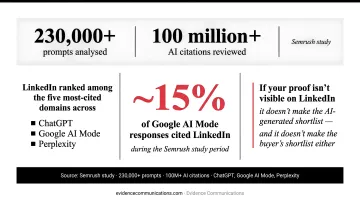
A Semrush study analyzing over 230,000 prompts and 100 million AI citations found LinkedIn among the five most-cited domains across ChatGPT, Google AI Mode, and Perplexity. Google AI Mode alone cited LinkedIn in nearly 15% of responses during the study period.
That's not an abstraction. When a prospect types "who are the leading manufacturers of [your product category]" into an AI assistant, LinkedIn content is part of what shapes the answer. If your company's proof isn't visible on LinkedIn, it doesn't make the AI-generated shortlist — and it doesn't make the buyer's shortlist either.
Organic Reach Still Works Here
On most social platforms, brand organic reach has declined sharply as algorithms prioritize paid content. LinkedIn behaves differently. Quality B2B content — particularly native posts, video, and carousels — still reaches professional audiences without requiring paid amplification. That makes it one of the few channels where industrial companies can build genuine visibility through consistent publishing rather than ad spend.
Decision-makers researching vendors, AI tools pulling content directly into answers, and organic reach that still rewards consistency — that's a rare combination. Most channels offer one of those. LinkedIn offers all three.
Optimizing Your LinkedIn Presence for B2B Success
Treat Your Company Page as a Buyer's First Impression
A LinkedIn Company Page is often the first place a buyer looks after hearing your company's name. According to LinkedIn's own data, pages with complete information receive 30% more weekly views than incomplete ones.
What "complete" actually means for B2B:
- Lead your About section with the problems you solve and outcomes you've delivered. Buyers use this section to assess fit, not learn history.
- Treat your banner image like a billboard — communicate your value proposition visually, not just your logo.
- Pin your highest-value assets for visitors: a case study, a capability overview, a demonstration.
- Complete your custom URL and contact info. A default URL or missing website link signals a company not actively invested in its market presence.
The About section is where most industrial companies underperform. Generic corporate descriptions ("We are a leading provider of...") answer no buyer questions. Lead instead with what you do, who you do it for, and what changes when you're involved.
Leverage Personal Profiles for Reach and Credibility
Company page posts reach a fraction of what personal profiles reach. According to Social Media Examiner, personal profile posts receive 3 to 4 times more reach than company page posts — and for B2B, where relationships and expertise drive decisions, the credibility advantage of an individual voice compounds that difference further.
The solution isn't to choose one over the other. Coordinating both gives you the brand consistency of a company hub and the reach that only personal profiles can generate.
Practical approach:
- Supply team members with consistent branded banner graphics and profile photo guidelines for visual consistency
- Let individuals write their own About sections in their own voice — human, first-person content builds trust faster than polished corporate copy
- Encourage founders and senior leaders to post regularly, drawing on real experience and expertise
Together, a well-maintained company page and active personal profiles create the kind of layered presence that shows up when buyers research — and stays credible when they verify.
Building a B2B Content Strategy That Earns Buyer Attention
Define Your Content Pillars Before You Post Anything
Random posting produces random results. Before publishing anything, define 3–4 recurring themes that reinforce your expertise and serve your target audience. These become your content pillars.
For industrial and B2B companies, a useful pillar structure might include:
- Capability proof: Real demonstrations, application footage, before-and-after comparisons
- Engineering education: How-it-works explanations from engineers and operators, not marketers
- Client outcomes: Specific case study content with measurable results
- Industry expertise: Category commentary, trend analysis, technical insight relevant to your buyers
LinkedIn's own data shows companies posting at least weekly see a 2x lift in content engagement — and Hootsuite's 2026 benchmark found that 2 posts per week correlated with the highest overall engagement rate in their dataset (3.56%). Buyers don't act the first time they see you. Consistent presence builds the familiarity that earns consideration when the need surfaces.
Choose Formats That Fit LinkedIn's Culture
Once your pillars are set, format choice determines how far your content actually travels. LinkedIn's algorithm rewards content that keeps users on the platform — posts that send readers elsewhere tend to underperform native content in distribution.
Formats that work in B2B:
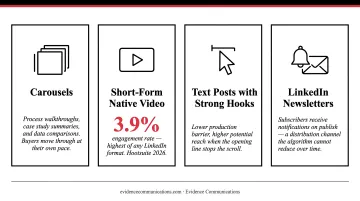
- Carousels: Ideal for process walkthroughs, case study summaries, and visualizing data comparisons. Buyers can move through them at their own pace.
- Short-form native video: Direct uploads outperform links. Hootsuite's 2026 data shows video achieves a 3.9% engagement rate — the highest of any LinkedIn format.
- Text posts with strong hooks: Lower production barrier, higher potential reach when the opening line stops the scroll.
- LinkedIn Newsletters: Subscribers receive notifications when you publish, creating a distribution channel the algorithm cannot reduce over time.
Master the Opening Hook
The first 125 characters of a LinkedIn post — before "see more" — determine whether someone stops or scrolls past. Three hook formats that work consistently:
- Data/insight hook: Lead with a credible, specific statistic. "73% of B2B decision-makers say thought leadership is more trustworthy than marketing materials — yet most industrial companies produce neither."
- Question hook: Open with something your audience wants answered. "What does a buyer see when they search for your company at 10pm before a vendor shortlist meeting?"
- Contrarian hook: Challenge an assumption to spark genuine engagement. "Posting more frequently on LinkedIn won't fix the real problem. Here's what will."
The hook isn't decoration. It's the entire distribution mechanism. Write it last, after you know what the post actually delivers.
Thought Leadership and Evidence-Based Positioning on LinkedIn
The Commercial Case for Thought Leadership
Thought leadership on LinkedIn has a direct commercial impact — not an abstract brand-building one. The 2024 Edelman-LinkedIn B2B Thought Leadership Impact Report, which surveyed 3,484 management-level professionals, found:
- 54% of decision-makers spend at least one hour per week consuming thought leadership
- 73% say an organization's thought leadership is a more trustworthy basis for assessing capability than its marketing materials
- 60% are willing to pay a premium to work with organizations that produce high-quality thought leadership
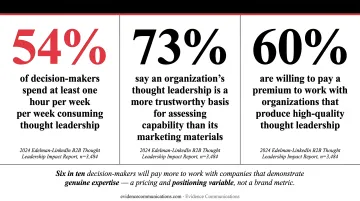
That last number deserves attention: six in ten decision-makers will pay more to work with companies that demonstrate genuine expertise. This is not a soft metric — it's a pricing and positioning variable.
The Proof Deficit Problem
Most industrial and B2B companies — manufacturers, infrastructure providers, specialty services firms — have real operational capability and almost no visible evidence of it where modern buyers are looking.
Buyers now research suppliers using AI tools, LinkedIn peer validation, and YouTube explanations before contacting anyone. If a company's proof isn't visible across those channels, buyers don't send a rejection — they simply move on. The company never gets the call. That's a visibility failure, not a sales failure, and it happens before the company ever enters the conversation.
Evidence Communications calls this the Proof Gap: the distance between what a company can actually do and what buyers and AI systems can find and verify independently. It shows up consistently in the same forms:
- No visible content where buyers actually learn (LinkedIn, YouTube, AI search)
- A website that carries all the proof but nothing reinforcing it elsewhere
- Capability claims without observable demonstration
- No customer or third-party validation in accessible formats
- Engineers and operators with real expertise who have no presence in buyer-facing channels
What Evidence-Based Content Actually Looks Like
Generic industry commentary is not thought leadership. For industrial and B2B companies, credible LinkedIn content means demonstrable proof — content that lets buyers evaluate capability without needing a sales conversation:
- Process documentation showing how work gets done, not just that it gets done
- Real-world application footage from actual operating environments
- Customer outcome stories with specific, defensible results
- Engineering explanations from the people who build and operate the products
- Before-and-after capability examples that buyers can relate to their own situation
Closing that gap means structuring content so buyers can reach a confident conclusion before sales is ever involved. Evidence Communications works specifically with industrial and B2B organizations to do exactly that — translating operational capability into buyer-facing proof systems built for the shortlist. As founder Jason Vargas puts it: buyers don't need more information, they need less doubt.
Employee Advocacy: Distributed Credibility at Scale
When engineers, project managers, and technical leads share genuine insights from actual work, it creates a level of credibility that no company page post can match. Industrial buyers are technical professionals themselves — they recognize real expertise and respond to it differently than to branded content.
Enabling this at scale doesn't require a formal program. It requires:
- Providing team members with content ideas drawn from real project work
- Supplying branded visual assets to reduce the production barrier
- Giving individuals latitude to write in their own voice — firsthand expertise from practitioners moves industrial buyers far more than polished corporate copy
In most industrial companies, the people closest to the work are also the most credible voices in the market. They just need a reason and a path to show up.
LinkedIn Targeting and Paid Advertising for B2B
Why LinkedIn's Targeting Is Different
On most platforms, targeting relies on inferred demographics — behaviors, browsing patterns, interest proxies. LinkedIn's targeting uses self-reported professional data: actual job titles, company names, seniority levels, industries, and skills. Members have professional incentives to keep their profiles accurate, which makes the data far more reliable for B2B campaigns.
That means you can reach the exact job functions at the exact companies you want, with no inference required.
Three Tools Industrial B2B Marketers Should Know
- Company Targeting lets you serve content to named accounts you've identified as priority targets — the foundation of account-based marketing.
- Contact Targeting matches your CRM or email lists to LinkedIn members, so you can reach known prospects directly on the platform.
- LinkedIn Insight Tag Retargeting segments website visitors by the pages they viewed. Someone who read your case study is a different prospect than someone who hit your homepage.
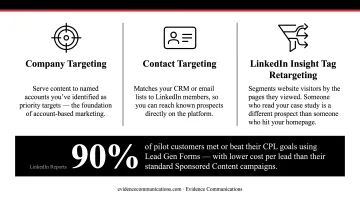
On lead capture, LinkedIn's Lead Gen Forms pre-populate with member profile data, removing the friction that typically kills form completion rates. LinkedIn reports that 90% of pilot customers met or beat their CPL goals using Lead Gen Forms — with lower cost per lead than their standard Sponsored Content campaigns.
The Organic-First, Paid-Amplify Approach
Don't run paid campaigns on content that hasn't proven itself organically. Use organic posts to test which topics, formats, and hooks resonate — then invest paid budget to amplify what's already working. Sponsored Content extends your best-performing posts to a precisely targeted audience who hasn't found you yet.
Amplifying content that has already earned engagement means your paid budget goes toward messages buyers have already validated — not toward testing whether a message works at all.
Measuring and Optimizing Your LinkedIn Marketing
Metrics That Indicate Commercial Interest
Likes measure visibility, not intent. Track these instead:
- Engagement rate (interactions divided by viewers, not just impressions)
- Comment quality — substantive professional discussion signals genuine resonance
- Profile visits from ICP companies — check which organizations are viewing your page
- Connection requests from target-role individuals — inbound signals from the right personas
- Clicks to high-intent pages — contact, services, or case study pages
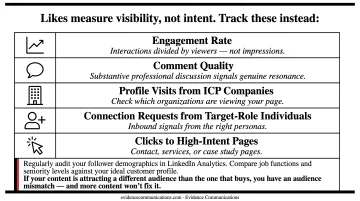
Regularly audit your follower demographics in LinkedIn analytics. Compare job functions and seniority levels against your ideal customer profile. If your content is attracting a different audience than the one that buys, you have an audience mismatch — and more content won't fix it.
UTM Parameters Are Not Optional
Tag every LinkedIn link with UTM parameters to track downstream behavior in Google Analytics. The goal isn't counting clicks — it's knowing which posts produce engaged sessions and conversions. Without UTM tagging, LinkedIn traffic gets misattributed in your analytics, and you lose the ability to connect content decisions to business outcomes.
The Content Optimization Loop
Use LinkedIn's built-in analytics to identify top-performing posts by engagement rate. When a post significantly outperforms, investigate why — format, angle, topic — then build on it.
One strong insight can carry several posts:
- Reuse the core idea with a different hook
- Update it with new data when it becomes available
- Reformat it from text to carousel to reach a different segment
This isn't repetition. Different people see your content at different times, and the same idea lands differently depending on how it's framed.
Frequently Asked Questions
How often should B2B companies post on LinkedIn?
For company pages, LinkedIn's data supports a minimum of once per week (associated with a 2x engagement lift), while Hootsuite's 2026 benchmark found that 2 posts per week correlated with the highest overall engagement rate. Consistency matters more than posting at a specific hour — LinkedIn's algorithm surfaces content based on relevance and engagement, not chronological timing.
What types of content generate the most B2B leads on LinkedIn?
Native formats consistently outperform external link posts. Carousels, short-form video, and strong-hook text posts drive the highest engagement, while gated assets via Sponsored Content with Lead Gen Forms work best for direct lead capture. For industrial and technical buyers specifically, demonstrations, case studies, and engineering explanations outperform generic thought leadership.
How is B2B marketing on LinkedIn different from other social platforms?
LinkedIn's professional context and first-party member data allow precise targeting by job title, company, seniority, and industry — accuracy that entertainment-oriented platforms simply can't match. Audiences arrive with a work-focused mindset, making them substantially more receptive to B2B messages than the same professionals on Instagram or Facebook.
What is the difference between a LinkedIn Company Page and a personal profile for B2B marketing?
Company Pages build a searchable brand hub and are critical for discoverability, while personal profiles generate significantly higher organic reach and are more trusted by audiences. Both serve different purposes and work best in coordination — the company page anchors credibility while personal profiles distribute content and build relationships.
How does LinkedIn advertising work for B2B companies?
LinkedIn ads are managed through Campaign Manager and support Sponsored Content, Message Ads, and Lead Gen Forms. Targeting uses professional self-reported data, making it precise for B2B audiences — costs per click run higher than other platforms, but the audience quality is worth the cost for reaching senior decision-makers at named accounts.
How can industrial or manufacturing companies use LinkedIn to attract enterprise clients?
Focus on making operational capability visible through evidence-based content — process demonstrations, client outcome stories, engineering explanations, and real-world application footage. Enterprise buyers in industrial sectors conduct independent research before ever contacting a vendor, and they're looking for proof that a supplier can perform under their specific operating conditions. Claims without demonstration rarely make the shortlist.