The B2B buying journey is the end-to-end process a business buyer follows from recognizing a problem to selecting a vendor. That process has shifted fundamentally. Buyers now conduct independent research using AI tools, peer networks, and digital content — and they're doing it without you.
This article breaks down the key stages of the B2B buying journey, what's changed about how modern buyers move through it, and what manufacturers, distributors, and industrial suppliers must do to remain visible and credible before the decision is made.
Key Takeaways
- B2B buyers complete most of their research — and form their shortlists — before contacting a vendor
- The journey has three core stages: Awareness, Consideration, and Decision, each requiring different proof
- 94% of buyers now use AI tools during purchasing, so buyers who can't find your proof during independent research will simply move on
- Industrial companies with strong capabilities but weak digital presence are dropped from shortlists before the first call ever happens
- Closing that gap means putting verifiable proof — case studies, demonstrations, validated outcomes — on the channels buyers actually research
What Is the B2B Buying Journey?
The B2B buying journey is the structured — yet non-linear — process through which a business buyer moves from recognizing an operational problem to selecting and onboarding a vendor. Most sellers can describe it. Far fewer actually build their commercial efforts around it.
How it differs from B2C:
| Factor | B2B | B2C |
|---|---|---|
| Decision-makers | Committees of 6–13+ people | Typically one individual |
| Timeline | Months (often 10+) | Hours to days |
| Accountability | High — wrong decisions halt operations | Lower personal risk |
| Evidence required | Extensive proof and validation | Emotion and convenience |
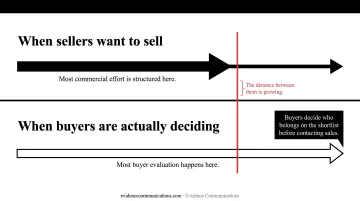
That gap in accountability and evidence requirements explains the central failure mode for industrial sellers: most still structure their commercial efforts around when they want to sell rather than when buyers are actually deciding. Those two windows are rarely aligned — and the distance between them is growing.
The Key Stages of the B2B Buying Journey
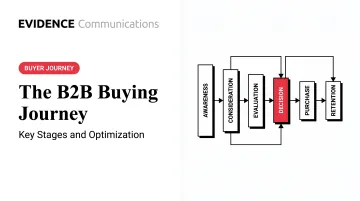
While every purchase is different, the journey generally follows three core stages. Each requires a different type of content and a different behavior from sellers.
Awareness: Problem Recognition and Early Research
A buyer — often a mid-level champion, not the final decision-maker — has identified an internal problem and starts self-educating. They search online, consult industry publications, ask peers, and increasingly query AI tools.
At this stage, sellers must provide educational content that confirms the problem is real and positions the company as credible. Not promotional copy — proof-based content. Think:
- Technical explainers addressing specific operational challenges
- Industry-specific case examples showing the problem in context
- Thought leadership on the category from engineers or operators
The buyer isn't evaluating vendors yet. They're deciding who seems worth evaluating.
Consideration: Vendor Evaluation and Shortlisting
This is where deals are actually won or lost — and most industrial sellers don't realize it.
According to 6sense's 2025 B2B Buyer Experience Report, buyers evaluated an average of 5.1 vendors, had 3.6 already on their Day One shortlist, and 94% ranked that shortlist before ever engaging with a seller. First contact from a seller occurred at 61% through the journey — meaning preferences were already set before the conversation began.
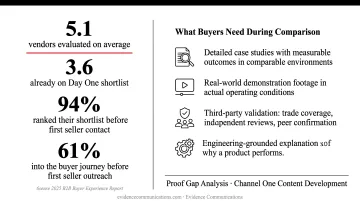
The content gap here is severe. What buyers need during comparison:
- Detailed case studies with measurable outcomes in comparable environments
- Real-world demonstration footage — products working in actual operating conditions
- Third-party validation — trade publication coverage, independent reviews, peer confirmation
- Engineering-grounded explanations of why a product performs, not just that it does
That gap is precisely where Evidence Communications focuses its proof-building work for industrial clients. Through services like Proof Gap Analysis and Channel One Content Development, the firm converts undocumented operational capability into verifiable, buyer-accessible evidence distributed across LinkedIn, YouTube, and AI-readable web content.
Decision: Confirmation and Commitment
The buying committee is largely decided, but doubt remains. Internal stakeholders raise new objections. The CFO challenges commercial terms. The operations lead wants to know what happens if something goes wrong.
Sellers must eliminate that doubt before it's voiced. What works:
- References available and prepped
- Implementation plans that are clear and specific
- Equip buyers to defend the decision internally with language they can share with procurement and leadership
- Consistent messaging across every seller touchpoint
Evidence Communications frames this as decision defensibility: at this stage, buyers have enough information. What they need is confidence that the choice will hold up under internal scrutiny. In industrial purchasing, that stakes are personal — individuals own the outcome, including exposure to downtime, safety risk, and warranty claims.
How the Modern B2B Buying Journey Has Changed
Traditional B2B selling assumed sellers could guide buyers through discovery via outbound outreach. That assumption no longer holds.
6sense's 2025 research across nearly 4,000 buyers found buyers initiated 79% of seller engagements, and first contact occurred at 61% through the journey. A foundational 2012 CEB/Google study put that figure at 57% — the number has only moved in one direction since.
The AI Factor
94% of buyers now use AI tools during the purchasing process, according to the same 6sense research. They're using these tools to compare vendors, analyze reviews, simulate total cost of ownership, and draft RFPs — before anyone picks up the phone.
Sellers without visible, structured evidence online are effectively invisible during this phase. AI tools don't invent credibility; they surface and reflect what already exists across the open web. If proof isn't there, the recommendation goes elsewhere.
The Committee Problem
B2B purchases increasingly involve buying teams of 10 or more stakeholders, with Gartner finding that 74% of buying teams experience unhealthy conflict during the decision process. The stakes of navigating that conflict are measurable: teams that reach consensus are 2.5x more likely to report a high-quality deal outcome.
For sellers, that translates to three practical realities:
- A single message pitched to the whole committee misses the distinct concerns of each role
- Technical evaluators, financial approvers, and end users require different proof
- Unhealthy conflict often stalls deals that would otherwise close
The Non-Linear Reality
Buyers loop back. They pause, re-evaluate, and restart. A seller who appears once during awareness and then disappears until outreach misses the repeated touchpoints that build genuine familiarity. Sustained presence across the full journey matters more than a single well-timed outreach.
Key Factors That Shape B2B Buying Decisions
B2B buyers don't decide on vendors — they eliminate them. Five factors determine whether your company survives that process.
Engineers, finance, operations, and procurement each need different proof. Technical specs for one stakeholder do nothing for the CFO evaluating risk-adjusted ROI. A single message aimed at everyone reaches no one effectively.
Industrial buyers are risk-averse for good reason. A bad vendor decision can halt production, trigger compliance failures, or put individuals' professional credibility on the line — not just a budget line. Larger deals draw more stakeholders and more scrutiny.
Visible evidence outweighs sales claims. Forrester found that 86% of B2B technology buyers were more likely to trust vendor claims backed by objective third-party content. Certifications, case studies, client references, and third-party validation do the work that sales conversations can't.
Buyers scan for reasons to eliminate, not reasons to engage. Sellers who look undifferentiated — thin proof, vague positioning, no verifiable results — get cut early. They usually never hear why.
Familiarity functions as a filter before outreach even happens. Vendors buyers recognize from prior exposure start with an advantage. For sellers entering new accounts, consistent digital presence and content distribution builds the recognition needed to make the consideration set.
Common Mistakes B2B Sellers Make Along the Journey
Arriving Too Late
Many B2B sellers focus commercial energy on outbound prospecting at the moment they want to sell. By the time a rep makes contact at 61% through the journey, the shortlist may already exclude them — and they'll never know why the deal was lost.
Confusing Capability With Credible Proof
This is the most pervasive problem in industrial sectors. Companies with strong products, experienced teams, and solid performance records assume that track record speaks for itself. It doesn't — not if buyers can't find it.
Evidence Communications defines this as the Proof Gap: the distance between a company's real capabilities and what AI systems and buyers can actually verify online. Before a buyer will trust a supplier, they need five things:
- See it work through real use cases, demonstrations, and observable evidence
- Understand why it works through engineering explanations, not marketing language
- Trust it works for their specific environment, scale, and conditions
- Defend the decision internally with clear language shareable with peers and procurement
- Find it confirmed elsewhere through independent sources, not just the seller's channels
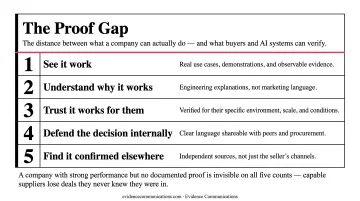
A company with strong performance but no documented proof is invisible on all five counts — which means capable suppliers lose deals they never knew they were in.
Treating All Stakeholders as One Buyer
Selling a single message to the entire buying committee is a common and costly mistake. Each stakeholder evaluates the decision differently:
- Procurement managers need compliance documentation and supplier risk data
- Operations leads need reliability evidence and implementation track record
- CFOs need total cost of ownership analysis and ROI justification
Missing any one of them extends the cycle or kills the deal.
How to Optimize for Each Stage of the B2B Buying Journey
Each stage of the buying journey requires a different type of investment — and a different definition of "showing up." Here's what optimization looks like across all three.
Awareness Optimization
Make the company discoverable by buyers who don't yet know it exists.
- Build educational, search-discoverable content addressing the operational problems your buyers are researching
- Prioritize technical content, sector-specific case examples, and thought leadership — not promotional material
- Ensure content is structured for AI platforms to surface: FAQ pages, knowledge content, and capability pages that answer the questions buyers are actually asking tools like ChatGPT and Perplexity
Once buyers know you exist, they shift into verification mode — and that's where most industrial sellers fall short.
Consideration Optimization
Build and distribute proof assets in the formats buyers use when comparing vendors.
- LinkedIn: Proof from engineers, operators, and customers — peer validation that buyers use to confirm supplier legitimacy
- YouTube: "How it works" video explanations, in-field demonstrations, customer installations
- Trade publications and industry forums: Third-party credibility that AI tools surface alongside owned content
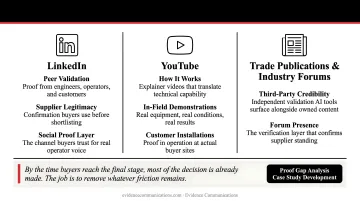
This is where most industrial sellers have the largest gap — and where Evidence Communications' Proof Gap Analysis and Case Study Development services are most directly applied.
By the time buyers reach the final stage, most of the decision is already made. The job here is to remove whatever friction remains.
Decision Optimization
Remove friction before the final committee conversation.
- Have references available and prepped before they're requested
- Provide buyers with content they can share internally — clear, credible language that doesn't sound like marketing
- Ensure messaging is consistent across every touchpoint so late-stage doubt doesn't compound
- Address likely objections before they're raised: implementation clarity, post-sale support, risk mitigation
Frequently Asked Questions
What is a B2B buyer?
A B2B buyer is an individual or team within an organization responsible for procuring goods or services for business use. Modern B2B buyers are typically strategic decision-makers accountable for ROI, compliance, and operational outcomes — not just purchase price.
What does B2B stand for?
B2B stands for "business-to-business," referring to commercial transactions between two businesses rather than between a business and an individual consumer. The contrasting model, B2C, is covered in the question below.
What are the four main categories of B2B buyers?
The four primary categories are producers (companies that transform purchased goods into other products), resellers (wholesalers, distributors, retailers), governments (public sector entities at all levels), and institutions (nonprofits, hospitals, educational organizations).
How do you market successfully to B2B buyers?
Successful B2B marketing starts with meeting buyers where they research independently. That means credible, evidence-based content at the awareness and consideration stages, with messaging aligned to each stakeholder's specific concerns. Buying committees require verified proof — not claims.
What is the difference between the B2B and B2C buying journey?
B2B journeys involve multiple stakeholders, longer timelines, higher personal accountability, and heavy reliance on evidence and proof. B2C journeys are typically individual decisions, influenced by emotion and convenience, and resolved much faster. The professional risk attached to a wrong B2B purchase has no real B2C equivalent.
How has AI changed the B2B buying journey?
AI tools now allow buyers to independently research, compare, and validate vendors faster than ever — without contacting sales. Sellers who lack visible, AI-searchable proof are often filtered out before a single conversation takes place.