Introduction
Modern B2B buyers don't wait for a sales call to form opinions. According to HubSpot's 2025 State of Sales research, 96% of prospects conduct their own research before speaking with a sales representative — meaning your company's visibility during that self-directed phase determines whether you're on the shortlist before sales ever gets involved.
In 2026, SEO is no longer just a traffic play. It's the primary mechanism by which industrial and B2B companies remain visible and credible while buyers independently decide who to trust, with AI tools now doing much of the initial filtering. If your proof isn't surfaced where buyers are looking, you're eliminated before the first conversation happens.
That's the gap this guide addresses. The five-step framework below is built for B2B and industrial companies that need to translate real operational capability into market confidence — before the decision is made.
Key Takeaways
- B2B SEO in 2026 must account for longer sales cycles, multiple decision-makers, and AI-assisted research — not just search volume
- Bottom-of-funnel keywords targeting high-intent buyers consistently deliver stronger ROI than high-volume, low-intent terms
- Technical SEO creates the foundation — proof-based content is what moves buyers from awareness to a shortlist decision
- ChatGPT, Perplexity, and Google AI Overviews are now standard research tools for B2B buyers; structured, authoritative content is what gets cited there
- Organic SEO authority compounds — rankings, inbound leads, and AI citations grow without ongoing ad spend
Why B2B SEO Is More Critical Than Ever in 2026
The Self-Directed Buyer Has Changed Everything
Buyers now complete the majority of vendor evaluation independently — using search engines, AI tools, and peer review platforms — before engaging a sales team. Companies that aren't visible during this research phase are eliminated before the first call ever happens. Sales isn't failing. It's being invited in after buyers' opinions have already formed.
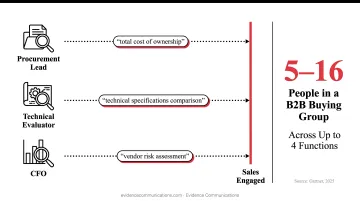
This is especially pronounced in industrial and complex B2B sectors. A procurement lead, a technical evaluator, and a CFO may all research independently, using entirely different search terms, before any of them raises a hand. Gartner's 2025 research found that B2B buying groups now range from 5 to 16 people across as many as four functions — each one potentially researching your category without your knowledge.
B2B vs. B2C SEO: A Fundamental Difference
B2C SEO optimizes for individual consumers making fast decisions. B2B SEO is something else entirely:
- Multiple decision-makers searching independently, often without coordination
- Longer sales cycles measured in weeks or months, not minutes
- Lower search volumes with significantly higher commercial intent and cost-per-click
- Rational evaluation criteria — downtime risk, safety exposure, warranty implications — not impulse purchases
These differences require a fundamentally different keyword and content approach. High-volume terms that work for B2C are often irrelevant for B2B. The goldmine is narrow, specific, high-CPC terms that signal active buying intent.
The AI Search Dimension
Forrester's 2025 Buyers' Journey Survey reports that 94% of business buyers now use AI in the buying process, with business buyers twice as likely as consumers to use ChatGPT and four times as likely to use Microsoft Copilot. AI tools are now standard in the B2B research stack — not experimental.
For industrial companies, the consequence is straightforward: if AI can't find your proof, it won't recommend you. Content must be structured and citable — built to surface in AI-generated answers, not just to rank in a traditional search results page.
The Visibility Gap Is a Proof Problem
For industrial and complex B2B companies, the gap in consideration isn't typically a product problem. It's a proof and communication problem. Companies with strong operational capabilities frequently lose consideration because those capabilities aren't visible where buyers look. Evidence Communications describes this as the Proof Gap — the distance between what a company can actually do and what AI systems and buyers can independently verify.
Closing that gap means building commercial infrastructure that operates in the pre-sales research window — so that when buyers finally engage sales, the shortlist has already been shaped in your favor.
Step 1: Build Decision-Maker Personas and Map Your Sales Funnel
Defining Your Decision-Maker Personas
B2B personas differ fundamentally from B2C. You're not targeting one consumer — you're targeting a set of stakeholders within a target account, each researching from their own vantage point.
Each stakeholder evaluates the same purchase through a different lens. A capital equipment buyer focuses on total cost of ownership and procurement risk. An engineering manager cares about performance tolerances, installation requirements, and failure modes. A CFO wants ROI timelines and replacement cycles.
Build a documented persona for each key stakeholder using:
- Job title and function — Who owns the outcome if this decision goes wrong?
- Primary business goals — What metric are they measured on?
- Pain points and evaluation criteria — Downtime, reliability, safety exposure, supplier risk
- Preferred content formats — Technical specs, case studies, video demonstrations, peer reviews
- Questions searched at each buying stage — These become your keyword targets
This data should come from actual sales conversations and customer interviews, not internal assumptions. If you lack interview data, start with three sales calls recorded specifically for this purpose — the patterns surface quickly.
Once your personas are documented, the next step is matching each one to the specific stage of your sales funnel where they're most active.
Mapping Your Sales Funnel to Search Intent
Each funnel stage requires different content and keywords:
| Funnel Stage | Search Behavior | Content Type |
|---|---|---|
| Top of Funnel | Problem definition, education | Guides, explainers, industry articles |
| Middle of Funnel | Evaluating approaches and vendors | Comparisons, how-it-works content, FAQs |
| Bottom of Funnel | Comparing solutions, looking for proof | Case studies, spec sheets, application pages |
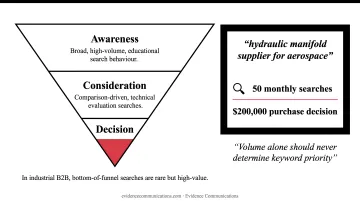
In industrial B2B, the bottom-of-funnel stage often involves highly specific, low-volume searches with high commercial value. A keyword like "hydraulic manifold supplier for aerospace" may have 50 monthly searches but represent a $200,000 purchase decision. Volume alone should never determine keyword priority.
Step 2: Conduct B2B Keyword Research That Maps to Buyer Intent
Low-Volume, High-Intent Keywords Are the B2B Goldmine
B2B keyword research must start at the bottom of the funnel — the specific phrases decision-makers use when they're actively evaluating solutions. Practical discovery methods include:
- Reviewing CRM data and sales call notes for the exact language buyers use
- Surveying existing customers on how they searched before contacting you
- Using competitor keyword analysis tools (Semrush, Ahrefs) to surface high-CPC terms competitors rank for
A keyword with 200 monthly searches and a $15 CPC signals that multiple advertisers are paying premium rates to reach that audience. Those searchers are active buyers.
WordStream's 2025 Google Ads benchmarks show average CPCs of $5.58 for Business Services and $5.70 for Industrial & Commercial across 16,000+ US campaigns. For bottom-of-funnel terms, those category averages run considerably higher.
Long-tail, application-specific terms are often the most valuable in industrial sectors:
- "custom precision machining for medical implants"
- "industrial automation integrator for automotive assembly"
- "contract manufacturer ISO 13485 certified"
These have minimal competition and high conversion potential. They're also exactly what a qualified buyer types when they've already decided to purchase. At that point, they're choosing the vendor, not the category.
Mapping Keywords Across the Funnel with Topic Clusters
Once you've identified the high-intent terms that matter to your buyers, the next step is organizing them into a content architecture that builds authority across the full funnel. The topic cluster model does this by pairing a broad pillar page (for example, "industrial automation solutions") with cluster pages that address specific sub-topics and long-tail variants. This structure:
- Signals topical authority to search engines
- Improves internal linking equity across the site
- Ensures visibility at every stage of the buyer journey
Use competitor keyword gap analysis as a tactical shortcut. Tools like Semrush and Ahrefs can show which high-intent keywords competitors rank for that you don't — helping you prioritize content creation around proven demand rather than guessing at topics.
Top-of-funnel content now faces a structural headwind: informational queries are increasingly answered directly in Google's AI summaries. Ahrefs research links AI Overviews to 58% lower average CTR for top-ranking pages. TOFU content must go deeper than an AI summary can reach. Original research, first-party data, and proprietary insights from real operating environments cannot be replicated by an AI Overview — and that's exactly where your content should compete.
Step 3: Establish a Technical SEO Foundation
Technical SEO is the prerequisite that determines whether all other investments pay off. Outstanding content underperforms if search engines can't efficiently crawl and index the site.
Core Technical Checklist
- Crawlability and indexing — No critical pages blocked in robots.txt; XML sitemap submitted to Google Search Console
- HTTPS/SSL — Required baseline; non-negotiable for trust signals
- Mobile responsiveness — Most B2B research now happens across devices
- Clean URL structure — Descriptive, keyword-relevant URLs aid both indexing and click-through
Core Web Vitals
Google uses Core Web Vitals as ranking signals, measuring three primary dimensions:
- LCP (Largest Contentful Paint) — Loading performance; target at or below 2.5 seconds
- INP (Interaction to Next Paint) — Responsiveness; target at or below 200 milliseconds (INP replaced First Input Delay in March 2024)
- CLS (Cumulative Layout Shift) — Visual stability; target at or below 0.1
Per Google's own documentation, strong Core Web Vitals scores don't guarantee top rankings — Google considers many signals — but poor scores create friction that compounds across every other SEO investment.
Structured Data for Industrial B2B
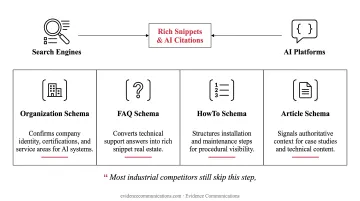
Schema markup has become a meaningful ranking and visibility lever in 2026. Implementing Organization, FAQ, HowTo, and Article schema helps both traditional search engines and AI platforms understand page context, increasing the likelihood of rich snippet appearances and AI citations.
For industrial companies, product specifications and service details translate well into structured formats. Most industrial competitors still skip this step — which makes it an accessible differentiator for teams willing to implement it.
Step 4: Create Proof-Based Content That Builds Buyer Confidence
The Core Philosophy for Industrial B2B
Content in 2026 must do two things simultaneously: rank by satisfying keyword intent and convert by building the kind of buyer confidence that comes from demonstrated capability, not marketing language. Content that contains real proof — case studies, performance data, third-party validation, application examples — accomplishes both goals.
This is where Evidence Communications' framework is particularly relevant. Their core insight: buyers don't need more information; they need less doubt. In industrial purchasing, the person who signs off owns the outcome personally — downtime, safety incidents, warranty claims, and reputational risk all land on them. Buyers look for evidence that makes a decision easier to defend internally, not more claims to process.
Optimize Product and Service Pages for High-Intent Searches
Each product or service page should target one primary bottom-of-funnel keyword, with on-page fundamentals in place:
- Keyword in the H1, title tag, URL, and within the first paragraph
- Clear H2/H3 structure that mirrors how a buyer evaluates options
- Meta description optimized for click-through, not just keyword inclusion
- Internal links to related cluster content
Beyond the technical basics, B2B product pages benefit directly from proof elements embedded on the page:
- Customer case studies with measurable outcomes
- Technical specifications and application parameters
- Certifications and compliance documentation
- Industry-specific application examples
These elements signal credibility to both buyers and search algorithms evaluating E-E-A-T (Experience, Expertise, Authoritativeness, Trustworthiness).
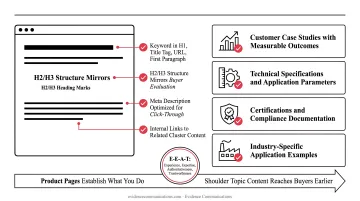
Product pages establish what you do. The next layer — shoulder topic content — reaches buyers before they've even settled on a solution category.
Build a Content Calendar Around Shoulder Topics
Rather than writing only about the product, create content around the challenges and questions that decision-makers are actively searching for. A hydraulic systems manufacturer writing about "how to reduce downtime in heavy equipment maintenance" reaches buyers during the research phase. At that point, those buyers haven't settled on a supplier category yet, let alone a specific vendor.
High-performing B2B content in 2026 shares specific characteristics:
- Long-form, original, deeply researched — not a summary of what AI already knows
- Includes proprietary data or first-party insights from real operating environments
- Addresses buyer questions that require experience to answer, not just information to relay
One long-form pillar article can feed LinkedIn posts, YouTube scripts, email sequences, and industry publication submissions. This is the core of Evidence Communications' Proof Operationalization and Distribution service — prioritizing LinkedIn and YouTube as the channels where industrial buyers actually form purchasing decisions, with the website supporting the system rather than carrying it alone.
Step 5: Build Off-Page Authority and Optimize for AI Search Visibility
The Three Most Effective Off-Page Strategies for Industrial B2B
- Publish original research, industry surveys, or data reports that earn citations from trade publications. A single well-researched industry report can attract ten times the linking domains of comparable content
- Activate existing partner, supplier, and industry association relationships to secure contextually relevant links. In industrial sectors, niche trade publications carry real authority even with modest domain ratings
- Contribute to platforms where B2B decision-makers in your vertical consume information — guest articles and podcast appearances build authority with the exact audience making purchasing decisions
Generative Engine Optimization (GEO)
To appear in AI-generated answers — Google AI Overviews, ChatGPT, Perplexity — content must be structured, authoritative, and citable. Research by Aggarwal et al. found that adding citations, quotations, and statistics to content produced relative visibility improvements of roughly 30–40% in generative engine responses.
Practical GEO requirements:
- Use FAQ sections that directly answer specific buyer questions
- Include clear definitions and structured explanations
- Implement schema markup (Organization, FAQ, Article)
- Build references from credible external sources — trade publications, industry associations, peer platforms
Brand signals matter too. An Ahrefs study of 75,000 brands found branded web mentions had the strongest reported correlation with brand visibility in AI Overviews (correlation of 0.664). For industrial companies, LinkedIn presence and industry association mentions function as high-trust brand signals that strengthen overall search authority and AI recommendation frequency.
For companies that want to measure where they stand, an AI visibility audit maps how often the business appears across platforms within real buyer search scenarios — surfacing gaps before a competitor fills that shortlist spot instead.
Frequently Asked Questions
What is the 80/20 rule of SEO?
Roughly 80% of SEO results come from 20% of efforts — typically a small set of high-intent keywords, a few authoritative pages, and foundational technical health. For B2B, this means prioritizing bottom-of-funnel keywords and proof-rich landing pages above all else rather than spreading effort across dozens of low-impact initiatives.
What is the 95/5 rule for B2B?
Developed by Professor John Dawes at the Ehrenberg-Bass Institute, the 95/5 rule holds that only about 5% of your total addressable market is actively buying at any given time. SEO keeps you visible and credible with the other 95% — so when they do enter the buying cycle, your company is already trusted.
What are the 4 types of B2B marketing?
The four commonly cited types are product-based, service-based, relationship-based, and digital/content-based marketing. B2B SEO supports all four by ensuring your company is findable and credible no matter what buyers are searching for or evaluating.
How is B2B SEO different from B2C SEO?
B2B targets multiple decision-makers rather than individual consumers, and its keywords carry lower search volume but higher commercial intent and CPC. Content must also support a longer sales cycle built on rational evaluation — not impulse purchasing. Together, these differences demand a distinct approach to keyword selection, content depth, and proof.
How long does it take to see results from B2B SEO?
Meaningful organic ranking improvements typically begin appearing within 3–6 months for lower-competition keywords and can take 6–12 months or more for highly competitive terms. Unlike paid campaigns, SEO compounds over time — making early investment in technical foundations and well-targeted content critical to long-term ROI.
What are the 7 P's of B2B marketing?
The 7 P's — Product, Price, Place, Promotion, People, Process, and Physical Evidence — were extended from the original 4 P's by Booms and Bitner in 1981. Each shapes the messaging and keywords a B2B company needs to reach decision-makers at the right stage of their research.