Introduction
A procurement manager at a mid-sized automotive manufacturer opens ChatGPT and types: "Who are the most reliable contract manufacturers for precision machined components in the Midwest?" Three competitors appear in the response. Your company — with tighter tolerances, a stronger quality record, and two decades of customer retention — isn't mentioned.
Your work isn't the problem. AI simply had no visible evidence to draw from.
This is the defining commercial risk for industrial and B2B companies right now. According to a 6sense survey of more than 4,000 B2B buyers, 94% used LLMs during their buying process, and first seller contact didn't occur until 61% of the journey was already complete. The same study found that 95% of winning vendors were already on the buyer's Day One shortlist — meaning the competitive selection was largely over before your sales team ever got the call.
This guide walks through what AEO is, why it matters more for B2B than most companies realize, and how to make your company visible to AI systems before buyers finalize their shortlists.
Key Takeaways
- AEO gets your brand cited by AI engines — ChatGPT, Perplexity, Google AI Overviews — when buyers ask questions in your category
- B2B buyers now use AI tools to shortlist vendors before contacting sales — making AI visibility a pre-sales priority
- Winning AI citations requires presence in both layers: pre-trained model data and real-time retrieval sources
- Effective AEO rests on three pillars: technical accessibility, structured proof content, and cross-platform authority
- AEO success is measured by citation frequency and share of voice, not rankings or click-through rates
What Is Answer Engine Optimization (AEO)?
Answer Engine Optimization is the discipline of structuring a company's content, technical infrastructure, and digital authority so that AI-powered platforms — ChatGPT, Google AI Overviews, Perplexity, Bing Copilot — surface and cite that company in their generated responses.
You'll also see it called by other names:
- Generative Engine Optimization (GEO)
- LLM Optimization (LLMO)
- AI search optimization
The terminology varies. The goal is the same: become the source AI recommends when buyers ask questions in your category.
How Answer Engines Differ from Search Engines
Traditional search engines return a ranked list of links. Answer engines synthesize information from multiple sources and deliver a single composed response. The company cited in that answer wins the moment. Every other company — regardless of their organic ranking — is invisible in that exchange.
The stakes are different. A company that ranks second on Google still gets seen. One that's absent from an AI-generated answer is eliminated from consideration — without the buyer ever knowing it existed.
AEO Builds on SEO — It Doesn't Replace It
AEO requires the same technical foundations as SEO: crawlability, domain authority, content quality, structured data. What it adds are layers specific to how AI systems select sources — things like entity authority, structured Q&A content, consistent citation signals across third-party channels, and topical depth that demonstrates expertise on a subject, not just a page.
Strong SEO creates the conditions for AEO to work. Weak SEO makes AEO nearly impossible. The two disciplines reinforce each other. Companies that treat them as competing priorities typically underinvest in both — and end up invisible in neither channel nor the other.
Why AEO Is Critical for B2B and Industrial Companies
The Proof Deficit Problem
Most industrial and B2B companies face a specific version of this challenge: they have genuine capabilities — certified processes, engineering expertise, track records of successful deployments — but haven't translated those capabilities into formats that AI systems can find, read, and cite.
Evidence Communications calls this the Proof Gap: the gap between what a company can actually do and what AI systems and buyers can verify across the open web. It's a common diagnostic finding across industrial sectors, and it shows up in predictable patterns:
- Case studies and customer success outcomes locked in internal sales decks
- Certifications, quality records, and performance data unpublished or inaccessible
- Engineering expertise shared only in verbal sales conversations, never documented publicly
- No third-party validation from trade publications, industry associations, or customer references visible online
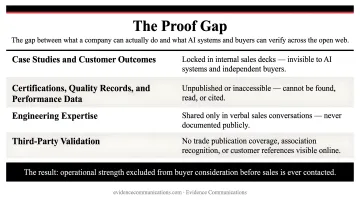
The result: a company with real operational strength is excluded from buyer consideration before sales is ever contacted.
The Compounding Disadvantage of Delayed Action
AI engines develop citation patterns based on which sources have consistently demonstrated authority over time. Proof visibility is not a one-time fix — it's a compounding asset. Companies that start earlier accumulate more credibility signals as competitors build their own proof infrastructure.
The downstream consequences of delay are concrete:
- Longer sales cycles — buyers who can't independently verify a company take more time to engage, or don't engage at all
- Price pressure — without visible credibility signals, companies compete on price rather than value
- Compressed multiples — for PE-backed or acquisition-minded companies, reduced market visibility directly impacts valuation
A window of asymmetric opportunity still exists for industrial companies willing to act. A small number of organizations have already adapted — and that gap is where challenger companies can gain disproportionate ground before competitors entrench their positions in AI training data and real-time retrieval indexes.
How Answer Engines Find and Cite Content
The Two-Source Model
AI engines draw from two distinct layers:
- Pre-trained datasets — massive corpora assembled before the model launched, including Common Crawl, Wikipedia, Reddit, and industry publications
- Real-time retrieval (RAG) — where the model fetches current web content when a query requires fresh or specific information
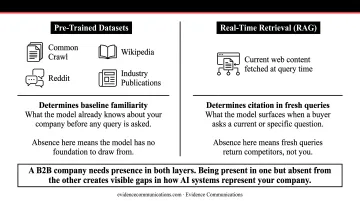
A B2B company needs presence in both layers. Pre-training determines baseline familiarity; real-time retrieval determines citation in fresh queries. Being present in one but absent from the other creates visible gaps in how AI systems represent your company.
What AI Engines Look for When Selecting Sources
Research from the GEO paper, which tested 10,000 queries across multiple datasets, found that adding source citations, quotations, or statistics produced approximately 30–40% relative visibility gains. Clear, fluent writing produced 15–30% gains. Keyword stuffing performed about 10% worse than baseline.
The characteristics that improve citation likelihood include:
- Direct, answer-first language — content that delivers a clear response within the first paragraph
- Scannable formatting — headers, lists, and tables that signal structure to AI crawlers
- Server-rendered HTML — content that loads as complete HTML without JavaScript dependencies
- Freshness signals — published and updated dates that indicate recency
- External authority — third-party mentions, citations, and references from credible sources
Why Third-Party Platforms Matter
AI engines don't cite brand websites alone. A Semrush analysis of 230,000 prompts across ChatGPT, Google AI Mode, and Perplexity found LinkedIn appearing in nearly 15% of Google AI Mode responses, with YouTube among the five most-cited domains.
For industrial and B2B companies, this creates a specific problem: proof content locked in gated PDFs, sales decks, or verbal presentations is invisible to AI systems.
To be retrievable, that content needs to exist in publicly accessible, crawlable formats:
- Case studies and customer references published on the web
- Technical explanations on indexed product or service pages
- Certifications and validation distributed across platforms AI systems draw from
Technical Crawlability Requirements
AI crawlers such as OpenAI's OAI-SearchBot and Perplexity's PerplexityBot have documented behaviors that affect what they can access:
- JavaScript rendering: Vercel's analysis of approximately 1 billion crawler requests confirmed that GPTBot and ClaudeBot do not execute client-side JavaScript. Content rendered only via JavaScript may be invisible to these crawlers.
- robots.txt and CDN settings must permit access to legitimate AI crawlers — blocking them removes your content from retrieval
- Page load speed affects indexing — slow pages are more likely to be skipped under limited crawler time budgets
- llms.txt — a root-level file that signals to AI crawlers what to index, not yet officially standardized — is worth monitoring as adoption develops
The 4 Core AEO Strategies for B2B Visibility
These four areas work in parallel, not in sequence. Delaying one undermines the others.
Establish Technical Accessibility First
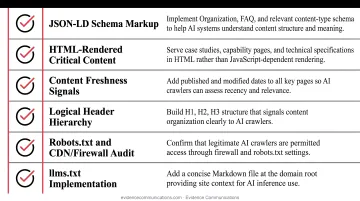
Before any content strategy can work, AI crawlers need to be able to reach and read your content. Essential technical foundations:
- Implement JSON-LD schema markup for Organization, FAQ, and relevant content types. While Google states that schema doesn't guarantee AI citation, it helps AI systems understand content structure and meaning.
- Serve critical content in HTML rather than JavaScript-dependent rendering, particularly for case studies, capability pages, and technical specifications
- Add content freshness signals — published and modified dates on all key pages
- Build a logical header hierarchy (H1, H2, H3) that signals content organization to crawlers
- Audit robots.txt and CDN/firewall settings to ensure legitimate AI crawlers are permitted access
- Consider implementing llms.txt, a simple Markdown file at the domain root that provides concise site context for AI inference use
Build and Publish Structured Proof Content
For B2B and industrial companies, proof content — case studies with specific outcomes, technical process explanations, certifications, client references — is the raw material AI engines need to cite a company with confidence.
This content must be:
- Published in public, crawlable formats: blog posts, dedicated case study pages, press releases, structured FAQs (not gated PDFs or internal decks)
- Written in direct, answer-first language: lead with the outcome or key fact, not with narrative context
- Structured for extraction: self-contained headers and paragraphs that communicate meaning even when pulled out of context
- Concise on key claims: structure proof statements within 160 characters where possible, front-loading the most important facts
Evidence Communications' Proof Gap Analysis identifies which proof assets are missing or inaccessible, then prioritizes what needs to be created or restructured first. For companies that aren't sure where to start, it provides a clear, sequenced action plan.
Distribute Proof Across Cross-Platform Authority
AI engines weight sources they encounter repeatedly across multiple platforms. For B2B and industrial companies, cross-platform authority means:
- LinkedIn: publish proof from engineers, operators, and customers (the voices that carry credibility with technical buyers)
- YouTube: document "how it works" explanations, in-field demonstrations, and customer application footage that buyers can verify without talking to sales
- Trade publications and industry forums: earn mentions and coverage that provide independent, third-party validation
- Directories and industry associations: consistent, accurate business information across all platforms reinforces AI trust signals
AI tools don't create credibility. They surface and reflect what already exists across the open web. The proof content on your website should be distributed in adapted forms across the platforms AI systems are known to cite.
Monitor, Measure, and Iterate
Profound's analysis of approximately 80,000 prompts per platform found that between 40.5% and 59.3% of cited domains changed in a single month across four major answer engines. Citation patterns are highly volatile, meaning a one-time audit tells you almost nothing about sustained visibility.
Ongoing monitoring requires:
- Run target prompts regularly across ChatGPT, Perplexity, Google AI Overviews, and Bing Copilot, covering awareness, comparison, and decision-stage buyer queries
- Track share of voice relative to named competitors to identify where competitors are being recommended instead
- Use AI visibility platforms such as Profound or Scrunch to automate monitoring at scale. Evidence Communications' proprietary AVAS™ (AI Visibility Assessment) provides the same ongoing tracking, evaluating how often a company appears across ChatGPT, Gemini, Claude, Perplexity, and Grok in buyer search scenarios.
- Configure GA4 to capture traffic originating from AI referral sources as a supplementary signal
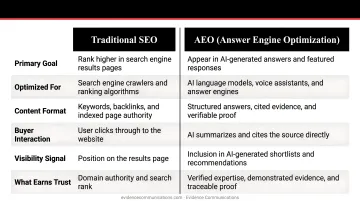
AEO vs. Traditional SEO: Understanding the Difference
| Dimension | Traditional SEO | AEO |
|---|---|---|
| Goal | Rank in search results | Be cited in AI-generated answers |
| Success metric | Rankings, organic traffic | Share of voice, citation frequency |
| User behavior | Click through to website | May never visit your site |
| Content format | Keyword-optimized pages | Answer-first, structured for extraction |
| Foundation | Crawlability, authority, content quality | Same, plus AI-specific formatting and distribution |
The Zero-Click Implication
When AI delivers a complete answer, Pew Research found that users clicked a traditional result on only 8% of visits with an AI summary present, versus 15% without one. Users clicked a source link inside the summary on just 1% of visits.
For B2B and industrial companies, this flips the usual measurement logic: your brand can influence a buyer's shortlist decision without that buyer ever visiting your website. Citation presence has commercial value even when it generates no measurable traffic.
A buyer who sees your company named as a reliable supplier in an AI response carries that impression into their next conversation — a vendor call, a procurement review, or an RFQ decision — regardless of whether they ever clicked through.
Don't measure AEO success by website traffic alone. Track citation frequency, brand mention share in AI responses, and whether your company appears when buyers search for the problems you solve.
How to Measure and Track Your AEO Performance
Establish a Baseline First
Start by identifying the specific prompts B2B buyers in your category are likely to ask AI tools — spanning awareness ("Who are the leading suppliers of X?"), comparison ("How does X compare to Y for Z application?"), and decision stages ("What should I look for when evaluating a supplier for X?").
Run these prompts manually across ChatGPT, Perplexity, Google AI Overviews, and Bing Copilot. Document:
- Where your company is cited and in what context
- Where you're absent and which competitors appear instead
- Which specific content pages or platforms are driving citations when you do appear
This baseline becomes your benchmark for measuring progress and identifying the highest-priority content gaps to close.
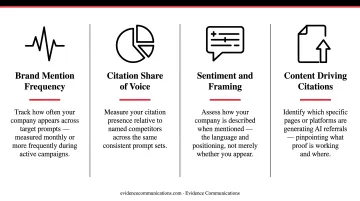
Key Metrics to Track Over Time
- Brand mention frequency across target prompts, measured consistently (monthly, or more frequently in active campaigns)
- Citation share of voice relative to named competitors across the same prompt sets
- Sentiment and framing — how your company is described when mentioned, not just whether it appears
- Specific content driving citations — which pages or platforms are generating AI referrals
Connect Visibility to Commercial Outcomes
Visibility scores alone don't justify the investment. For B2B companies, the downstream indicators that AEO is influencing the pre-sales research phase include:
- Growth in branded search volume — buyers who encountered your company in AI responses often search for you directly afterward
- Increase in inbound inquiries from well-researched buyers — buyers who arrive already familiar with your capabilities, requiring less qualification time
- Shorter sales cycles — when proof of credibility is visible before the first call, buyers arrive with confidence already formed and less ground to cover
These indicators won't move in weeks. Sustainable AI visibility requires consistent publishing, technical maintenance, and cross-platform authority-building over months. When the commercial signal does appear, it reflects real influence on buyer behavior — before the first conversation ever happens.
Frequently Asked Questions
What is Answer Engine Optimization (AEO)?
AEO is the practice of structuring content, technical infrastructure, and digital authority so AI-powered platforms like ChatGPT, Perplexity, and Google AI Overviews cite your company in their generated responses. Unlike traditional SEO, which targets rankings in search results pages, AEO targets citations within synthesized answers — where buyer shortlisting now increasingly happens.
How is AEO different from SEO?
SEO optimizes for ranked links and click-through rates. AEO optimizes for being named within AI-synthesized answers. Both share technical and content foundations — crawlability, authority, content quality — and strong SEO practices support AEO rather than compete with it. The difference lies in how success is measured: rankings versus citation presence.
Why does AEO matter specifically for B2B and industrial companies?
B2B and industrial buyers use AI tools to research and shortlist vendors before ever contacting sales — meaning companies invisible to AI answer engines are removed from consideration before the sales conversation begins. The proof assets most industrial companies hold (certifications, case studies, engineering expertise) are often inaccessible to AI systems, creating a gap between real capability and market visibility.
What types of content are most likely to be cited by AI answer engines?
Content that is direct, answer-first, and publicly accessible performs best. Structured formats — FAQs, lists, comparison tables, technical explanations with clear headers — make content easier for AI systems to extract. Pages with freshness signals (published and updated dates), schema markup, and server-rendered HTML also improve accessibility for AI crawlers.
How do I find out if my company is appearing in AI search results?
Start by running relevant buyer prompts manually across ChatGPT, Perplexity, and Google AI Mode and checking for brand mentions. Platforms like Profound or Scrunch automate this at scale. Evidence Communications' AVAS™ diagnostic provides a structured assessment of citation frequency across major AI platforms in actual buyer search scenarios.
How long does it take to see results from AEO efforts?
AI visibility improvements can appear faster than traditional SEO since citation patterns update more dynamically. Sustainable visibility, however, requires consistent publishing, technical maintenance, and cross-platform authority-building over months rather than weeks.