Introduction
Clients are asking a question that traditional SEO tools can't answer: "Why is our competitor showing up when buyers ask ChatGPT who to use — and we're not?"
That question has become one of the most common pressure points in agency-client relationships. Gartner forecast in 2024 that traditional search volume would fall 25% by 2026 due to AI chatbots and virtual agents.
That shift is already showing up in buyer behavior. A Gartner survey of 645 B2B buyers in May 2026 found that 45% already use generative AI to research vendors and products — before any sales conversation takes place.
When buyers shift to AI-generated answers, rank tracking tools stop being relevant. They measure positions on search results pages — not citations inside ChatGPT, Perplexity, or Gemini responses. That's a different problem, and it requires a different category of tool.
This guide covers the 7 best AI visibility tools built specifically for agency workflows in 2026, evaluated on multi-client management, AI engine coverage, reporting depth, and partner support.
TL;DR
- AI visibility tools track brand mentions inside AI-generated responses — something traditional rank trackers don't capture
- Agency-grade tools need multi-client dashboards, pitch environments, and reporting integrations — not just monitoring dashboards
- Strong tools go beyond tracking: they surface sentiment analysis, citation attribution, and optimization workflows
- Top picks include Profound (enterprise depth), Otterly.AI (affordability), AthenaHQ (agency lead matching), and Peec AI (pitch-ready reporting)
- Tracking without a content strategy produces dashboards, not results — gaps still need to be closed
What Is AI Visibility and Why Marketing Agencies Can't Ignore It
AI visibility tracking monitors how often, in what context, and with what sentiment a brand appears inside AI-generated answers from platforms like ChatGPT, Claude, Perplexity, and Google's AI Overviews. The key distinction: this isn't about whether a website ranks on a results page — it's about whether the brand is named in the answer itself.
Why does that distinction matter commercially? In 2024, 58.5% of US Google searches produced no click at all. Organic CTR on queries where AI Overviews appeared fell from 1.76% to 0.61% between June 2024 and September 2025 — a 61% decline. Traffic data alone no longer captures where buyers first encounter and evaluate brands.
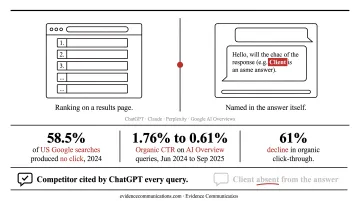
For agencies, the accountability question follows directly: if a client's competitor is being cited by ChatGPT every time a buyer researches that product category, and your client isn't — that gap costs deals before a salesperson ever enters the conversation. Agencies that can measure and manage AI presence are building a capability most clients don't yet know how to ask for — but will.
7 Best AI Visibility Tools for Marketing Agencies in 2026
These tools were selected based on agency-specific utility: multi-client dashboards, pitch environments, engine breadth, and the depth of actionable recommendations beyond passive monitoring.
Profound
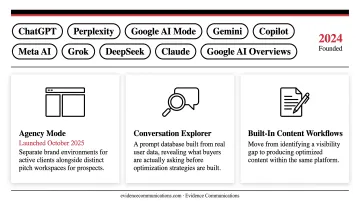
Founded in 2024, Profound has positioned itself as one of the more comprehensive enterprise-grade AI visibility platforms available. Its engine coverage currently includes ChatGPT, Perplexity, Google AI Mode, Gemini, Copilot, Meta AI, Grok, DeepSeek, Claude, and Google AI Overviews — one of the broadest sets in the category.
The standout feature for agencies is Agency Mode, launched in October 2025, which creates separate brand environments for active clients alongside distinct pitch workspaces for prospects. The Conversation Explorer — a prompt database built from real user data — helps agencies identify what buyers are actually asking before building optimization strategies around it.
Content creation workflows are built in, so agencies can move from identifying a gap to producing content within the same platform.
| Key Features | Agency Mode, Conversation Explorer, prompt volume data, agent analytics, content optimization workflows |
| Best For | Large agencies managing multiple enterprise-level client accounts |
| Pricing | Agency Growth starts at $99/month (10 pitch workspaces); full client workspaces at $399/month each; Enterprise pricing on request |
Otterly.AI
Otterly.AI is among the most accessible entry points in this category — a straightforward platform that converts existing target keywords into related LLM prompts, making onboarding fast for agencies new to AI search services.
The GEO Audit feature scans pages for AI-search visibility and citation readiness, and the Prompt Research tool surfaces relevant prompts for a given brand. Core plans track ChatGPT, Google AI Overviews, Perplexity, and Microsoft Copilot — with Claude, Google AI Mode, and Gemini available as paid add-ons.
There are no built-in content workflows, and engine breadth is narrower than enterprise alternatives. For smaller agencies or those piloting AEO services with new clients, the entry pricing is a practical starting point.
| Key Features | GEO audit, brand sentiment monitoring, keyword-to-prompt conversion, optimization guidance |
| Best For | Smaller agencies or teams getting started with AEO client services on a limited budget |
| Pricing | Lite at $25/month (billed annually); Standard at $160/month (billed annually); free 7-day trial, no credit card required |
Peec AI
Peec AI is built specifically for agency and enterprise team workflows. Its Pitch Workspaces feature lets agencies share AI visibility reports with prospects — a practical tool for winning new AEO business by showing a brand's current AI presence before a contract is signed.
AI-generated prompt suggestions based on a client's domain speed up onboarding, and a native Looker Studio connector enables live dashboard reporting without manual CSV exports. Current engine coverage includes ChatGPT, Gemini, Perplexity, Microsoft Copilot, and Google AI Overviews.
| Key Features | Pitch Workspaces, competitor benchmarking, daily tracking, Looker Studio connector, AI-generated prompt suggestions |
| Best For | Agencies needing client-ready reporting and prospect pitch tools |
| Pricing | Starter at $95/month; free 7-day trial available — verify current tiers at peec.ai/pricing as plans update frequently |
AthenaHQ
AthenaHQ offers something structurally different from most tools: unlimited user seats across all plans. For agencies with multiple client teams accessing the platform, this eliminates a significant cost variable that compounds quickly on per-seat pricing models.
The agency partnership program goes beyond the tool itself — AthenaHQ refers qualified leads to partner agencies based on their focus areas, adding a genuine business development dimension. Integrations include GA4, Google Search Console, Looker Studio, and Tableau. Client and pitch workspaces are available on paid plans.
| Key Features | Unlimited seats, agency lead referrals, client/pitch workspaces, web analytics, GA4 and GSC integrations |
| Best For | Agencies wanting to grow their AEO practice with platform-driven lead generation support |
| Pricing | Multiple tiers available — verify current structure at athenahq.ai/plans, as pricing has been updated from earlier published figures |
Scrunch
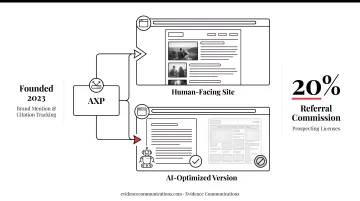
Founded in 2023, Scrunch combines brand mention and citation tracking with one genuinely differentiated feature: the Agent Experience Platform (AXP). AXP automatically generates an AI-optimized version of a client's website and delivers that version directly to AI bots — without requiring any changes to the human-facing site.
For agencies with clients whose sites are JavaScript-heavy or image-dense, this matters. AI crawlers struggle to extract content from those formats; AXP routes around that problem structurally rather than requiring a full technical rebuild. Scrunch's agency program includes a 20% referral commission and prospecting licenses.
| Key Features | AXP (AI-optimized site delivery), citation tracking, agency prospecting licenses, 20% referral commissions |
| Best For | Agencies with clients whose websites structurally limit AI crawler access |
| Pricing | Standard plans start at $250/month; Agency Core at $500/month; Agency Enterprise on request |
Semrush AI Visibility Toolkit
For agencies already running on Semrush, this toolkit extends existing infrastructure rather than adding a new platform to manage. It extends existing SEO infrastructure into AI search tracking — covering ChatGPT, Gemini, Google AI Overviews/AI Mode, and Perplexity — and draws on a database of more than 289 million prompts and responses.
The integration advantage is real: when the toolkit surfaces an AI visibility gap, keyword research, backlink analysis, and site audit tools are a click away in the same platform. No separate login, no context switching. Worth noting — reviews on G2 reflect Semrush as a whole platform, not this toolkit specifically.
| Key Features | 289M+ prompt database, brand mentions, sentiment tracking, competitor benchmarking, full Semrush SEO integration |
| Best For | Agencies already using Semrush who want AI visibility within their existing workflow |
| Pricing | Add-on starting at $99/month per domain; see semrush.com/pricing/ai for current subscription requirements |
Brandlight
Brandlight emerged publicly in April 2025 with $5.75M in pre-seed funding. What distinguishes it in this category is built-in A/B testing for content optimization — the ability to measure whether specific content changes actually move AI visibility metrics, not just theorize about it.
The partnerships product identifies publishers and media relationships that influence how AI systems cite a brand, which is useful for large content agencies managing consumer brands with broad citation footprints. Because Brandlight is early-stage, there is no meaningful independent review base yet — factor that into vendor risk assessment for enterprise commitments.
| Key Features | Built-in content optimization, A/B testing for visibility impact, outreach target identification, competitive analysis, executive dashboards |
| Best For | Large content agencies managing consumer brands who need to prove content ROI on AI visibility |
| Pricing | Custom pricing; request a demo at brandlight.ai |
What Marketing Agencies Should Look for in an AI Visibility Tool
Not every tool in this category was designed with agency operations in mind. Before committing to a platform, evaluate these dimensions:
Multi-client management — Single-brand dashboards create operational friction at agency scale. Look for dedicated client workspaces with proper data isolation, plus pitch environments for prospecting. Tools that treat multi-brand management as an afterthought require expensive workarounds as the client roster grows.
Engine coverage — There's no established industry standard for minimum engine count, but the practical floor for most client bases is ChatGPT, Perplexity, Google AI Overviews, and Gemini. For B2B and industrial clients — the kinds Evidence Communications works with — buyers may also be using Claude or Copilot for vendor research, so broader coverage reduces the risk of missing citation gaps where competitors are winning.
Monitor vs. monitor-and-act — Some platforms surface visibility scores and stop there. Others include content optimization workflows, writing tools, and actionable recommendations. The right depth depends on what services the agency is selling — tracking-only tools can't support a full AEO retainer without a separate content stack alongside them.
Reporting and integrations — Native connections to Looker Studio, GA4, or BI platforms matter for agencies running regular client reporting cycles — CSV exports alone won't sustain a reporting workflow. Peec AI and AthenaHQ both offer native Looker Studio integration; confirm this before signing a contract.
Pricing at scale — Most tools price by prompt volume, engine count, and seat count. A plan that looks affordable for one client can balloon quickly across a full roster. Calculate total cost at expected client count before committing to annual terms.
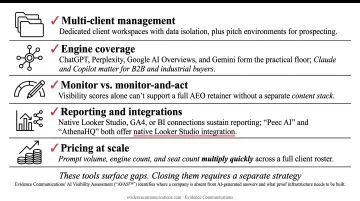
These tools surface gaps — but closing them requires a separate strategy. For B2B and industrial companies, building the content and proof infrastructure that AI engines actually cite is a deliberate, structural effort.
Evidence Communications' AI Visibility Assessment (AVAS™) is designed for that diagnostic step: identifying where a company is absent from AI-generated answers and what proof infrastructure needs to be built to change that.
How We Selected These Tools
These tools were assessed on:
- Agency-specific functionality — multi-client dashboards, pitch environments, partner programs, and referral economics
- Engine coverage breadth — how many AI platforms are tracked and at what tier
- Insight depth — passive monitoring only vs. actionable optimization workflows
- Integration capabilities — native connections to reporting and analytics platforms
- Pricing transparency — public pricing and scalability as your client base grows
- Third-party reviews — G2, Capterra, and Slashdot where product-specific data was available (Scrunch: 4.6/5 from 73 reviews; AthenaHQ: 4.9/5 from 34 reviews; Peec AI: 4.9/5 from 12 reviews)
This category moves fast. New platforms launch regularly, feature sets shift quarterly, and pricing can change without notice — as several tools in this guide already reflect. Prioritize tools with active development roadmaps and transparent support before committing to annual contracts.
Conclusion
The right AI visibility tool for a marketing agency depends on four things: client size and complexity, existing tech stack, whether the agency needs monitoring-only or a full monitor-and-act workflow, and whether agency growth support — like lead referrals and pitch environments — is a business priority.
The tools on this list cover that range. Profound and Peec AI emphasize multi-client operations and pitch workflows. AthenaHQ adds unlimited seats and lead referral economics. Scrunch solves structural content delivery problems for technically constrained client sites. Semrush fits agencies already running on that platform. Otterly.AI keeps the cost of entry low. Brandlight offers advanced content experimentation for agencies that need to prove content ROI.
None of them, however, solve the underlying problem. Visibility data shows where clients are absent from buyer consideration, but earning citations requires the content, proof points, and credibility signals that AI engines actually reference. Tracking without that foundation produces dashboards, not pipeline.
For B2B and industrial companies whose agencies have identified AI visibility gaps, Evidence Communications helps translate real operational capability into evidence-based content that earns citations and builds buyer confidence before a sales call happens.
The starting point is an AI Visibility Assessment (AVAS™) — a diagnostic that identifies exactly where a company is absent from AI-generated answers and what needs to change. Reach out at jvargas@evidencecommunications.com to start that conversation.
Frequently Asked Questions
What is AI visibility tracking and why does it matter for marketing agencies?
AI visibility tracking monitors how and where a brand appears inside AI-generated responses from platforms like ChatGPT, Perplexity, and Gemini. Agencies need this capability because buyers increasingly use AI tools to research and shortlist vendors before any sales interaction — meaning brands not cited in those answers are being removed from consideration before the sales team ever gets involved.
How is AI visibility different from traditional SEO tracking?
Traditional SEO tools track keyword rankings on search results pages. AI visibility tools track whether a brand is mentioned inside the AI-generated answer itself. With organic CTR falling 61% on queries where AI Overviews appear, being cited in the answer has become more commercially significant than appearing in the results list below it.
Can AI visibility tools manage multiple client brands at once?
The best agency-grade tools — Profound, AthenaHQ, Peec AI, and Scrunch — include dedicated multi-client dashboards and client workspaces. Not all tools support this natively. Agencies should confirm multi-brand data isolation and per-seat pricing before selecting a platform.
What answer engines should agencies track for their clients?
ChatGPT, Perplexity, Google AI Overviews, and Gemini are the practical baseline for most client bases. For B2B and industrial clients specifically, Claude and Copilot are also worth tracking — buyers in those sectors often use a different mix of AI tools when evaluating vendors during longer research cycles.
How do AI visibility tools help agencies prove ROI to clients?
The strongest tools provide share-of-voice scores, competitive benchmarking, sentiment trends, and citation attribution. Together, those metrics give agencies trackable, client-ready reporting on how AI search visibility is shifting over time and against named competitors — a proof point organic rank position alone cannot provide.
Do B2B brands need AI visibility tools differently than B2C brands?
B2B buyers — particularly in industrial and technical sectors — conduct longer, more verification-heavy research cycles and are more likely to use AI to compare vendors before contacting anyone. Whether a brand is cited or not can determine shortlist inclusion before a decision-maker ever picks up the phone. For B2B brands, the cost of that invisibility is a missed sales conversation, not just a missed click.