If your proof isn't visible where buyers are looking, you're not losing deals. You're being excluded before they start.
This guide covers what B2B lead generation actually is, why the rules changed, and 15 strategies that industrial and B2B companies can act on now.
Key Takeaways
- B2B buyers complete over half their research before contacting any vendor
- MQLs need nurturing; SQLs need fast-tracking — knowing the difference matters
- Buying committees now include 13+ internal stakeholders on average
- A "proof deficit" removes companies from consideration before sales ever gets the call
- The best lead generation combines inbound credibility-building with targeted outbound outreach
What Is B2B Lead Generation?
B2B lead generation is the structured process of identifying ideal business buyers, generating interest in your product or service, and guiding those prospects toward a purchase decision.
It differs from B2C in three critical ways:
- Buying committees — multiple stakeholders influence the decision, not just one person
- Longer sales cycles — weeks or months, not hours or days
- Organizational proof — buyers need evidence that holds up to internal scrutiny, not just personal appeal
Modern B2B lead generation spans both inbound and outbound channels: content marketing, SEO, cold email, LinkedIn outreach, referrals, paid advertising, and event marketing. No single channel dominates — the companies that generate leads most reliably run multiple channels in parallel, each reinforcing the others.
Understanding which channels you're running only gets you halfway there. What matters next is knowing what kind of lead each one produces — and what that lead actually needs from you.
Types of B2B Leads
Marketing Qualified Leads (MQLs) have shown early-stage interest — downloading gated content, visiting key pages, signing up for a newsletter. They're not ready for sales; they need nurturing before a rep's time is well spent.
Sales Qualified Leads (SQLs) have demonstrated clear purchase intent: requesting a demo, responding to outbound outreach, asking for a proposal. These leads must be prioritized immediately — research consistently shows response time within the first hour dramatically increases conversion rates compared to following up even a few hours later.
Why B2B Lead Generation Is Critical in an AI-Driven Marketplace
The Shortlist Forms Before You Get the Call
The 6sense data above tells a stark story, but the practical consequence is even more striking: 95% of buyers purchased from a vendor already on their initial shortlist, and 94% ranked that shortlist before contacting any seller. If you're not on the list when research begins, you won't be on it when the decision is made.
The 2024 Edelman-LinkedIn B2B Thought Leadership Impact Report adds another dimension: 73% of B2B decision-makers said thought leadership was a more trustworthy basis for assessing a company's capabilities than product sheets or conventional marketing materials. Buyers are forming opinions through content and credibility signals long before sales gets involved.
The Proof Deficit Problem
Evidence Communications describes this dynamic through the concept of the "Proof Gap" — the gap between a company's real operational capability and what AI tools and buyers can actually find and verify online. The language they use is deliberate: "Buyers form their shortlist before sales ever gets involved."
When a buyer uses ChatGPT, Perplexity, or Claude to research suppliers in your category, the AI surfaces companies whose proof is visible across the open web. No case studies, no YouTube demonstrations, no LinkedIn validation from engineers or operators? The company doesn't appear — and the buyer never knows it was an option. This is how capable industrial and B2B companies are eliminated from consideration: not through a lost pitch, but through absence.
The Buying Committee Reality
A typical B2B decision now involves 13 internal stakeholders and nine external influencers. A single asset that tries to speak to everyone ends up speaking to no one. Effective lead generation means producing proof that addresses each stakeholder's specific concerns:
- Engineering teams need technical demonstrations and operational specifics
- Procurement needs defensible risk assessment and verifiable performance data
- Executive leadership needs confidence the choice holds up at the board level
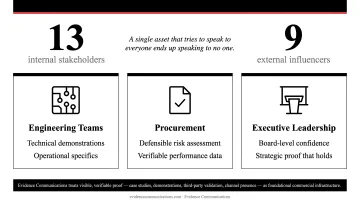
For industrial companies, Evidence Communications treats this kind of visible, verifiable proof — case studies, demonstration assets, third-party validation, channel presence — as foundational commercial infrastructure.
The B2B Lead Generation Process: Three Key Steps
Step 1 — Identify Your Ideal Buyer
Build a detailed Ideal Customer Profile (ICP) by defining:
- Company attributes: industry, size, organizational structure
- Decision-maker titles and the roles they play in purchases
- Key pain points and purchase criteria
- Barriers to buying (risk aversion, internal approval chains, budget cycles)
In industrial B2B contexts, personas differ meaningfully across functions. An engineer evaluating a new component manufacturer asks different questions than the procurement officer approving the contract or the COO signing off on the investment. Your ICP needs to account for all three.
Step 2 — Choose Your Strategies and Channels
Channel selection depends on your specific buyers, not a generic formula. Start by answering three questions:
- Where do your target buyers actually spend time during research?
- What stage of the buying journey are they in — awareness, consideration, or decision?
- Which channels can your team execute on consistently, not just launch once?
The answers shape which of the 15 strategies below deserve your attention first.
Step 3 — Qualify and Prioritize Leads
The BANT framework (Budget, Authority, Need, Timing) gives sales teams a practical lens for assessing lead readiness. Pair it with lead scoring to prioritize who deserves immediate attention.
Assign point values to buyer behaviors:
| Behavior | Score |
|---|---|
| Whitepaper download | Low |
| Webinar attendance | Medium |
| High-value page visit | Medium-High |
| Demo request | High |
| Proposal inquiry | Highest |
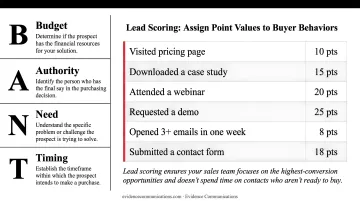
Lead scoring ensures your sales team focuses on the highest-conversion opportunities and doesn't spend time on contacts who aren't ready to buy.
15 Proven B2B Lead Generation Strategies
Content and Thought Leadership Strategies
Strategy 1 — Build SEO-driven content that matches how buyers search
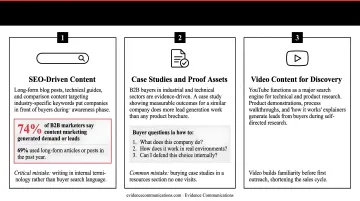
Long-form blog posts, technical guides, and comparison content targeting industry-specific keywords put companies in front of buyers during the awareness phase. The critical mistake: writing in internal terminology rather than the language buyers actually search. A precision machining company writing about "tolerance optimization" may miss buyers searching "CNC machining for aerospace parts."
74% of B2B marketers say content marketing generated demand or leads, and 69% used long-form articles or posts in the past year.
Strategy 2 — Publish case studies and proof assets prominently
B2B buyers — especially in industrial and technical sectors — are evidence-driven. A case study showing measurable outcomes for a similar company does more lead generation work than any product brochure. The common mistake is burying case studies in a resources section no one visits.
Evidence Communications treats case study development as commercial infrastructure: structured to answer the three questions buyers ask independently before contacting sales — What does this company do? How does it work in real environments? Can I defend this choice internally?
Strategy 3 — Invest in video content for discovery and credibility
YouTube functions as a major search engine for technical and product research. Companies publishing product demonstrations, process walkthroughs, or "how it works" explainers generate leads from buyers who discover them during self-directed research. Video builds familiarity before the first outreach, which shortens the sales cycle when contact finally happens.
Digital Optimization Strategies
Strategy 4 — Optimize landing pages and CTAs
Clear value propositions, low-friction lead capture forms (ask only for what you need), and interactive elements measurably improve conversion rates. 38% of B2B buyers identified interactive content as compelling in recent research. If your landing pages are static and form-heavy, that's a conversion problem, not a traffic problem.
Strategy 5 — Run ongoing A/B tests
Small variables produce outsized results. In one documented case, Databricks tested LinkedIn Message Ad copy — putting a hyperlink in the first sentence nearly doubled clicks and conversions. WorkZone changed colored customer logos to black and white and increased lead-form submissions by 34%. Optimization is a process, not a one-time launch decision.
Strategy 6 — Ensure full mobile optimization
A significant share of B2B research now happens on mobile devices — during travel, between meetings, at trade shows. Competitors in industrial sectors have been slow to optimize for mobile, which creates a real advantage for those who do. A site that performs poorly on mobile eliminates you from consideration before any conversation starts.
Outbound and Social Selling Strategies
Strategy 7 — Use LinkedIn for targeted outreach and thought leadership
73% of B2B decision-makers trust thought leadership more than product sheets for assessing vendor capabilities, and 75% said a piece of thought leadership prompted them to research a product they hadn't previously considered (Edelman-LinkedIn, 2024). Combine consistent content publishing with personalized connection outreach — build visibility before making a direct ask.
Strategy 8 — Cold email and sales cadences
Structured outreach sequences — combining email, LinkedIn messages, and follow-up calls — give sales teams the best chance of reaching prospects. Personalization based on company-specific research dramatically outperforms templated mass email. Gong's analysis of 300M cold calls found top-quartile reps connect at 13.3% versus 5.4% for average reps — a gap explained almost entirely by cadence discipline and message quality, not volume.
Strategy 9 — Ask for referrals systematically
Referrals are among the highest-converting lead sources in B2B. Forrester found 82% of B2B buyers trusted coworkers and management as information sources — making peer referrals the highest-trust channel measured. Most sales professionals never ask. Build a structured referral request into post-project follow-up and contract renewal conversations. The conversion rate on referrals typically makes it the most efficient outreach motion in the mix.
Trust, Proof, and Relationship-Building Strategies
Strategy 10 — Collect and display reviews and testimonials
Clutch found that 94% of B2B buyers used an online review in a buying decision, with 47% reading at least six reviews before engaging a vendor. G2's research found that 31% of B2B decision-makers named public review sites as their most-consulted source — up from 13% in 2021. Make review solicitation a standard step in your client success process. Testimonials sitting in a shared folder are not doing lead generation work.
Strategy 11 — Invite guest contributors and subject-matter experts
Co-authored content, expert interviews, and guest contributions expand reach into new audiences while adding third-party credibility. This is the B2B equivalent of influencer marketing: when a respected industry voice associates with your company, their audience becomes a lead generation channel. A respected manufacturing engineer sharing your content reaches an audience your marketing budget can't buy.
Strategy 12 — Distribute proof across buyer-facing channels
For industrial and B2B companies, the most effective trust-building approach is systematic proof distribution — not a one-time campaign, but ongoing infrastructure.
Evidence Communications builds this as a structured system: real-world demonstrations, verified performance data, client validation, and capability documentation distributed across the channels buyers actually use. That means LinkedIn for peer and operator proof, YouTube for "how it works" demonstrations, trade publications for independent validation, and AI platforms for discoverability.
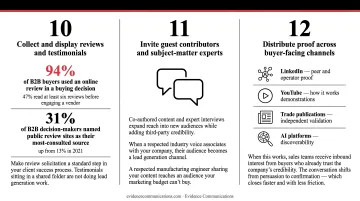
When this works, sales teams receive inbound interest from buyers who already trust the company's credibility. The conversation shifts from persuasion to confirmation — which closes faster and with less friction.
Data-Driven and Account-Based Strategies
Strategy 13 — Implement account-based marketing (ABM)
ABM focuses resources on a defined list of high-value target accounts rather than broad audience marketing. Demandbase's analysis of 1,452 companies found that engaging buying groups and increasing sales touches is associated with 2-3x higher win rates, larger deal sizes, and more predictable pipeline. In complex industrial sales environments with multi-stakeholder committees, ABM's precision outperforms volume-based approaches.
Strategy 14 — Personalize web content for buyer personas
Website content can be dynamically tailored by industry, role, or geography. A procurement manager at a manufacturing company and a CTO at a tech firm should not see identical messaging. Forrester found that 82% of global B2B marketing decision-makers agreed buyers expect experiences tailored to their specific needs — and 63% of B2B marketers have already adopted some form of personalization.
Strategy 15 — Use lead scoring and structured outreach cycles
Assign point values to buyer behaviors — webinar attendance, gated content downloads, high-value page visits — and use those scores to prioritize outreach. Structure when your team prospects as well. Not every day yields equal results, and organizing outreach cadences around high-connection windows improves efficiency without adding headcount.
How to Measure B2B Lead Generation Success
Track four metrics — not just lead volume:
| Metric | What It Measures |
|---|---|
| Conversion Rate | % of leads who take a desired action |
| Cost Per Lead | Total spend ÷ leads generated |
| Lead Quality | Measured by lead scoring and close rates |
| Return on Investment | Revenue generated relative to total lead gen investment |
CRM and marketing automation tools tie these together. Integrating lead capture forms, email campaigns, and sales outreach data into a single CRM gives a complete view of the lead journey from first touch to closed deal — and reveals which channels are producing the highest-quality opportunities, not just the most volume.
That data only drives decisions when sales and marketing are working from the same definitions. When both teams agree on what constitutes a qualified lead and measure against the same benchmarks, conversion rates improve and pipeline reviews become strategic rather than political. Conduct regular joint reviews where both teams evaluate lead quality against what's actually closing.
Frequently Asked Questions
What is B2B lead generation?
B2B lead generation is the process of identifying and attracting ideal business buyers, then guiding them toward a purchase decision. It differs from B2C primarily in the complexity of buying committees, longer sales cycles, and the need for organizational-level proof rather than personal persuasion.
What are examples of B2B lead generation?
Common examples include publishing SEO-optimized content, running LinkedIn outreach campaigns, hosting webinars, distributing case studies, cold email sequences, referral programs, and attending industry trade shows. Most effective strategies combine several of these at once.
What is the average cost per lead for B2B?
Cost per lead varies significantly by industry and channel. First Page Sage's 2026 benchmarks show blended CPLs ranging from $237 for B2B SaaS to $553 for manufacturing and $651 for professional services. Lead quality matters more than raw volume — a cheap lead that never converts is more expensive than a pricier one that closes.
What are the main types of B2B marketing?
The four primary categories are inbound marketing (SEO, content, social), outbound marketing (cold outreach, paid ads, direct calling), account-based marketing (ABM), and demand generation. Most effective B2B programs combine inbound and outbound rather than relying on either alone.
What is the difference between inbound and outbound B2B lead generation?
Inbound attracts buyers through content and visibility — they find you. Outbound involves proactively reaching target prospects — you find them. Inbound builds long-term pipeline; outbound can produce faster results. The two work best together: inbound builds credibility so outbound outreach lands with a warm audience.