Introduction: Why More B2B Companies Are Outsourcing Their Marketing
B2B buyers have changed how they decide — and most companies haven't caught up. According to 6sense's 2024 Buyer Experience Report covered by Demand Gen Report, buyers are nearly 70% through their purchasing process before engaging a seller — and they initiate first contact 80% of the time. Buyers are forming shortlists, comparing suppliers, and eliminating options before sales ever gets involved.
For industrial and technical B2B companies, this creates a specific problem: deep operational capability with little commercial infrastructure to communicate it. A manufacturer with 30 years of precision engineering expertise may be invisible to a buyer using AI tools to research suppliers on a Tuesday afternoon.
Outsourcing marketing functions is a strategic response to this shift. The goal is building the commercial infrastructure that shapes buyer perception before a buyer ever requests a call.
This guide covers:
- What B2B marketing outsourcing actually means
- The four functions you can outsource
- Key benefits and when outsourcing makes sense
- How to choose the right partner
- Common pitfalls that derail outsourcing engagements
Key Takeaways
- B2B buyers complete most of their research before engaging sales — outsourcing helps close the credibility gap before that first conversation
- Four functions can be outsourced: product marketing, demand generation, content marketing, and account-based marketing (ABM)
- Outsourcing delivers faster time-to-market and eliminates the overhead of building internal capability from scratch
- The right partner brings strategic orientation, not just execution capacity
- Defining quality-based success metrics before engagement begins is non-negotiable
What Is B2B Marketing Outsourcing?
B2B marketing outsourcing is the practice of delegating specific marketing functions — content creation, thought leadership, demand generation, commercial messaging — to external specialists, while retaining internal ownership of strategy and commercial goals.
The scope matters. Marketing outsourcing and sales outsourcing are not interchangeable:
| Marketing Outsourcing | Sales Outsourcing | |
|---|---|---|
| Focus | Buyer education, credibility, content | Cold outreach, SDRs, appointment setting |
| Timing | Pre-sales research phase | Active sales engagement |
| Goal | Shape buyer perception before contact | Execute pipeline activity |
| Output | Brand visibility, proof, buyer confidence | Meetings, proposals, closed deals |
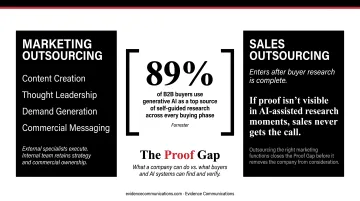
That gap between the two columns is where deals get won or lost before sales ever enters the picture. Forrester reports that 89% of B2B buyers had adopted generative AI as a top source of self-guided information across every buying phase. If a company's proof isn't visible in those AI-assisted research moments, no amount of sales skill recovers the opportunity — they may never get the call.
Evidence Communications, a Chicago-based strategic consultancy serving industrial and B2B companies, frames this as the "Proof Gap" — the gap between what a company can actually do and what buyers and AI systems can find and verify. Outsourcing the right marketing functions closes that gap before it removes the company from buyer consideration entirely.
The 4 Types of B2B Marketing You Can Outsource
B2B marketing breaks into four core categories. Each can be partially or fully outsourced depending on where internal gaps are greatest.
Demand Generation and Lead Generation
Demand gen is the most commonly delegated function. It includes:
- Outbound email and cold calling
- Paid media management
- Top-of-funnel pipeline creation
- Prospecting and SDR functions
Most outsourced demand gen providers operate here — focused on activity volume and pipeline creation. This is valuable, but it operates downstream of where buyer preferences actually form.
Content Marketing and Thought Leadership
Outsourcing content marketing means engaging external partners to produce:
- Case studies and customer success stories
- Technical blogs and white papers
- LinkedIn content and industry reports
- "How it works" explanations for AI-assisted research
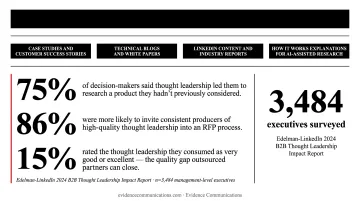
The Edelman-LinkedIn 2024 B2B Thought Leadership Impact Report — based on surveys with 3,484 management-level executives — found that 75% of decision-makers said thought leadership led them to research a product they hadn't previously considered. And 86% were more likely to invite consistent producers of high-quality thought leadership into an RFP process. The same study found only 15% rated the thought leadership they consumed as very good or excellent — a significant quality gap that outsourced partners can help close.
Brand Communications and Commercial Messaging
This is the most underserved function in industrial sectors. It involves translating complex technical capabilities into market-facing narratives that resonate with executive buyers.
Manufacturers and industrial firms often have strong operational proof — documented performance, precision engineering, proven field results — but weak visibility in the channels buyers use to decide.
External partners who specialize in commercial messaging turn that operational credibility into buyer-accessible proof across LinkedIn, YouTube, and AI-readable web content.
Account-Based Marketing (ABM) Execution
Where brand messaging builds broad credibility, ABM goes narrow — targeting a defined list of high-value accounts with personalized, multi-channel campaigns. It requires tight alignment between marketing content, sales outreach, and CRM data, which is why specialized outsourced partnerships are often a better fit than general-purpose agencies.
Adoption is growing: Demand Gen Report's 2023 ABM Benchmark Survey found 67% of practitioners already used an ABM strategy, with 81% of non-users planning adoption. ABM programs reporting pipeline growth reached 84%, and 72% reported higher ROI than other marketing approaches.
Key Benefits of Outsourcing B2B Marketing
Access to Specialized Expertise Without Full-Time Overhead
Building an internal marketing team capable of content strategy, demand generation, and commercial messaging is expensive and slow — particularly for mid-sized industrial firms without existing marketing functions.
The U.S. Bureau of Labor Statistics reports a $161,030 median annual wage for marketing managers alone. Add benefits, tools, recruiting, training, and management overhead, and the true cost of an internal team multiplies quickly. Outsourcing replaces that fixed cost with focused, deployable expertise.
For industrial companies — where dedicated marketing departments are often absent — this gap is especially acute. CMI's 2024 manufacturing marketing research found 57% of manufacturing marketers cited lack of resources as their most pressing challenge, and 54% lacked a scalable content creation model.
Faster Speed to Market
Outsourced marketing teams can launch campaigns, develop content, and build buyer-facing assets in a fraction of the time it takes to hire and ramp internal staff. SHRM notes that employee onboarding can last up to 12 months before full productivity is reached.
External partners — especially those already experienced in your sector — arrive with frameworks, templates, and buyer context already in place. The ramp period compresses from months to weeks.
Scalability Without Fixed Cost Risk
Industrial companies face cyclical demand. Outsourcing allows marketing activity to scale up during growth phases or product launches and scale back during market uncertainty — without the financial exposure of permanent headcount.
This flexibility is especially valuable for companies in commercial transition:
- Entering new markets or geographies
- Launching new product lines with targeted campaigns
- Repositioning the brand following an acquisition
- Scaling back during demand downturns without headcount risk
Improved Buyer Credibility and Commercial Visibility
The commercial argument for outsourcing marketing is ultimately about visibility and credibility in the channels where buyers now research.
Buyers in technical B2B sectors need more than information — they need verifiable proof that answers three questions before they ever contact sales (Evidence Communications frames this as the core of commercial visibility for industrial companies):
- What does this company actually do?
- How does it work in real operating environments?
- Can I defend this choice internally?
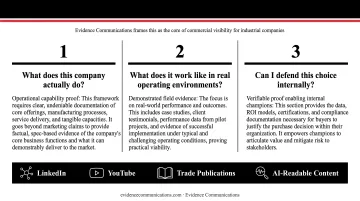
Outsourced partners who understand these research dynamics — and who can produce and distribute proof across LinkedIn, YouTube, trade publications, and AI-readable content — help industrial companies remain visible and credible throughout the buyer's self-directed decision process.
When Should a B2B Company Outsource Its Marketing?
Signal 1 — Pipeline Inconsistency or Declining Visibility
Companies experiencing stagnant inbound leads, declining organic visibility, or buyers who seem to evaluate and eliminate vendors before making contact are often missing from the research phase entirely. The problem isn't the sales team — it's that marketing hasn't built the credibility infrastructure that gets companies onto shortlists in the first place.
Signal 2 — Internal Team Capacity or Expertise Gaps
When internal teams are stretched managing existing accounts, or when no dedicated marketing function exists, outsourcing provides expertise and bandwidth without the risk of a lengthy internal build. This is the most common trigger for industrial firms where operations have always come first.
Signal 3 — Commercial Transition or Growth Inflection Point
Companies entering new markets, launching product lines, repositioning after an acquisition, or scaling toward enterprise buyers face a critical gap between their operational capabilities and how those capabilities are communicated.
Evidence Communications specifically serves executive teams in these transition moments — helping companies that have strong underlying capability but need commercial infrastructure that reflects that capability to modern buyers. This includes:
- PE-backed portfolio companies preparing for growth or exit
- Firms transitioning from sub-supplier to direct enterprise relationships
- Manufacturers entering new verticals or product categories
At each of these inflection points, buyers are already researching and shortlisting. Companies without visible proof of capability don't get the call — they get screened out before sales ever enters the picture.
How to Choose the Right B2B Marketing Outsourcing Partner
Evaluate Industry and Buyer-Context Fit
The most important selection criterion is whether the partner genuinely understands your buyers — their decision-making process, technical complexity, and the channels they use to research vendors.
A partner who works primarily with SaaS companies may not understand:
- Long industrial sales cycles and procurement dynamics
- The proof requirements of engineering-led buying committees
- How buyers in manufacturing or infrastructure sectors verify supplier credibility
Ask for specific examples of work in your vertical, not just adjacent industries.
Assess Strategic vs. Execution Orientation
Execution partners handle content production, ad management, and cold outreach. Strategic partners bring commercial thinking: identifying visibility gaps, defining positioning, and building the proof points that drive buyer confidence.
For companies in commercial transition, that strategic orientation is often more valuable. Evidence Communications works at this layer — starting with a diagnostic to identify proof deficits, then designing commercial infrastructure, then distributing that proof across the channels buyers actually use. Diagnosis before execution is what separates a strategic partner from a content vendor.
Demand Transparency on Metrics and Reporting
Any outsourced marketing partner should provide clear reporting on leading indicators:
- Content engagement and organic visibility
- Pipeline contribution and meeting quality
- AI discoverability benchmarks
- Competitive visibility comparisons
Avoid partners who lead with vanity metrics (impressions, page views, email open rates). Establish reporting cadences and success criteria before engagement begins — not after.
Run a Structured Pilot Before Committing to Scale
Start with a defined, time-bounded pilot focused on one function or channel. Measure results before expanding scope. This approach reduces risk and validates whether the partner's approach generates real buyer engagement in your specific market — not just activity.
Common B2B Marketing Outsourcing Mistakes to Avoid
No ICP, no foundation. The most common failure mode is engaging an outsourced partner before you've defined your ideal customer profile, core value proposition, and the specific buyer problems you solve. Outsourcing amplifies execution — if the strategy is unclear, partners produce high volumes of activity with low commercial impact.
Withholding internal context from the partner. Companies that keep competitive positioning, win/loss insights, technical differentiators, and customer proof internal limit the partner's ability to produce credible, specific content. Generic content fails — industrial buyers recognize it on sight. The best outsourcing relationships involve continuous collaboration and shared intelligence — the client is the source of truth; the partner translates it.
Measuring volume instead of buyer quality. ANA research found that in a 2021 survey of senior marketers, nearly 60% said up to 30% of marketing budget was lost to agency-management inefficiencies — and 80% reported high stress about agencies not delivering on expectations.
Much of this traces back to measuring success by leads generated or emails sent rather than meeting quality, pipeline conversion, or buyer engagement depth. Define quality-based success metrics before the engagement begins, not after the first quarterly review.
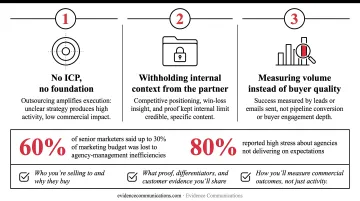
The three mistakes share a root cause: partners can only execute what clients have actually defined. Before outsourcing any function, confirm you have clarity on:
- Who you're selling to and why they buy
- What internal proof, differentiators, and customer evidence you'll share
- How you'll measure commercial outcomes — not just activity
Frequently Asked Questions
What is B2B outsourcing?
B2B outsourcing is the practice of delegating specific business or marketing functions — content creation, lead generation, commercial communications — to external specialists. It allows internal teams to focus on strategy, product development, and closing while external partners handle the execution of buyer-facing activities.
What are the 4 types of B2B marketing?
The four core types are product marketing (positioning and messaging), demand generation (pipeline and lead creation), content marketing (thought leadership and educational assets), and account-based marketing (personalized campaigns targeting specific high-value accounts). Each can be fully or partially outsourced.
How is B2B marketing outsourcing different from B2B sales outsourcing?
Sales outsourcing covers execution activities like cold calling, SDR outreach, and appointment setting. Marketing outsourcing covers buyer education, brand credibility, content strategy, and the commercial infrastructure that shapes buyer perception before sales engagement begins — where more of the actual decision now happens.
When does outsourcing B2B marketing make the most sense?
Outsourcing delivers the most value during commercial transitions, market expansions, or when internal teams lack the bandwidth or expertise to build consistent buyer-facing visibility. This matters most when buyers are researching and deciding before they ever contact sales.
What should I look for in a B2B marketing outsourcing partner?
Prioritize buyer-context expertise, strategic orientation (not just execution capacity), transparent reporting on quality metrics, and demonstrated experience with companies of similar complexity, industry, and sales cycle length. Ask to see specific examples, not just case study summaries.
What are the biggest risks of outsourcing B2B marketing?
The top risks are misalignment on ICP and messaging, generic content that fails to reflect real technical capability, and optimizing for activity volume over buyer quality. Mitigate all three by defining quality-based success metrics upfront and building in ongoing strategic collaboration — not just execution handoffs.