Introduction
Most manufacturers have earned their reputation the hard way — through engineering precision, operational reliability, and decades of proven performance. The problem isn't capability. It's visibility.
According to the 2025 State of Marketing to Engineers report, technical buyers complete an average of 60% of the buying process online before speaking with a supplier. They're using AI tools, YouTube, LinkedIn, and peer forums to form vendor shortlists — and they're doing it without your sales team in the room.
This raises the stakes of agency selection. The wrong partner burns budget reaching audiences that will never buy. The right one puts your company in front of qualified buyers early — visible and credible before a shortlist ever forms.
This guide covers five manufacturing-specialist agencies worth serious consideration, the criteria that separate them, and what a well-structured engagement actually looks like.
Key Takeaways
- Technical buyers finish most research before contacting sales — your credibility must exist where they look, not just where you talk
- Manufacturing marketing requires agencies with existing knowledge of engineering audiences, long sales cycles, and multi-stakeholder decisions
- Five agencies consistently stand out: Industrial Strength Marketing, Gorilla 76, Altitude Marketing, TREW Marketing, and Kula Partners
- Evaluate agencies on manufacturing client depth, technical fluency, and revenue-relevant reporting — not creative portfolios
- Expect 3–4 months before early indicators appear; full pipeline contribution takes longer given industrial sales cycle lengths
Why Manufacturing Marketing Requires a Specialist
Manufacturing buyers are not impulse purchasers. The person evaluating your CNC equipment, fluid handling system, or custom fabrication capability is typically an engineer, procurement manager, or operations lead who owns the outcome personally — downtime, safety exposure, missed throughput, warranty exposure. That individual accountability shapes how they buy.
The Buying Group Problem
Research complicates things further. Gartner's 2024 B2B buying study found 5–16 stakeholders involved in a typical enterprise purchase across multiple functions, with 74% of buyer teams showing unhealthy conflict during the decision process. Manufacturing adds another layer: technical proof must survive scrutiny from engineers, finance, and operations simultaneously.
A generalist agency rarely understands this dynamic. They optimize for click-through rates and form fills. Manufacturing buyers don't behave like that — and content written for them needs to reflect that reality.
What This Creates for Marketing
Three specific demands separate manufacturing marketing from general B2B work:
- Technical accuracy — engineers distrust content that oversimplifies or misrepresents how something works
- Long-cycle nurturing — not weeks, but months of deliberate, educational content across multiple touchpoints
- Niche role targeting — specific job functions at specific company types with specific challenges, not broad industries
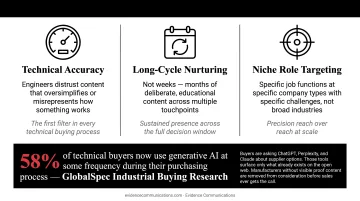
The AI layer has compounded this pressure. According to GlobalSpec's industrial buying research, 58% of technical buyers now use generative AI at some frequency during their purchasing process — and that number will keep climbing.
Buyers are asking ChatGPT, Perplexity, and Claude about supplier options. Those tools can only surface what already exists across the open web. Manufacturers without visible proof content are removed from consideration before sales ever gets the call.
Top Manufacturing Marketing Agencies
Each agency below was evaluated on manufacturing-specific client history, demonstrated B2B results, technical fluency, and ability to support long sales cycles through to qualified lead hand-off.
Industrial Strength Marketing (INDUSTRIAL)
Founded in 2003 and headquartered in Nashville, INDUSTRIAL is a full-service agency built specifically for industrial and manufacturing companies across the supply chain. Their client roster includes ABB/Baldor, Mitsubishi Electric, Schneider Electric, Motion Industries, and ProcessBarron — companies with complex product portfolios and demanding technical audiences.
What differentiates INDUSTRIAL is a dual capability most agencies don't offer: customer acquisition and workforce recruitment marketing. Given the persistent skilled labor shortage in manufacturing, that combination carries real weight.
They also specialize in brand architecture for manufacturers navigating mergers, acquisitions, or multi-brand consolidation — a scenario where brand clarity directly affects both customer perception and internal culture.
| Attribute | Details |
|---|---|
| Core Specialization | Integrated brand strategy, demand creation, distributor enablement, and workforce recruiting campaigns for industrial and manufacturing companies |
| Best For | Mid-to-large manufacturers needing a long-term agency of record across brand, digital, and internal communications |
| Pricing Model | Custom/Retainer — built for ongoing partnership, not one-off projects |
Gorilla 76
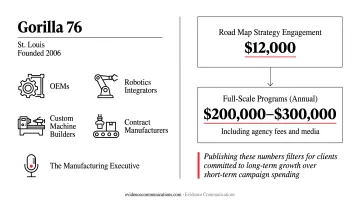
Gorilla 76 (St. Louis, founded 2006) focuses specifically on engineering-heavy OEMs, custom machine builders, robotics integrators, and contract manufacturers. They're well-known in industrial marketing circles for their podcast The Manufacturing Executive and for requiring a paid strategy phase before any execution begins.
Their published pricing is uncommon: the Road Map strategy engagement runs $12,000, with full-scale programs budgeted at $200,000–$300,000 per year including agency fees and media. Publishing those numbers filters for clients committed to long-term growth over short-term campaign spending.
| Attribute | Details |
|---|---|
| Core Specialization | Industrial content strategy, brand positioning, video production, SEO, and sales enablement for OEMs and complex machine builders |
| Best For | Mid-sized B2B manufacturers with long sales cycles who want a content-first growth strategy and thought leadership platform |
| Pricing Model | Strategy engagement ($12K) + full-scale program ($200K–$300K/year including fees and media); publicly stated |
Altitude Marketing
Altitude Marketing (Pennsylvania) has operated for over 20 years across industrial technology, life sciences, and manufacturing clients. Their core strength is translation: taking highly technical product details and turning them into clear, market-facing messaging that resonates with niche decision-makers.
They publish tiered pricing, which remains uncommon in this space. Monthly retainer tiers run $9,500–$12,500 (Organic Growth), $12,500–$16,000 (Digital Acceleration), and $16,000+ (Full Integration). Altitude reports that approximately 80% of clients operate on long-term retainers averaging three years — roughly twice the industry average by their own account.
| Attribute | Details |
|---|---|
| Core Specialization | Full-service integrated marketing including SEO/SEM, branding, content, PR, trade show support, and web development for complex B2B sectors |
| Best For | Mid-to-large manufacturing and industrial technology companies needing fully integrated marketing support across multiple channels |
| Pricing Model | Retainer-based; published tiers from $9,500–$16,000+/month; ~80% of clients on retainer |
TREW Marketing
TREW Marketing (Austin, founded 2008) specializes exclusively in engineering and technology companies, including industrial automation, robotics, electronics, and manufacturing. As a HubSpot Platinum Solutions Partner, they're a strong fit for manufacturers committed to inbound marketing and CRM-driven lead nurturing.
Their signature approach is "technical storytelling" — working with engineers and subject matter experts to extract real operational insight and turn it into content that earns trust with technical buyers. If your sales team is already in HubSpot and your growth strategy depends on organic content building confidence with engineering audiences, TREW is a natural fit.
| Attribute | Details |
|---|---|
| Core Specialization | Inbound marketing, brand positioning, HubSpot implementation, demand generation, and technical content for engineering and industrial automation companies |
| Best For | Engineering-led manufacturers moving toward inbound and content-driven lead generation, especially those adopting or already using HubSpot |
| Pricing Model | Custom/Retainer — scaled to content volume and HubSpot management scope |
Kula Partners
Kula Partners (Halifax, operating since 2004) focuses on B2B manufacturers selling in complex, account-focused environments. Their podcast The Kula Ring has built a following among manufacturing marketers, and their Account-Based Marketing practice is among the most developed in this space.
Where most agencies optimize for volume — more leads, more traffic, more form fills — Kula builds strategies around a defined account list. Their ABM model suits manufacturers with limited target accounts, niche markets, and high-value transactions where a single wrong-fit lead consumes more resources than it's worth.
| Attribute | Details |
|---|---|
| Core Specialization | Account-Based Marketing, marketing strategy, web design and development, and sales enablement for niche B2B manufacturers |
| Best For | Manufacturers with a small, high-value target account list who need precision ABM rather than broad-funnel lead generation |
| Pricing Model | Custom — based on account scope, strategy depth, and execution requirements |
How We Chose the Best Manufacturing Marketing Agencies
The Evaluation Framework
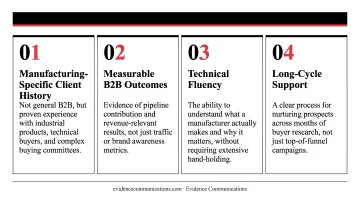
Agencies were assessed on four criteria:
- Manufacturing-specific client history — not general B2B, but proven experience with industrial products, technical buyers, and complex buying committees
- Measurable B2B outcomes — evidence of pipeline contribution and revenue-relevant results, not just traffic or brand awareness metrics
- Technical fluency — the ability to understand what a manufacturer actually makes and why it matters, without requiring extensive hand-holding
- Long-cycle support — a clear process for nurturing prospects across months of buyer research, not just top-of-funnel campaigns
The Most Common Selection Mistake
Manufacturers frequently choose agencies based on creative portfolio or brand recognition. This is understandable — strong creative work is visible and easy to evaluate. But creative execution is rarely the limiting factor in industrial marketing. The harder problem is communicating technical proof to skeptical, committee-based buyers who evaluate risk rather than respond to aesthetics.
An agency that has never sold to an engineer will spend months learning what your team already knows.
The Additional Filter That Now Matters
Research from the Content Marketing Institute found that 64% of manufacturing marketers struggle to attribute content ROI, and 53% cannot connect performance to business goals. This measurement gap is real — and it means the baseline for accountability in this space is low.
One additional filter now separates adequate agencies from genuinely effective ones: does the agency help manufacturers build buyer confidence through visible proof — case studies, technical demonstrations, engineering explanations — across the channels buyers actually use before they reach out? Agencies that treat this as optional are working with an outdated model of how industrial buyers decide.
Before committing to an agency, a diagnostic step matters. Evidence Communications' Proof Gap Analysis identifies where a manufacturer's real capabilities aren't matched by discoverable, verifiable proof online. Their AI Visibility Assessment (AVAS™) evaluates how the company appears across platforms like ChatGPT, Claude, and Perplexity — before buyers ever reach the sales team. That foundation makes subsequent agency work more targeted and measurable.
The Four Non-Negotiables
The agencies reviewed in this guide were held to all four criteria above. The profiles that follow reflect which ones actually delivered against them — and where each one tends to be strongest.
What to Expect When Working with a Manufacturing Marketing Agency
The Onboarding Reality
Most high-quality manufacturing agencies begin with a strategy or discovery phase before any execution starts. Expect to invest four to eight weeks in onboarding — briefing on technical product details, defining buyer personas, mapping the sales process, and aligning on KPIs. That groundwork is what separates campaigns that reflect your actual market position from ones that miss it entirely.
Manufacturers who skip this phase or rush through it consistently report frustration with output that doesn't reflect their actual market position.
Realistic Timelines
Early indicators — organic traffic growth, lead volume from content — typically become visible within three to four months. Revenue impact and pipeline contribution take longer, reflecting the length of industrial sales cycles rather than any shortcoming in the program. Don't evaluate a manufacturing marketing engagement at the 90-day mark on pipeline metrics alone.
Your Role in the Partnership
Agency results depend heavily on manufacturer inputs that most clients underestimate:
- Access to subject matter experts — engineers, operators, and application specialists who can be interviewed for content
- Willingness to approve technical content quickly — slow review cycles are among the most common causes of campaign delays
- Sales-marketing alignment — a shared definition of what constitutes a qualified lead, so the agency is generating the right opportunities and not just volume
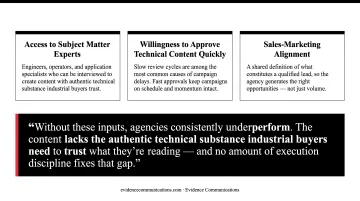
Without these inputs, agencies consistently underperform. The content lacks the authentic technical substance industrial buyers need to trust what they're reading — and no amount of execution discipline fixes that gap.
Frequently Asked Questions
What does a manufacturing marketing agency actually do?
A manufacturing marketing agency develops and executes B2B strategies tailored to industrial companies — covering technical content creation, SEO, lead generation, sales enablement, and branding. The key difference from generalist agencies is familiarity with technical audiences, long sales cycles, and multi-stakeholder buying processes.
How much does a manufacturing marketing agency typically cost?
Costs vary significantly by scope. Altitude Marketing publishes retainer tiers from $9,500 to $16,000+/month for integrated programs. Gorilla 76 structures engagements around a $12,000 strategy project, with full programs budgeted at $200,000–$300,000 annually including media. Project-based work typically costs less upfront but lacks the continuity industrial sales cycles require.
How long does it take to see results from manufacturing marketing?
Early indicators like organic traffic and lead volume typically appear within three to four months. Revenue impact and sales pipeline contribution often take longer, reflecting the length of industrial sales cycles rather than any program shortcoming.
What is the difference between a general B2B agency and a manufacturing-specific one?
Manufacturing-specific agencies bring pre-existing knowledge of technical product categories, engineering buyer personas, and industrial sales dynamics. This reduces the time spent educating the agency on your market and improves content accuracy. Technical buyers notice imprecision immediately, and inaccurate content damages credibility faster than no content at all.
How do I know if my manufacturing company needs a marketing agency?
Common indicators include: stagnant pipeline despite strong product performance, over-reliance on referrals and trade shows to generate leads, inability to reach new accounts outside existing networks, or a lack of digital presence that leaves the company invisible when buyers conduct independent research.
What services should a manufacturing marketing agency offer?
Core capabilities to look for: industrial content marketing, technical SEO, lead generation and nurturing, account-based marketing, web design for technical products, and CRM/sales stack integration. Agencies that also support AI visibility and proof content development are increasingly relevant as buyer research continues shifting to AI-assisted platforms.